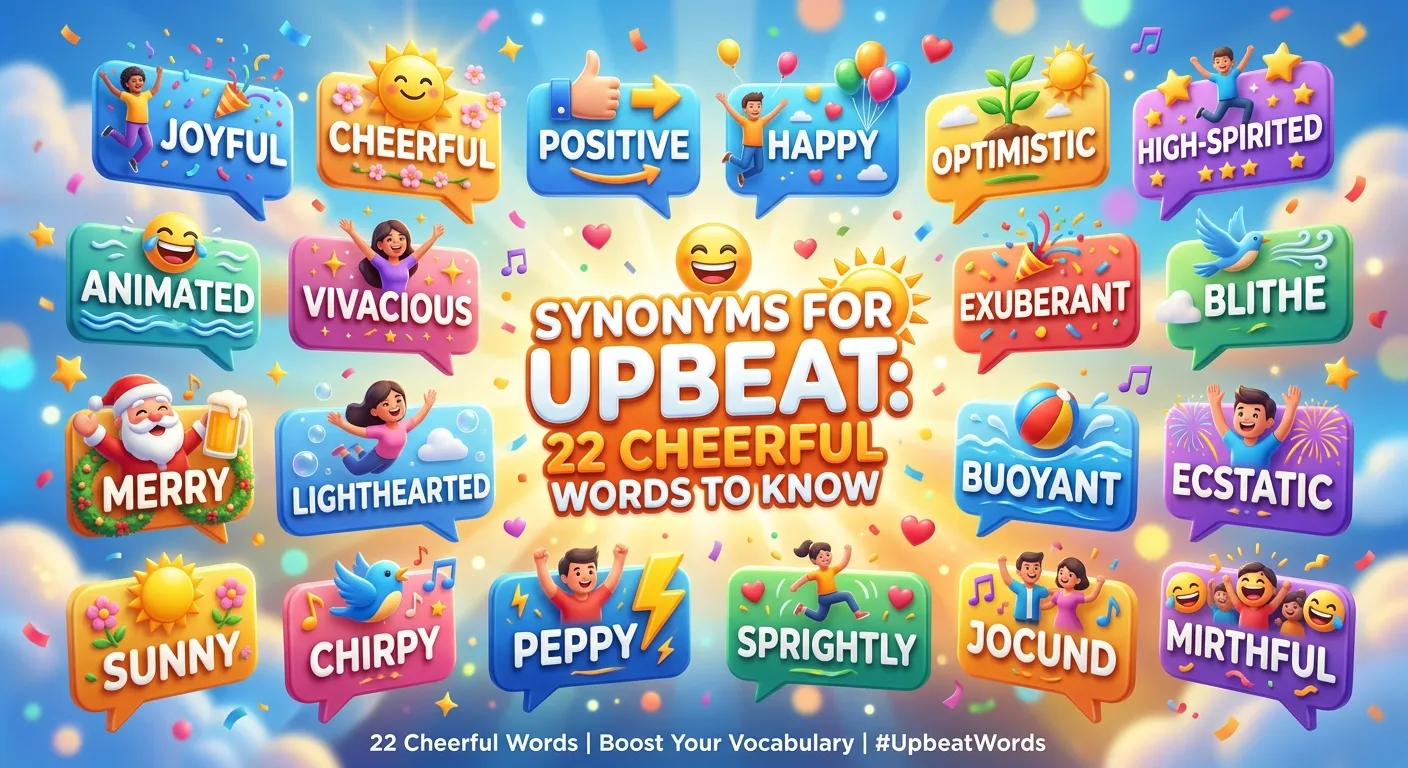
Quick Answer
Upbeat means cheerful and confident about what is happening or what lies ahead.
The 5 best synonyms are:
- Cheerful — the closest match for a happy mood you can see and hear.
- Optimistic — focuses on expecting a good outcome, not on smiling.
- Positive — the broad, safe choice for an attitude or message.
- Buoyant — stays cheerful despite pressure or disappointment.
- Sunny — warm and pleasant by nature, like a personality rather than a moment.
If you only need one replacement, choose cheerful for mood and optimistic for outlook.
The Main Synonyms for Upbeat
1. Cheerful — neutral
Happy and visibly in good spirits. Example: Despite the early start, Lena was cheerful with every customer who came in.
Use it when someone’s happiness shows in their voice or behaviour. Avoid it when you mean hope about the future — use optimistic instead.
2. Optimistic — neutral
Believing that things will turn out well. Example: After the first sales figures arrived, Tomas grew optimistic about the launch.
Use it when the focus is expectation. Avoid it when nothing future-facing is involved; an optimistic person need not sound happy today.
3. Positive — neutral
Showing confidence, approval, or a constructive attitude. Example: Her review of the draft was positive, even where she suggested cuts.
Use it when you need a formal-safe, general word. Avoid it when you want colour — positive is accurate but flat.
4. Buoyant — neutral
Cheerful and quick to recover after a setback. Example: The team stayed buoyant in the dressing room, already talking about the next match.
Use it when resilience is part of the picture. Avoid it when there was never any difficulty to bounce back from.
5. Hopeful — neutral
Wanting and expecting something good to happen. Example: We left the meeting hopeful that funding would be approved.
Softer and less certain than optimistic; it admits doubt.
6. Sunny — neutral
Warm, cheerful, and pleasant to be around. Example: With his sunny manner, the new guide put the nervous group at ease.
Best for temperament, not for reports or forecasts.
7. Lively — neutral
Full of energy and activity. Example: The workshop turned lively once people started testing their ideas aloud.
Use it when energy, not happiness, is the point.
8. Chipper — informal
Bright and cheerful, especially in speech or early in the day. Example: “Morning, all!” he said, far too chipper for a Monday.
Lovely in conversation and light writing; too breezy for formal prose.
9. Perky — informal
Lively and cheerfully alert, sometimes a little too much so. Example: The perky presenter bounced through the weather forecast in a yellow jacket.
Often describes manner; it can sound faintly teasing.
10. Bubbly — informal
Openly cheerful, talkative, and full of social energy. Example: Our bubbly host kept refilling glasses and introducing strangers to each other.
Works for people, not for company reports or serious speeches.
11. Sanguine — formal
Calmly confident that things will go well, even when others worry. Example: While investors panicked, the founder remained sanguine about the merger.
Use it when you want measured confidence. Avoid it when writing for beginners.
12. Joyful — neutral
Feeling or expressing deep happiness. Example: It was a joyful reunion, with cousins hugging in the station doorway.
Stronger than upbeat — save it for real occasions of happiness.
13. Spirited — neutral
Energetic, determined, and full of character. Example: The underdogs gave a spirited defence and nearly held the champions to a draw.
Often used for performances and efforts, where energy mixes with courage.
14. Enthusiastic — neutral
Showing strong interest and eagerness. Example: Parents were enthusiastic about the later start time for school.
Use it when someone is keen on a specific thing — you are enthusiastic about something, while upbeat describes a general mood.
15. Exuberant — formal
Extremely joyful and energetic, without holding back. Example: Exuberant fans poured into the square, singing and waving scarves.
The strongest word here — for crowds and celebrations, not calm confidence.
16. Bright — neutral
Cheerful in manner, or promising for the future, depending on context. Example: She gave us a bright smile and promised the figures by noon.
Useful but ambiguous: a “bright outlook” is promising, a “bright smile” is cheerful.
How These Synonyms Differ
The closest words all sound positive, but each answers a different question:
| Word | Main focus | Typical subject | Strength |
|---|---|---|---|
| Cheerful | Visible happiness now | Person, voice, manner | Medium |
| Optimistic | Belief about the future | Person, forecast, outlook | Medium |
| Positive | General constructive attitude | Attitude, message, response | Mild to medium |
| Buoyant | Cheerfulness after difficulty | Person, team, market | Medium |
| Sunny | Warm temperament | Personality, disposition | Medium |
| Lively | Energy and activity | Event, discussion, place | Medium |
A useful test: if you can add “about the future,” choose optimistic or hopeful. If you can see it on someone’s face, choose cheerful or sunny. If the person has just had bad news and is coping well, buoyant is the precise word.
Collocations: Phrases Upbeat Naturally Appears In
Upbeat most often describes moods, tones, and messages rather than objects:
- an upbeat mood / tone / message — the overall feeling something gives
- an upbeat outlook / assessment / forecast — a confident view of what is coming
- remain / stay upbeat — She stayed upbeat throughout the negotiations.
- upbeat about something — He is upbeat about his chances.
- an upbeat song / tempo — music that feels fast, light, and happy
- an upbeat ending — a story or film that closes on a hopeful note
- surprisingly / cautiously upbeat — cautiously upbeat is a favourite in business reporting: hope without certainty
Common Mistakes Learners Make
Using upbeat for anything good. Upbeat is about mood and outlook. Good weather is fine or pleasant, not upbeat, unless you mean the feeling it creates.
Confusing upbeat with enthusiastic. You are upbeat in general, but enthusiastic about a particular plan, hobby, or idea. “She is enthusiastic about the future” is possible, but it sounds stronger and more eager than “She is upbeat about the future.”
Forcing it into sad contexts. Calling a funeral speech or an apology “upbeat” usually sounds tone-deaf. In difficult situations, hopeful, calm, or comforting fit better.
Treating positive as an exact copy. “A positive message” can simply mean a message of approval. Upbeat adds cheerfulness and energy that positive does not guarantee.
Misplacing the stress. The stress falls on the first syllable: UP-beat, not up-BEAT. See the pronunciation note below.
Word Family and Pronunciation
Pronunciation: /ˈʌp.biːt/ — two syllables, UP-beet, with the stress on up.
Word family: Upbeat has no common adverb or noun form in everyday use; writers rephrase (“in an upbeat way”) rather than use the rare upbeatly. Its natural opposite is downbeat (pessimistic or subdued).
The musical meaning: As a noun in music, an upbeat is the last beat of a bar, the lighter beat just before the strong downbeat starting the next bar. That sense came first, in the 19th century; the cheerful adjective developed later. In this article, upbeat means the adjective.
FAQs
Is upbeat formal or informal?
It sits in the middle — common in journalism, business reporting, and everyday speech, and acceptable in most formal writing. For very formal prose, optimistic or sanguine may be more precise; in friendly conversation, chipper or bubbly are warmer.
What is the difference between upbeat and optimistic?
Optimistic is a belief: you expect a good result. Upbeat is a mood: you feel and sound cheerful. A manager can give an upbeat presentation about a plan she is privately not optimistic about — the tone is cheerful even if the expectation is not.
Can upbeat describe music?
Yes. An upbeat song usually has a brisk tempo and a mood that lifts the listener — in practice, “music that makes me feel good.”
What is the opposite of upbeat?
The direct opposite is downbeat. Pessimistic, gloomy, and negative also work, depending on whether you mean expectation, mood, or attitude.
Conclusion
Upbeat earns its popularity because it bundles cheerfulness and confidence into one short word. Reach beyond it when you want to be exact: buoyant for someone recovering well, sanguine for calm confidence, cautiously upbeat when hope needs a brake. For a single sentence about a coach who has just lost a final yet is already praising her players and planning next season, though, no synonym quite replaces it — she is, simply, upbeat.

I’m Leo Jackson, an English writer with a soft spot for the peculiarities of language and vocabulary. Specializes in exploring the nuances of English synonyms, helping students, writers, and professionals choose the right word with confidence. My guides combine careful research with clear, practical explanations.