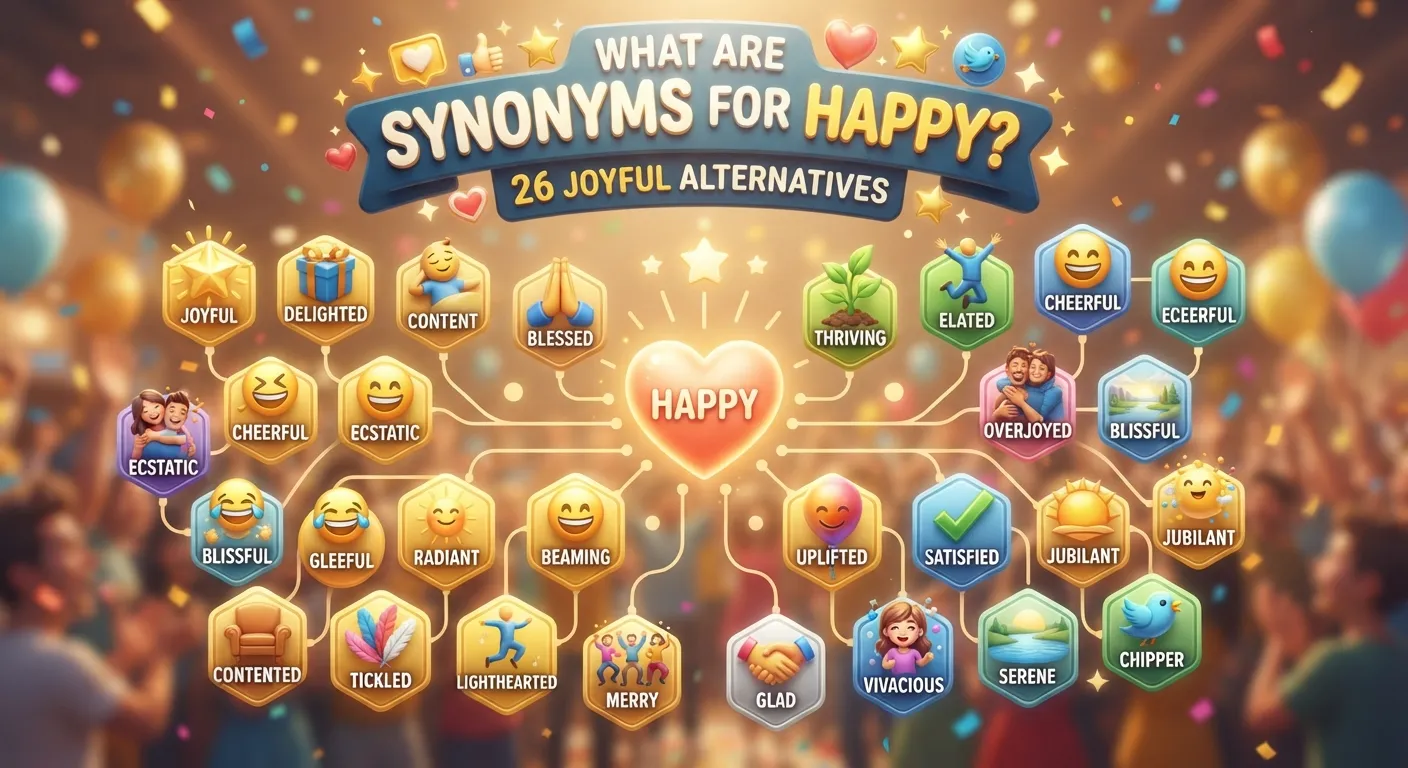
Happy means feeling or showing joy, pleasure, satisfaction, or contentment. Joyful, cheerful, delighted, pleased, content, upbeat, and glad are common synonyms for happy.
Happy means feeling or showing pleasure, joy, or satisfaction. Imagine a student opening an exam result and seeing a much higher score than expected. She smiles, calls her family, and feels happy about her success. Happy is one of the most common words in English because people use it to describe positive feelings in everyday life, relationships, work, and special moments.
However, the same word may not always express the exact feeling we want to describe. Learning synonyms helps English learners choose more precise words and makes writing more interesting. It also helps content writers avoid repeating happy in every sentence. In this article, you will learn the meaning, grammar, history, pronunciation, and 26 useful synonyms for happy, along with examples and semantic categories to help you choose the right word.
Meaning of What Are Synonyms for Happy?
Definition
Happy (Adjective): Feeling or showing pleasure, joy, satisfaction, or contentment.
Examples
- She was happy to see her old friend.
- The children were happy with their new toys.
Connotative Meaning
Connotation: The feeling or idea that a word suggests beyond its basic meaning.
- Positive tone: Joy, pleasure, satisfaction, or delight.
- Negative tone: Happy itself is positive, but phrases such as “too happy” can sometimes suggest carelessness or excessive excitement.
- Neutral tone: It can simply describe someone’s emotional state without adding strong emotional detail.
Etymology
The word happy developed from the noun hap, meaning luck, chance, or fortune.
- Old English (450–1100): The modern word happy was not yet in common use. The related word hap referred to chance or fortune.
- Middle English (1100–1500): Happy developed from hap with the suffix -y, first carrying the sense of being fortunate or favored by good luck.
- Modern English (1500–Present): Its meaning expanded from being fortunate to having feelings of pleasure, joy, and satisfaction.
Pronunciation (IPA)
- IPA: /ˈhæpi/
- Syllables: hap-py
Affixation Pattern of Happy
- Root: hap
- Prefix: None
- Suffix: -y
- Word formations:
- happy: adjective
- happily: adverb
- happiness: noun
- unhappy: adjective
- unhappily: adverb
- unhappiness: noun
- happier: comparative adjective
- happiest: superlative adjective
26 Synonyms of Happy With Meaning & Examples
1. Joyful (Adjective)
Meaning: Feeling or showing great joy.
Examples:
- The children were joyful during the festival.
- She gave a joyful smile.
2. Cheerful (Adjective)
Meaning: Happy and positive in mood.
Examples:
- He is always cheerful in the morning.
- Her cheerful attitude lifted everyone’s mood.
3. Glad (Adjective)
Meaning: Feeling pleased about something.
Examples:
- I am glad you came.
- She was glad to hear the good news.
4. Delighted (Adjective)
Meaning: Very pleased and happy.
Examples:
- We were delighted with the results.
- She was delighted to receive the award.
5. Pleased (Adjective)
Meaning: Feeling satisfied or happy about something.
Examples:
- The teacher was pleased with his work.
- I am pleased to meet you.
6. Content (Adjective)
Meaning: Calmly happy and satisfied with what you have.
Examples:
- She felt content after a quiet evening at home.
- He was content with his simple life.
7. Satisfied (Adjective)
Meaning: Feeling that something has met your needs or expectations.
Examples:
- The customer was satisfied with the service.
- She felt satisfied after completing the project.
8. Cheerful (Adjective)
Meaning: Showing a bright and pleasant mood.
Examples:
- Her cheerful voice made everyone smile.
- He remained cheerful despite the rain.
9. Upbeat (Adjective)
Meaning: Positive, hopeful, and cheerful.
Examples:
- She has an upbeat attitude.
- The team remained upbeat after the difficult match.
10. Elated (Adjective)
Meaning: Extremely happy and excited.
Examples:
- He felt elated after winning the competition.
- She was elated by the unexpected news.
11. Ecstatic (Adjective)
Meaning: Extremely happy and excited.
Examples:
- The fans were ecstatic after the victory.
- She was ecstatic about her new opportunity.
12. Thrilled (Adjective)
Meaning: Extremely pleased and excited.
Examples:
- I was thrilled to receive the invitation.
- They were thrilled by the announcement.
13. Exuberant (Adjective)
Meaning: Showing lively and energetic happiness.
Examples:
- The children were exuberant at the party.
- His exuberant personality filled the room.
14. Buoyant (Adjective)
Meaning: Cheerful and confident, especially during a difficult situation.
Examples:
- She remained buoyant despite the setback.
- His buoyant mood encouraged the team.
15. Sanguine (Adjective)
Meaning: Cheerful and hopeful about the future.
Examples:
- She remained sanguine about the project’s success.
- He was sanguine despite the uncertain situation.
16. Merry (Adjective)
Meaning: Cheerful and full of enjoyment.
Examples:
- Everyone had a merry time at the celebration.
- The group was merry after dinner.
17. Jubilant (Adjective)
Meaning: Extremely joyful because of a success or victory.
Examples:
- The crowd was jubilant after the win.
- The players were jubilant at the final whistle.
18. Blissful (Adjective)
Meaning: Extremely peaceful and happy.
Examples:
- They spent a blissful afternoon by the lake.
- She enjoyed a blissful weekend at home.
19. Overjoyed (Adjective)
Meaning: Extremely happy about something.
Examples:
- The parents were overjoyed by the news.
- She was overjoyed to see her family.
20. Gleeful (Adjective)
Meaning: Very happy and excited, often in a playful way.
Examples:
- The children were gleeful during the game.
- He gave a gleeful laugh.
21. Buoyant (Adjective)
Meaning: Cheerful and confident despite problems.
Examples:
- She stayed buoyant during the difficult period.
- His buoyant spirit helped the group.
22. Radiant (Adjective)
Meaning: Showing great happiness through one’s face or appearance.
Examples:
- The bride looked radiant on her wedding day.
- She had a radiant smile.
23. Carefree (Adjective)
Meaning: Free from worry or serious concerns.
Examples:
- The children enjoyed a carefree afternoon.
- They spent a carefree day at the beach.
24. Lighthearted (Adjective)
Meaning: Cheerful and free from serious worry.
Examples:
- We had a lighthearted conversation.
- His lighthearted joke made everyone laugh.
25. Triumphant (Adjective)
Meaning: Feeling or showing great happiness after success.
Examples:
- She returned home triumphant after the competition.
- The team looked triumphant after the victory.
26. Blissful (Adjective)
Meaning: Filled with deep happiness and peace.
Examples:
- They enjoyed a blissful holiday together.
- The quiet morning felt blissful.
Prototype Meaning
The most typical meaning of happy is feeling pleasure, joy, or satisfaction. When people hear happy, they often imagine someone smiling, laughing, celebrating good news, enjoying time with loved ones, or feeling satisfied with life.
Prototype Categorization
The synonyms can be grouped by the type or strength of happiness they express:
- General happiness:glad, cheerful, joyful, merry, upbeat
- These work well for everyday situations involving a positive mood.
- Strong happiness:delighted, elated, ecstatic, thrilled, overjoyed
- These words express stronger feelings than ordinary happy.
- Peaceful satisfaction:content, satisfied, blissful, carefree, lighthearted
- These describe calm happiness, inner peace, or freedom from worry.
- Hopeful positivity:buoyant, sanguine, upbeat
- These suggest optimism and a positive outlook, even when circumstances are difficult.
- Happiness linked to success:jubilant, triumphant
- These are especially useful when happiness comes from winning, achieving, or overcoming something.
- Visible happiness:radiant, exuberant, gleeful
- These words focus more on how happiness is expressed through appearance, energy, or behavior.
This categorization helps writers choose a word that matches the strength, source, and emotional style of the happiness they want to describe.
Antonyms of Happy
1. Unhappy (Adjective)
Not feeling pleased, satisfied, or joyful.
2. Sad (Adjective)
Feeling sorrow or unhappiness.
3. Miserable (Adjective)
Feeling extremely unhappy or uncomfortable.
4. Gloomy (Adjective)
Having a sad or negative mood.
5. Depressed (Adjective)
Feeling very low or unhappy; the word can also refer to a clinical mental-health condition depending on context.
6. Dissatisfied (Adjective)
Not pleased with something because it does not meet expectations.
7. Discontented (Adjective)
Not satisfied with a situation or condition.
Short Questions and Answers
Q: What does happy mean?
Happy means feeling or showing pleasure, joy, or satisfaction.
Q: When should happy be used?
Use happy when you want to describe a general feeling of pleasure, joy, or satisfaction.
Q: Is happy positive or negative?
Happy has a positive connotation because it describes pleasure, joy, or satisfaction.
Q: How is it different from similar words?
Happy is a broad word. Delighted and ecstatic express stronger happiness, while content suggests calm satisfaction and cheerful often describes a person’s general mood.
Conclusion
Learning happy and its synonyms gives English learners more ways to describe positive emotions. Words such as glad, cheerful, joyful, and pleased work well for common situations, while delighted, thrilled, elated, and ecstatic express stronger feelings. Other words, such as content, blissful, carefree, and lighthearted, describe calm or peaceful happiness.
Knowing these differences can make your writing and speaking more precise and natural. It also helps you avoid repeating happy in every sentence. Instead of using a synonym at random, think about the exact feeling you want to express and choose the word that matches it. Practicing a few new words each day can steadily improve your vocabulary, strengthen your communication skills, and build confidence in English.
Synonyms for Yikes: 30 Useful Expressions

I am Clara Stephen, passionate about making English simple and easy to understand through clear synonym comparisons, vocabulary guides, and language tips. Through thoughtful, reliable content, I aim to be a trusted guide for anyone looking to expand their English vocabulary.







![]Synonyms for superfluous including unnecessary, redundant, excessive, and extraneous](https://synonymcanvas.com/wp-content/uploads/2026/09/synonyms-for-superfluous-150x150.webp)