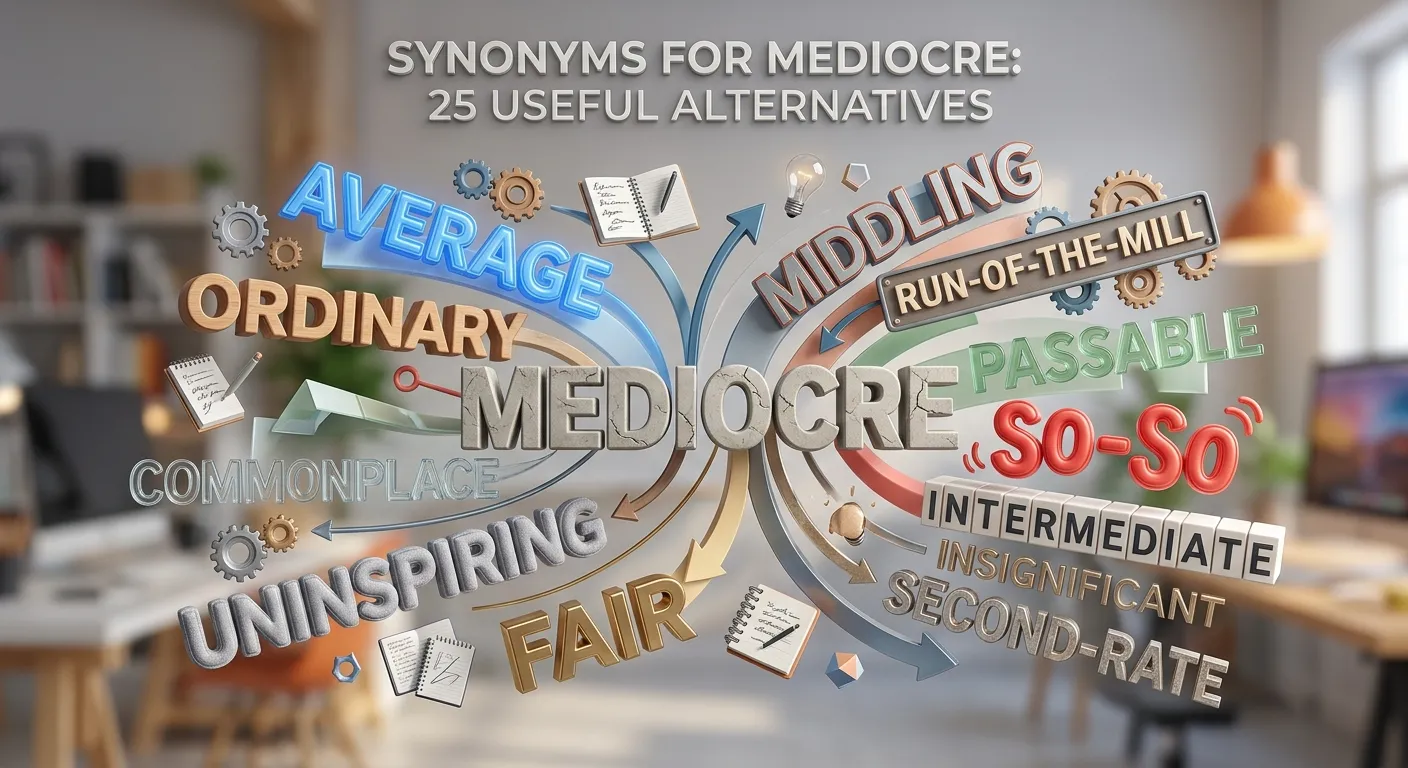
Average, ordinary, middling, unremarkable, so-so, second-rate, and lackluster are useful alternatives to mediocre.
Imagine a student who studies for an exam but does only enough to pass. The result is neither poor nor impressive. You might describe the performance as mediocre. The word mediocre is commonly used when something is of only average or moderate quality. It can describe a meal, movie, performance, product, result, or piece of work that does not stand out.
Learning synonyms for mediocre helps English learners express small differences in quality and tone. It also helps content writers avoid repeating the same word in every sentence. In this article, we will explore the meaning, examples, pronunciation, history, word formation, and semantic categories of mediocre. You will also learn 25 useful synonyms and see how each one works in natural English.
Meaning of Mediocre
Definition
Mediocre (Adjective): Of only average quality; not especially good, impressive, or bad.
Examples
- The restaurant served a mediocre meal.
- His performance was mediocre, despite having plenty of time to prepare.
Connotative Meaning
Connotation: The feeling or idea that a word suggests beyond its basic meaning.
- Positive tone: Usually none, although mediocre can sound mild when it simply means average.
- Negative tone: Commonly suggests that something is disappointing or fails to meet expectations.
- Neutral tone: It can describe something as average without strong criticism, depending on context.
Etymology
The word mediocre comes from Latin mediocris, meaning “of middle height,” “moderate,” or “ordinary.” It entered English through French médiocre.
- Old English (450–1100): The word mediocre was not part of Old English vocabulary.
- Middle English (1100–1500): The English form was not yet common; the word developed from Latin and French usage.
- Modern English (1500–Present): Mediocre entered English in the late 16th century and came to mean something of only moderate or average quality.
Pronunciation (IPA)
- IPA: /ˌmiːdiˈoʊkər/
- Syllables: me-di-o-cre
Affixation Pattern of Mediocre
- Root: The word comes from Latin mediocris, related to medius, meaning “middle.”
- Prefix: None in modern English.
- Suffix: No productive English suffix is added to create mediocre.
- Related word formations:
- mediocre: adjective
- mediocrity: noun
- mediocrities: plural noun
- mediocrely: adverb, rare
The word is best understood as a historical borrowing rather than a modern English word built from a simple prefix + root + suffix pattern.
25 Synonyms of Mediocre With Meaning & Examples
1. Average (Adjective)
Meaning: Having a quality or level that is around the usual or middle point.
Examples:
- The restaurant received an average rating.
- His exam result was average compared with the class.
2. Ordinary (Adjective)
Meaning: Not unusual, special, or impressive.
Examples:
- It was an ordinary meal with nothing memorable about it.
- The movie had an ordinary storyline.
3. Middling (Adjective)
Meaning: Of moderate or average quality.
Examples:
- The hotel offered middling service.
- Her performance was middling rather than outstanding.
4. Unremarkable (Adjective)
Meaning: Not especially interesting, impressive, or unusual.
Examples:
- The book was pleasant but unremarkable.
- His performance was unremarkable.
5. So-so (Adjective)
Meaning: Fair but not very good.
Examples:
- The food was so-so, but the service was excellent.
- I thought the movie was just so-so.
6. Run-of-the-mill (Adjective)
Meaning: Ordinary and not special.
Examples:
- It was a run-of-the-mill action movie.
- The shop sells run-of-the-mill clothing.
7. Second-rate (Adjective)
Meaning: Below the quality of the best or highest standard.
Examples:
- The hotel provided second-rate service.
- Critics called the sequel second-rate entertainment.
8. Subpar (Adjective)
Meaning: Below an expected or acceptable standard.
Examples:
- The project had subpar results.
- Customers complained about the subpar service.
9. Lackluster (Adjective)
Meaning: Not exciting, energetic, or impressive.
Examples:
- The team gave a lackluster performance.
- The presentation was lackluster and difficult to remember.
10. Uninspired (Adjective)
Meaning: Showing little creativity, energy, or originality.
Examples:
- The designer produced an uninspired collection.
- The speech felt uninspired.
11. Pedestrian (Adjective)
Meaning: Ordinary, dull, or lacking originality.
Examples:
- The novel had a pedestrian plot.
- The restaurant offered a pedestrian menu.
12. Undistinguished (Adjective)
Meaning: Not especially good, important, or noticeable.
Examples:
- He had an undistinguished career.
- The hotel was clean but undistinguished.
13. Mediocre-quality (Adjective)
Meaning: Of only moderate or average quality.
Examples:
- The store was filled with mediocre-quality products.
- Customers complained about the mediocre-quality materials.
14. Passable (Adjective)
Meaning: Just good enough to be acceptable.
Examples:
- The food was passable, but I would not return.
- Her work was passable but needed improvement.
15. Fair (Adjective)
Meaning: Reasonable or acceptable but not excellent.
Examples:
- The restaurant offers fair food at a low price.
- His performance was fair, but it could have been stronger.
16. Moderate (Adjective)
Meaning: Neither very high nor very low in quality, degree, or amount.
Examples:
- The product received moderate reviews.
- The treatment produced moderate results.
17. Commonplace (Adjective)
Meaning: Ordinary and frequently seen or experienced.
Examples:
- The story uses a commonplace theme.
- The design looks commonplace and lacks originality.
18. Unexceptional (Adjective)
Meaning: Not better or worse than usual.
Examples:
- The meal was unexceptional.
- Her performance was competent but unexceptional.
19. Bland (Adjective)
Meaning: Lacking excitement, strong character, or distinctive qualities.
Examples:
- The movie felt bland and predictable.
- The article gave a bland description of the event.
20. Insipid (Adjective)
Meaning: Lacking interest, energy, or strong qualities.
Examples:
- The story was insipid and predictable.
- His speech sounded insipid.
21. Colorless (Adjective)
Meaning: Lacking excitement, character, or interest.
Examples:
- The article was colorless and difficult to remember.
- The speaker gave a colorless performance.
22. Unexciting (Adjective)
Meaning: Not interesting, thrilling, or stimulating.
Examples:
- The first half of the game was unexciting.
- The presentation was informative but unexciting.
23. Forgettable (Adjective)
Meaning: Not interesting or impressive enough to be remembered.
Examples:
- The film was entertaining but ultimately forgettable.
- It was a forgettable performance.
24. Second-string (Adjective)
Meaning: Not among the best or most important people or things in a group.
Examples:
- The team relied on several second-string players.
- The film featured several second-string actors.
25. Fair-to-middling (Adjective)
Meaning: Average or reasonably acceptable but not excellent.
Examples:
- The food was fair-to-middling.
- His results were fair-to-middling this year.
Prototype Meaning
The most typical meaning of mediocre is average in quality and not impressive. When people hear the word, they often imagine something that is acceptable but fails to stand out. A mediocre movie may be watchable but forgettable, while a mediocre performance may meet basic expectations without showing exceptional skill.
Prototype Categorization
The 25 synonyms fall into several useful semantic groups:
- Average quality: average, middling, moderate, fair, fair-to-middling — useful when something sits around the middle without strong praise or criticism.
- Ordinary or unremarkable: ordinary, unremarkable, commonplace, unexceptional, run-of-the-mill — useful when something lacks special or distinctive qualities.
- Below standard: second-rate, subpar, passable — better choices when the quality is weaker than expected.
- Dull or lacking energy: lackluster, uninspired, pedestrian, bland, insipid, colorless, unexciting — useful for performances, writing, entertainment, ideas, or experiences.
- Not memorable: undistinguished, forgettable — useful when something fails to make a strong impression.
- Lower-level status: second-string — mainly used for people, players, or alternatives that are not among the leading group.
This categorization helps writers choose a synonym based on the exact shade of meaning they want instead of replacing mediocre with a word that does not quite fit.
Antonyms of Mediocre
Excellent (Adjective)
Extremely good or of very high quality.
Outstanding (Adjective)
Much better than usual and deserving attention.
Exceptional (Adjective)
Unusually good or far above the normal level.
Superb (Adjective)
Excellent in quality or performance.
Remarkable (Adjective)
Unusual or impressive enough to attract attention.
Exceptional-quality (Adjective)
Far above ordinary standards in quality.
First-rate (Adjective)
Of the highest or best quality.
Short Questions and Answers
What does mediocre mean?
Mediocre means average or only moderate in quality, especially when something is not as good as it could be.
When should mediocre be used?
Use mediocre when you want to say that something is neither terrible nor impressive and falls around an ordinary or average level.
Is mediocre positive or negative?
Mediocre usually has a mildly negative tone because it often suggests that something failed to reach a higher standard.
How is it different from similar words?
The exact meaning depends on the synonym. Average can be neutral, ordinary stresses a lack of special qualities, while subpar clearly suggests that something is below the expected standard.
Conclusion
Learning mediocre and its synonyms gives English learners more ways to describe quality accurately. Instead of using mediocre repeatedly, you can choose average for a neutral meaning, ordinary for something that lacks distinction, subpar for something below expectations, or lackluster for something dull or unimpressive. These small differences make writing clearer and more natural. A strong vocabulary also helps speakers express opinions with greater precision.
Content writers can use varied vocabulary to make articles smoother and avoid unnecessary repetition. The best way to remember these words is to practice them in real sentences. Choose one new synonym each day, write two sentences with it, and notice how native speakers use it. With regular practice, your vocabulary and confidence will grow.
Synonyms for Superfluous: 22 Clear Alternatives

Amna Akhtar is a writer dedicated to making English easier to understand. She creates research-informed guides on grammar, vocabulary, spelling differences, antonyms, and synonyms, combining careful research with clear, practical explanations. She is also the co-author of the peer-reviewed research article “Determinants of Jobs Satisfaction of Female Teachers: An Evidence from District Hafizabad, Pakistan,”




![]Synonyms for superfluous including unnecessary, redundant, excessive, and extraneous](https://synonymcanvas.com/wp-content/uploads/2026/09/synonyms-for-superfluous-150x150.webp)