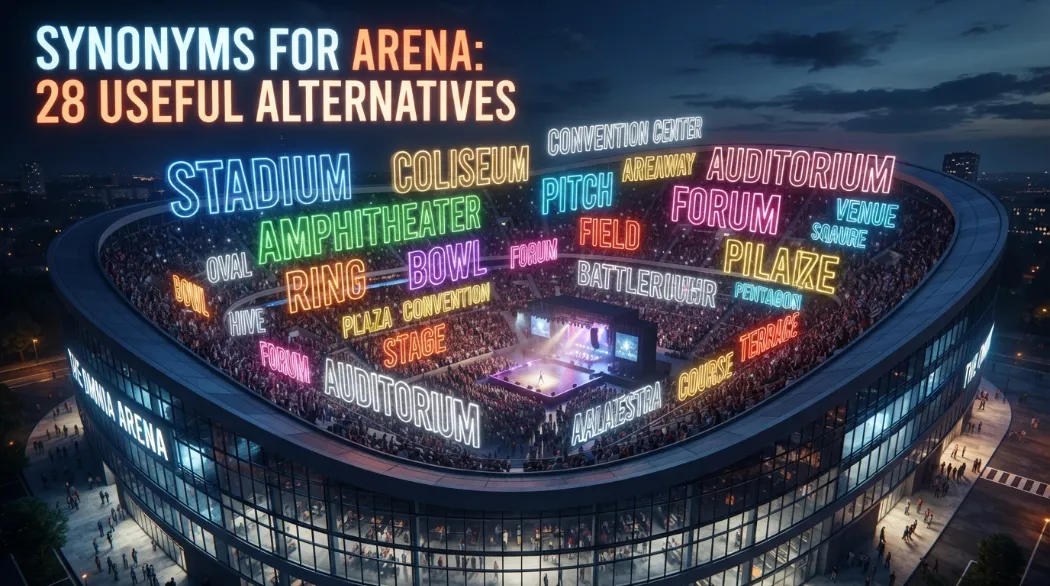
Stadium, venue, field, battleground, stage, forum, domain, sphere, setting, and playing field are useful alternatives to arena, depending on the context.
Arena can mean a place where people watch or take part in sports, contests, or performances. Imagine arriving at a large sports building where thousands of fans are waiting for a basketball game. You might call that building an arena. The word can also describe a place where people compete, debate, work, or deal with important issues.
For example, politics can be called an arena of public debate. Because it works in both physical and figurative contexts, arena is common in news, sports, business, and everyday English. Learning its synonyms helps English learners choose more precise words and helps writers avoid repetition. This article explores the meaning, synonyms, examples, grammar, history, pronunciation, and semantic categories of arena.
Meaning of Arena
Definition
Arena (Noun): A place where sports, competitions, performances, or other activities take place; it can also mean a field where people compete or act.
Examples
- Thousands of fans filled the arena before the basketball game.
- Technology has become a major arena for global competition.
Connotative Meaning
Connotation means the feeling or idea that a word suggests beyond its basic meaning.
- Positive tone: Can suggest excitement, opportunity, competition, or achievement.
- Negative tone: Can suggest conflict, rivalry, pressure, or confrontation.
- Neutral tone: Simply refers to a physical venue or a field of activity.
Etymology
The word arena comes from Latin harena, meaning “sand” or “sandy place.” Roman amphitheaters often had sand spread over their floors.
- Old English (450–1100): Arena was not a regular Old English word. English speakers used other terms for places of public contests and performances.
- Middle English (1100–1500): The Latin word and related forms became known in English through learned and European usage.
- Modern English (1500–Present): Arena developed its familiar meaning of a place for public contests and performances. It later gained the figurative meaning of a field or sphere of activity.
Pronunciation (IPA)
- IPA: /əˈriːnə/
- Syllables: a-re-na
Affixation Pattern of Arena
- Root: aren-, from Latin harena, meaning “sand”
- Prefix: None
- Suffix: None in the modern English word
- Word formations:
- arena: noun
- arenas: plural noun
- arena-based: compound adjective
- arena-like: compound adjective
28 Synonyms of Arena with Meaning & Examples
1. Stadium (Noun)
Meaning: A large sports venue with seating for spectators.
Examples:
- The football team played in a packed stadium.
- Fans entered the stadium before the match.
2. Venue (Noun)
Meaning: A place where an event takes place.
Examples:
- The concert venue can hold 10,000 people.
- They chose a large venue for the championship.
3. Field (Noun)
Meaning: An area where sports or outdoor competitions are played.
Examples:
- The players ran onto the field.
- The team practiced on the field all morning.
4. Playing Field (Noun)
Meaning: The area where a sports game is played; also a figurative area of competition.
Examples:
- The players walked onto the playing field.
- New technology has changed the playing field for businesses.
5. Court (Noun)
Meaning: A marked area used for sports such as basketball or tennis.
Examples:
- The players stepped onto the court.
- She spent two hours practicing on the court.
6. Grounds (Noun)
Meaning: The land or outdoor area used for an event or activity.
Examples:
- Thousands of people gathered on the grounds.
- The festival grounds opened at noon.
7. Amphitheater (Noun)
Meaning: A large circular or oval place with rows of seats around a central area.
Examples:
- The ancient amphitheater attracted many visitors.
- The band performed in an outdoor amphitheater.
8. Coliseum (Noun)
Meaning: A large stadium or arena, especially one used for public events.
Examples:
- The team played at the city coliseum.
- The coliseum was filled with cheering fans.
9. Hall (Noun)
Meaning: A large indoor space used for meetings, events, or performances.
Examples:
- The awards ceremony took place in a large hall.
- The exhibition filled the main hall.
10. Auditorium (Noun)
Meaning: A large room designed for audiences watching performances or presentations.
Examples:
- The audience filled the auditorium.
- The lecture was held in the university auditorium.
11. Theater (Noun)
Meaning: A place designed for performances before an audience.
Examples:
- The actors entered the theater before the show.
- The new theater attracts large audiences.
12. Stage (Noun)
Meaning: A raised area where performers or speakers appear.
Examples:
- The singer walked onto the stage.
- She addressed the audience from the stage.
13. Forum (Noun)
Meaning: A place or setting where people discuss ideas or issues.
Examples:
- The conference provided a forum for discussion.
- The internet has become a major forum for public debate.
14. Platform (Noun)
Meaning: A place or opportunity for people to express ideas or present work.
Examples:
- The event gave young artists a platform.
- The organization created a platform for public discussion.
15. Field of Competition (Noun Phrase)
Meaning: An area in which people or groups compete.
Examples:
- Technology is a growing field of competition.
- Several companies entered the field of competition.
16. Battleground (Noun)
Meaning: A place or area where opposing sides compete or fight.
Examples:
- The region became a political battleground.
- The market is a major battleground for competing brands.
17. Battlefield (Noun)
Meaning: A place where a conflict or battle takes place.
Examples:
- The museum stands near an old battlefield.
- The issue became a political battlefield.
18. Sphere (Noun)
Meaning: An area of activity, influence, or interest.
Examples:
- She is well known in the sphere of science.
- Education is an important sphere of public life.
19. Domain (Noun)
Meaning: A particular area of knowledge, activity, or responsibility.
Examples:
- Artificial intelligence is a rapidly changing domain.
- The company is successful in the digital domain.
20. Field (Noun)
Meaning: A particular area of study, work, or activity.
Examples:
- Medicine is a demanding field.
- She hopes to build a career in the field of education.
21. Setting (Noun)
Meaning: The place or situation in which an activity happens.
Examples:
- The conference provided a useful setting for discussion.
- The classroom became a setting for creative debate.
22. Context (Noun)
Meaning: The situation or circumstances surrounding an event or activity.
Examples:
- The decision must be understood in its social context.
- The economic context changed the debate.
23. Environment (Noun)
Meaning: The conditions or surroundings in which people work, compete, or act.
Examples:
- The company created a competitive environment.
- Students need a safe learning environment.
24. Sphere of Activity (Noun Phrase)
Meaning: A particular area in which people act or compete.
Examples:
- Business is a broad sphere of activity.
- Politics is an important sphere of activity in modern society.
25. Scene (Noun)
Meaning: A particular area of activity, especially involving a group or movement.
Examples:
- She became active in the local music scene.
- The city has a lively arts scene.
26. Circuit (Noun)
Meaning: A regular series of places or events where competitors or performers take part.
Examples:
- The tennis player competed on the international circuit.
- The band joined the festival circuit.
27. Marketplace (Noun)
Meaning: A place or environment where people or organizations compete to sell or exchange things.
Examples:
- The company faces strong competition in the global marketplace.
- Innovation is important in today’s digital marketplace.
28. Contest Ground (Noun Phrase)
Meaning: A place or area where competing people or groups face one another.
Examples:
- The election became a major contest ground for competing ideas.
- The tournament created a fair contest ground for young athletes.
Prototype Meaning
The most typical meaning of arena is a large place where people gather to watch or take part in sports, competitions, or performances. People often imagine a large indoor venue with rows of seats surrounding a central playing area. In figurative use, arena suggests a place or field where people, groups, or ideas compete or interact.
Prototype Categorization
The 28 synonyms and related alternatives can be grouped into several semantic categories:
- Sports and physical venues: stadium, venue, field, playing field, court, grounds, amphitheater, coliseum best for actual places where sports or public events happen.
- Performance and audience spaces: hall, auditorium, theater, stage useful for concerts, plays, speeches, and other performances.
- Discussion and expression: forum, platform suitable when people share ideas, opinions, or information.
- Competition and conflict: battleground, battlefield, circuit, contest ground useful when the focus is rivalry, competition, or conflict.
- Figurative areas of activity: sphere, domain, field, setting, context, environment best when arena refers to an area of work, study, influence, or activity.
- Social and commercial activity: scene, marketplace, sphere of activity useful for cultural, business, or social contexts.
This grouping helps writers choose the right alternative based on the intended meaning. For example, stadium fits a sports building, while sphere or domain works better for a figurative area of activity.
Antonyms of Arena
Because arena refers to a place or field of activity, it does not have one exact opposite. Depending on the context, these words can express contrasting ideas:
1. Isolation (Noun)
A state of being separated from others or from public activity.
2. Retreat (Noun)
A place or situation away from public activity or competition.
3. Seclusion (Noun)
The state of being away from other people.
4. Solitude (Noun)
The state of being alone rather than taking part in a group setting.
5. Private Space (Noun Phrase)
A place intended for personal use rather than public activity.
Short Questions and Answers
What does arena mean?
Arena means a place where sports, competitions, or performances take place. It can also mean a field where people compete or take part in an activity.
When should arena be used?
Use arena for a physical venue or for a figurative field of competition, discussion, work, or activity.
Is arena positive or negative?
Arena is usually neutral. Its tone depends on context. It may suggest excitement and opportunity in sports or competition, but it can suggest conflict when used figuratively.
How is it different from similar words?
Stadium usually refers to a large sports venue, while venue can describe almost any place where an event happens. Forum focuses on discussion, while sphere and domain describe broader areas of activity. Battleground emphasizes conflict or competition.
Conclusion
Learning synonyms for arena can help you describe places, activities, competition, and areas of influence with greater precision. Words such as stadium, venue, field, and court work well for physical sports settings. For performances, theater, auditorium, and hall may be more suitable. In figurative writing, words such as sphere, domain, forum, and battleground can express different ideas about activity, discussion, or competition.
These alternatives are not always interchangeable, so understanding their small differences is important. Using the right word makes writing clearer and reduces repetition. Try practicing a few alternatives each day by creating your own sentences. Over time, this habit can strengthen your vocabulary, improve your writing and speaking, and build greater confidence in English.
Synonyms for merely: 22 Simple Alternatives

Paul Emerson is a language writer specializing in English synonyms. His work focuses on distinguishing subtle differences in meaning and usage, helping readers select the most precise word for any given context.







![]Synonyms for superfluous including unnecessary, redundant, excessive, and extraneous](https://synonymcanvas.com/wp-content/uploads/2026/09/synonyms-for-superfluous-150x150.webp)