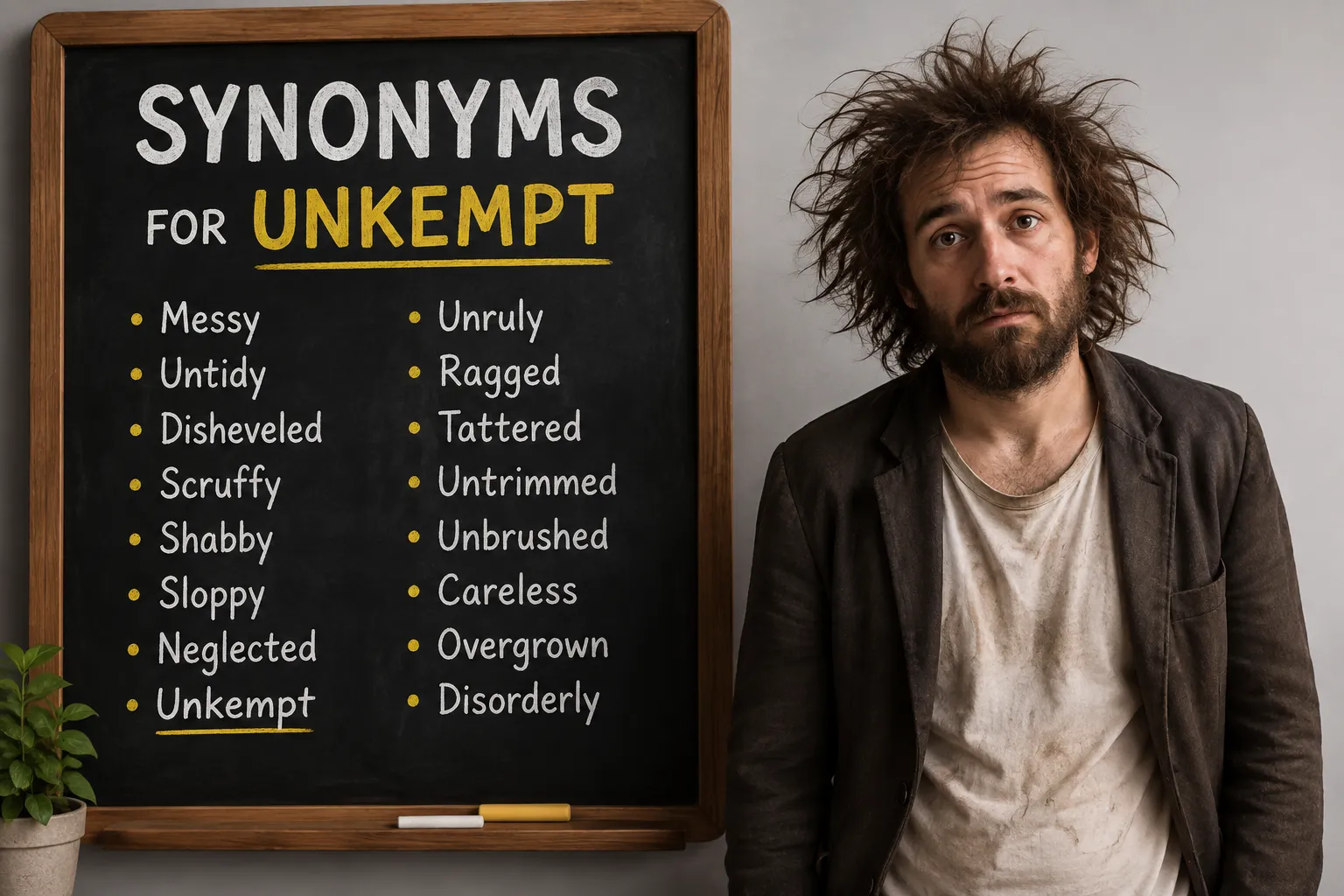
Unkempt: Untidy, messy, or poorly cared for in appearance or condition.
Quick Answer
Unkempt describes someone or something that looks untidy, messy, or poorly cared for. Imagine a person who has not combed their hair, their clothes are wrinkled, and their appearance looks neglected. You might describe that person as unkempt. The word is commonly used to talk about hair, clothing, gardens, rooms, and personal appearance. Learning synonyms for unkempt helps English learners describe different kinds of messiness with greater accuracy. It also helps writers avoid repeating the same word in descriptions and everyday writing. However, words such as messy, untidy, and disheveled do not always carry exactly the same meaning. This article explains the meaning of unkempt along with 30 synonyms, examples, grammar, etymology, pronunciation, word formation, antonyms, and semantic categories.
Meaning of Unkempt
Definition
Unkempt (adjective): Untidy or poorly cared for, especially in a person’s appearance, hair, clothing, or surroundings.
Examples
- His unkempt hair made him look as if he had just woken up.
- The garden looked unkempt after months without care.
Connotative Meaning
(Connotation: the feeling or idea that a word suggests beyond its basic meaning.)
- Positive tone: Usually none, although a casual or natural appearance may sometimes be viewed positively.
- Negative tone: Neglect, poor grooming, disorder, or lack of care.
- Neutral tone: A factual description of something that is not neat or well maintained.
Etymology
The word unkempt comes from the Middle English word unkempt, meaning “not combed.” It is formed from the negative prefix un- and the older word kempt, meaning “combed.”
- Old English (450–1100): The modern form unkempt was not used, but the related idea of combing or arranging hair existed in Old English.
- Middle English (1100–1500): Unkempt developed from un- + kempt, meaning “not combed” or “not arranged.”
- Modern English (1500–Present): The meaning expanded from hair that was not combed to a broader sense of being untidy, messy, or poorly maintained.
Pronunciation (IPA)
- IPA: /ʌnˈkɛmpt/
- Syllables: un-kempt
Affixation Pattern of Unkempt
- Root: kempt meaning neat or combed
- Prefix: un- meaning “not”
- Suffix: None
- Word formations:
- unkempt: adjective
- kempt: adjective
- unkemptness: noun
- unkemptly: adverb
30 Synonyms of Unkempt With Meaning & Examples
1. Untidy (Adjective)
Meaning: Not neat, clean, or well organized.
Examples:
- His untidy room was full of clothes.
- She looked untidy after a long day at work.
2. Messy (Adjective)
Meaning: Full of disorder or lacking neatness.
Examples:
- His hair looked messy after the journey.
- The kitchen was messy after dinner.
3. Disheveled (Adjective)
Meaning: Untidy in appearance, especially with messy hair or clothing.
Examples:
- He arrived with disheveled hair.
- Her clothes looked disheveled after the long trip.
4. Unruly (Adjective)
Meaning: Difficult to control or keep neat.
Examples:
- She has unruly curly hair.
- His unruly hair was difficult to style.
5. Scruffy (Adjective)
Meaning: Untidy and slightly dirty in appearance.
Examples:
- He wore a scruffy jacket.
- The old dog looked scruffy after playing outside.
6. Shabby (Adjective)
Meaning: Worn, old, or poorly maintained.
Examples:
- He lived in a shabby apartment.
- The building looked shabby after years without repairs.
7. Sloppy (Adjective)
Meaning: Careless, untidy, or lacking attention to appearance.
Examples:
- His sloppy appearance surprised his coworkers.
- She received criticism for her sloppy work.
8. Disordered (Adjective)
Meaning: Not arranged in an organized or neat way.
Examples:
- The files were disordered.
- His desk was completely disordered.
9. Unranged (Adjective)
Meaning: Not placed or organized in a proper order.
Examples:
- The books were left unranged on the shelves.
- The items appeared unranged and difficult to find.
10. Unorganized (Adjective)
Meaning: Not arranged in a clear or orderly way.
Examples:
- Her desk was unorganized.
- The papers were unorganized after the meeting.
11. Unsystematic (Adjective)
Meaning: Not organized according to a clear system or method.
Examples:
- His notes were unsystematic.
- The files were stored in an unsystematic way.
12. Neglected (Adjective)
Meaning: Not given enough care or attention.
Examples:
- The garden looked neglected.
- The house had become neglected over the years.
13. Uncared-for (Adjective)
Meaning: Not properly looked after or maintained.
Examples:
- They found an uncared-for garden behind the house.
- The building looked uncared-for.
14. Unmaintained (Adjective)
Meaning: Not kept in good condition through regular care.
Examples:
- The road was unmaintained.
- The unmaintained garden was covered with weeds.
15. Disorganized (Adjective)
Meaning: Not arranged in an orderly or efficient way.
Examples:
- His workspace was disorganized.
- The documents were completely disorganized.
16. Disorderly (Adjective)
Meaning: Untidy or lacking order.
Examples:
- The room was disorderly.
- The books were placed in a disorderly manner.
17. Unkempt-looking (Adjective)
Meaning: Having an appearance that is untidy or poorly cared for.
Examples:
- He appeared unkempt-looking after the hike.
- The unkempt-looking garden needed attention.
18. Ragged (Adjective)
Meaning: Old, torn, or worn and often giving an untidy appearance.
Examples:
- He wore a ragged coat.
- The traveler arrived in ragged clothes.
19. Tattered (Adjective)
Meaning: Torn, damaged, or badly worn.
Examples:
- He was wearing a tattered shirt.
- The old flag looked tattered.
20. Disarrayed (Adjective)
Meaning: Thrown into a state of disorder.
Examples:
- The room was disarrayed after the party.
- Her desk was completely disarrayed.
21. Uncombed (Adjective)
Meaning: Not combed or arranged neatly.
Examples:
- His uncombed hair stood up in every direction.
- She arrived with uncombed hair.
22. Unbrushed (Adjective)
Meaning: Not brushed or groomed.
Examples:
- He had unbrushed hair.
- Her unbrushed appearance suggested she had rushed out.
23. Untrimmed (Adjective)
Meaning: Not cut or shaped neatly.
Examples:
- He had an untrimmed beard.
- The bushes were untrimmed and overgrown.
24. Overgrown (Adjective)
Meaning: Covered with plants or growth that has not been controlled.
Examples:
- The garden was overgrown with weeds.
- They cleared the overgrown path.
25. Wild (Adjective)
Meaning: Growing or appearing without control or regular care.
Examples:
- Her hair looked wild after the storm.
- The garden had a wild appearance.
26. Rough (Adjective)
Meaning: Lacking a smooth, neat, or polished appearance.
Examples:
- He had a rough and unpolished appearance.
- His beard looked rough after several days.
27. Careless (Adjective)
Meaning: Showing little attention to neatness or appearance.
Examples:
- His careless appearance stood out at the formal event.
- She looked careless about her clothing.
28. Slovenly (Adjective)
Meaning: Very untidy or careless in appearance or habits.
Examples:
- His slovenly appearance attracted attention.
- The worker was criticized for his slovenly habits.
29. Unpolished (Adjective)
Meaning: Lacking neatness, refinement, or a finished appearance.
Examples:
- His appearance looked unpolished.
- The room had an unpolished and unfinished feel.
30. Negligent (Adjective)
Meaning: Failing to give proper care or attention.
Examples:
- The owner was negligent about maintaining the property.
- The negligent care left the garden in poor condition.
Prototype Meaning
The most typical meaning of unkempt is untidy because of a lack of grooming or care. When people hear this word, they often imagine messy hair, an untrimmed beard, wrinkled clothing, or a poorly maintained garden. The word usually suggests more than simple messiness because it often implies that something has not received proper care or attention.
Prototype Categorization
The 30 synonyms can be grouped into useful semantic categories:
- General untidiness: untidy, messy, disordered, disorderly, disorganized, disarrayed useful for rooms, objects, spaces, and general appearance.
- Personal appearance: disheveled, scruffy, unkempt-looking, uncombed, unbrushed, slovenly best for hair, clothing, grooming, or overall appearance.
- Lack of care or maintenance: neglected, uncared-for, unmaintained, negligent useful when untidiness results from poor care or attention.
- Hair and grooming: unruly, uncombed, unbrushed, untrimmed, wild suitable for hair, beards, and other aspects of personal grooming.
- Worn or damaged appearance: shabby, ragged, tattered, rough, unpolished useful when something looks old, worn, damaged, or unfinished.
- Natural or uncontrolled growth: overgrown, wild particularly useful for gardens, plants, grass, and outdoor spaces.
- Poor organization: unsystematic, unorganized, disorganized, disordered best when the main problem is a lack of order rather than physical dirt.
This categorization helps writers select a synonym based on what is untidy, why it looks untidy, and how strong the description should be.
Antonyms of Unkempt
1. Neat (Adjective)
Clean, orderly, and well arranged.
2. Tidy (Adjective)
Well organized and free from disorder.
3. Well-groomed (Adjective)
Having a clean and carefully maintained appearance.
4. Trim (Adjective)
Neat and well maintained in appearance.
5. Polished (Adjective)
Well presented, refined, and carefully prepared.
6. Immaculate (Adjective)
Extremely clean, neat, and well maintained.
7. Orderly (Adjective)
Arranged in a neat and organized way.
8. Well-maintained (Adjective)
Kept in good condition through regular care.
Short Questions and Answers
Q: What does unkempt mean?
A: Unkempt means untidy, messy, or poorly cared for, especially in appearance, hair, clothing, or surroundings.
Q: When should unkempt be used?
A: Use unkempt when something looks untidy because it has not been properly groomed, cleaned, arranged, or maintained.
Q: Is unkempt positive or negative?
A: Unkempt usually has a negative connotation because it suggests poor grooming, neglect, or a lack of care.
Q: How is it different from similar words?
A: Unkempt often suggests a lack of care or grooming. Messy is broader and simply means untidy, while disheveled mainly describes a person’s messy appearance, hair, or clothing. Neglected focuses more strongly on the lack of care over time.
Conclusion
Learning unkempt and its synonyms gives English learners more ways to describe untidy appearances and poorly maintained places. Words such as messy, untidy, and disheveled may seem similar, but each can describe a slightly different situation. Unkempt is especially useful when something looks untidy because it has not received enough care or grooming. Understanding these small differences helps you choose stronger and more accurate words in both speaking and writing. For content writers, a wider vocabulary also reduces repetition and makes descriptions more engaging. Try learning a few synonyms each day and use them in your own sentences. Regular vocabulary practice can improve your writing, strengthen your speaking skills, and build confidence in English.

Amna Akhtar is a writer dedicated to making English easier to understand. She creates research-informed guides on grammar, vocabulary, spelling differences, antonyms, and synonyms, combining careful research with clear, practical explanations. She is also the co-author of the peer-reviewed research article “Determinants of Jobs Satisfaction of Female Teachers: An Evidence from District Hafizabad, Pakistan,”