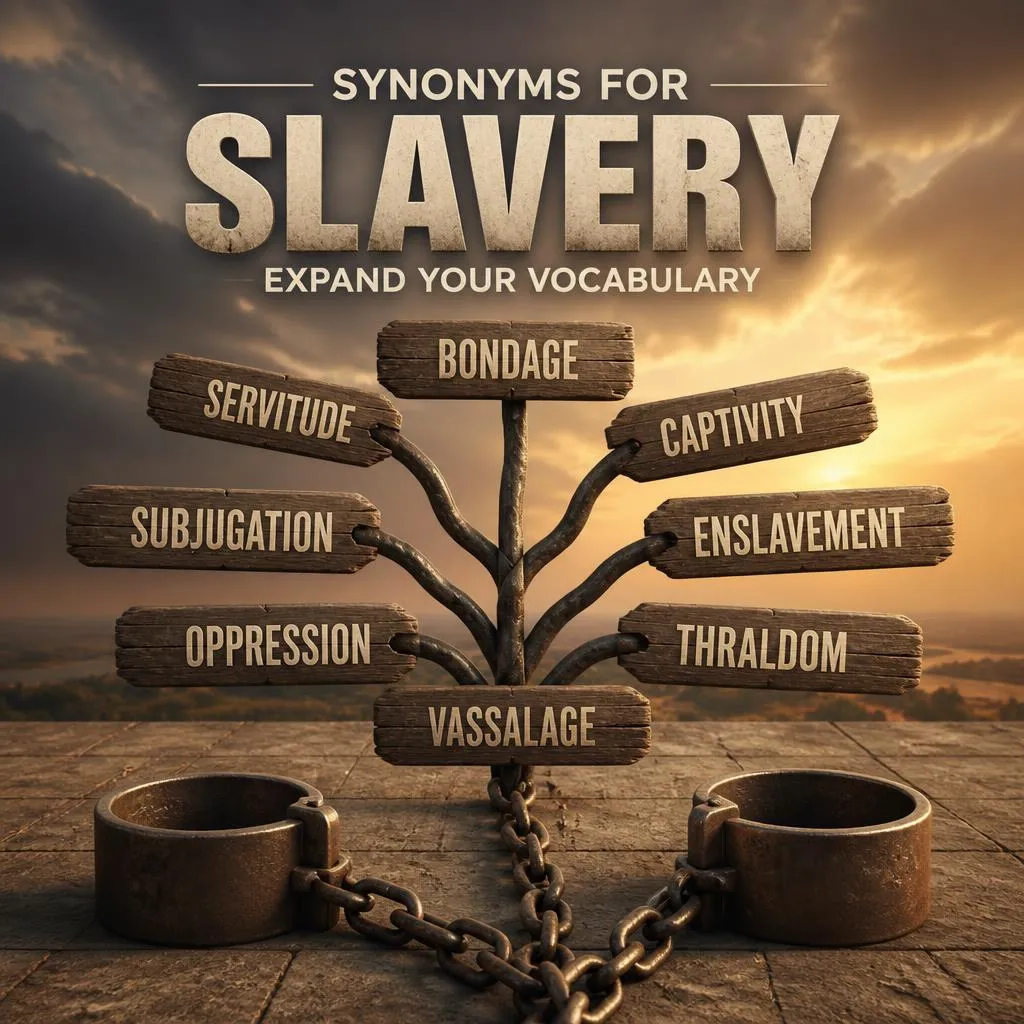
Slavery can be described with words such as bondage, servitude, enslavement, forced labor, subjugation, oppression, captivity, thralldom, exploitation, and involuntary servitude. Each word carries a slightly different meaning, so choosing the right one depends on the context.
Slavery means a system or condition in which people are treated as property or are forced to work and live under another person’s control. Imagine a person who cannot leave their work, receives no real freedom, and is controlled by someone else. This situation shows the basic idea behind slavery. The word is widely used in history, law, politics, and social studies because slavery has affected many societies across the world. Learning synonyms for slavery helps English learners understand different shades of meaning and helps writers avoid repeating the same word. However, related terms are not always exact substitutes.
This article explains the meaning of slavery and explores its synonyms through examples, grammar, history, pronunciation, word formation, and semantic categories.
Meaning of Slavery
Definition
Slavery (noun): A condition or system in which a person is deprived of freedom and is controlled or exploited by another person or group.
Examples
- Millions of people suffered under slavery throughout history.
- The novel tells the story of a family trying to escape slavery.
Connotative Meaning
Connotation: The feelings or ideas that a word suggests beyond its basic meaning.
- Positive tone: Slavery itself has no positive meaning, although discussions about emancipation may have positive associations with freedom and justice.
- Negative tone: Slavery strongly suggests cruelty, loss of freedom, exploitation, violence, and injustice.
- Neutral tone: In historical or academic writing, slavery may be used as a factual term to describe a social or legal system.
Etymology
The word slavery developed from the word slave, which entered English through Medieval Latin and Old French and is ultimately connected with the Latin Sclavus, referring to a Slav. This connection arose because many Slavic people were captured and enslaved during the medieval period.
- Old English (450–1100): The modern word slavery was not yet established. Earlier English used words such as þeowdom for a condition of servitude.
- Middle English (1100–1500): Slave entered English through French forms related to Medieval Latin sclavus. Words describing bondage and servitude were also used.
- Modern English (1500–Present): Slavery became the established noun for the condition or system of being enslaved. It is now widely used in historical, legal, social, and political discussions.
Pronunciation (IPA)
- IPA: /ˈsleɪvəri/
- Syllables: slav-er-y
Affixation Pattern of Slavery
- Root: slave
- Prefix: None
- Suffix: -ery
- Word formations:
- slave: noun/verb
- slavery: noun
- slaved: verb, past tense
- slaving: verb, present participle
- enslave: verb
- enslavement: noun
- enslaved: adjective/past participle
- enslaver: noun
- slaveholder: noun
- slaveholding: noun/adjective
- slavelike: adjective
24 Synonyms of Slavery With Meaning & Examples
1. Bondage (Noun)
Meaning: A condition in which a person lacks freedom and is controlled by another person or power.
Examples:
- The people fought to escape bondage.
- The story describes generations living in bondage.
2. Servitude (Noun)
Meaning: A condition of being forced to serve another person or power.
Examples:
- The workers lived in harsh servitude.
- She wrote about the effects of servitude on families.
3. Enslavement (Noun)
Meaning: The act or process of forcing someone into slavery.
Examples:
- The museum documents the enslavement of millions of people.
- Enslavement destroyed the freedom of entire communities.
4. Forced Labor (Noun)
Meaning: Work that people are made to perform against their will.
Examples:
- The report describes the use of forced labor.
- Forced labor remains a serious human rights concern.
5. Involuntary Servitude (Noun)
Meaning: A condition in which someone is compelled to serve or work without genuine freedom to leave.
Examples:
- The law prohibits involuntary servitude.
- The case involved allegations of involuntary servitude.
6. Thralldom (Noun)
Meaning: A state of complete dependence or bondage.
Examples:
- The poem describes a people living in thralldom.
- They dreamed of escaping thralldom.
7. Captivity (Noun)
Meaning: A condition in which someone is held and prevented from being free.
Examples:
- The prisoners remained in captivity for years.
- She wrote about her experience in captivity.
8. Subjugation (Noun)
Meaning: The act of bringing a person or group under complete control.
Examples:
- The people resisted military subjugation.
- The novel explores the effects of political subjugation.
9. Oppression (Noun)
Meaning: Cruel or unfair control over people who have less power.
Examples:
- The community protested against oppression.
- The book examines years of social oppression.
10. Exploitation (Noun)
Meaning: The unfair use of someone for another person’s benefit.
Examples:
- The workers suffered from exploitation.
- The article discusses the exploitation of vulnerable people.
11. Domination (Noun)
Meaning: Strong control or power over another person or group.
Examples:
- The group resisted foreign domination.
- Domination deprived the community of political freedom.
12. Subordination (Noun)
Meaning: A condition in which someone is placed under the authority or control of another.
Examples:
- The system created extreme social subordination.
- The study examines economic subordination.
13. Oppression (Noun)
Meaning: The prolonged use of unjust power or control against people.
Examples:
- The movement challenged racial oppression.
- Many families suffered under political oppression.
14. Coercion (Noun)
Meaning: The use of force or threats to make someone do something.
Examples:
- The agreement was obtained through coercion.
- Coercion removed any real choice from the workers.
15. Constraint (Noun)
Meaning: A restriction that limits someone’s freedom or actions.
Examples:
- Poverty placed severe constraints on their choices.
- The prisoners lived under strict constraints.
16. Subjection (Noun)
Meaning: The state of being placed under another person’s control or authority.
Examples:
- The population resisted foreign subjection.
- The story focuses on years of subjection.
17. Yoke (Noun)
Meaning: A condition of heavy control, burden, or oppression.
Examples:
- The people wanted to throw off the yoke of oppression.
- They struggled under the yoke of an unjust ruler.
18. Captivation (Noun)
Meaning: The act of capturing or holding someone; in modern English, it usually means attracting someone’s attention rather than enslaving them.
Examples:
- The soldiers were taken into captivity.
- The prisoners remained in captivity for months.
Note: Captivation is generally not a direct synonym for slavery. Captivity is the appropriate related word when physical confinement is meant.
19. Serfdom (Noun)
Meaning: A historical system in which peasants were legally tied to land and subject to a lord.
Examples:
- Serfdom shaped medieval European society.
- The reform gradually weakened the system of serfdom.
Note: Serfdom is related to slavery but is not identical to it. Serfs generally had a different legal status from enslaved people.
20. Slaveholding (Noun)
Meaning: The practice or condition of owning enslaved people.
Examples:
- Slaveholding was once protected by law in some societies.
- The museum examines the history of slaveholding.
21. Slave Trade (Noun)
Meaning: The buying, selling, and transportation of enslaved people.
Examples:
- The transatlantic slave trade affected millions of people.
- The museum teaches visitors about the slave trade.
22. Human Trafficking (Noun)
Meaning: The illegal exploitation or movement of people through force, fraud, or coercion.
Examples:
- Governments work to prevent human trafficking.
- The organization helps victims of human trafficking.
Note: Human trafficking and slavery can overlap, but they are not exact synonyms. Trafficking can involve different forms of exploitation.
23. Forced Servitude (Noun)
Meaning: A condition in which someone is compelled to serve another person against their will.
Examples:
- The investigation uncovered forced servitude.
- The victims were trapped in forced servitude.
24. Bonded Labor (Noun)
Meaning: A form of labor in which a person works to repay a debt but may become trapped in the arrangement.
Examples:
- The report describes cases of bonded labor.
- Laws have been introduced to prevent bonded labor.
Prototype Meaning
The most typical meaning of slavery is a system or condition in which one person or group has control over another person’s freedom and labor. When people hear the word, they often imagine people being treated as property, forced to work, denied basic rights, and prevented from leaving. The exact form of slavery has varied across different societies and historical periods.
Prototype Categorization
The 24 terms above can be grouped into several semantic categories. This helps writers choose a word that matches the exact idea they want to express.
- Direct terms for enslavement: bondage, servitude, enslavement, forced servitude, and involuntary servitude describe conditions of unfree service most closely related to slavery.
- Control and loss of freedom: subjugation, subjection, domination, and thralldom focus on being placed under another person’s power.
- Unfair treatment and abuse: oppression, exploitation, and coercion emphasize injustice, abuse, or the removal of free choice.
- Captivity and confinement: captivity describes being held and prevented from leaving. It can occur without slavery.
- Historical systems: serfdom, slaveholding, slave trade, and bonded labor refer to particular social, economic, or historical systems connected to unfree labor.
- Related modern terms: human trafficking can involve slavery-like exploitation, but it covers a broader range of crimes and situations.
- Figurative language: yoke and constraint can describe heavy control or restriction without referring to literal slavery.
This grouping helps writers avoid using every synonym as if it had exactly the same meaning. For example, bondage may fit a broad discussion of unfreedom, while forced labor focuses more specifically on compelled work.
Antonyms of Slavery
1. Freedom (Noun)
The state of being able to act and choose without unjust control.
2. Liberty (Noun)
The right or condition of being free.
3. Independence (Noun)
The state of not being controlled by another person or power.
4. Autonomy (Noun)
The ability to make one’s own decisions.
5. Emancipation (Noun)
The act of freeing someone from legal, social, or political control.
6. Liberation (Noun)
The act of freeing someone from confinement, oppression, or control.
7. Self-determination (Noun)
The ability of people or groups to decide their own future and affairs.
Short Questions and Answers
What does slavery mean?
Slavery means a condition or system in which people are deprived of freedom and controlled or exploited by others.
When should slavery be used?
Use slavery when discussing a system or condition involving severe loss of freedom and control over people. It is common in historical, legal, academic, and social discussions.
Is slavery positive or negative?
Slavery has a strongly negative connotation because it is associated with loss of freedom, exploitation, cruelty, and injustice. In academic writing, however, the word may be used neutrally as a factual historical or social term.
How is it different from similar words?
Words such as bondage, servitude, and enslavement can be close synonyms, but other terms have narrower meanings. Forced labor focuses on compelled work, captivity focuses on being held, serfdom describes a particular historical system, and human trafficking refers to a broader form of exploitation involving force, fraud, or coercion.
Conclusion
Learning slavery and its related words can make your English vocabulary more precise and flexible. Words such as bondage, servitude, enslavement, forced labor, subjugation, and oppression can describe different parts of the idea, but they should not always be treated as exact substitutes. Understanding these differences helps writers choose the right word for history, law, social studies, and everyday discussion. It also prevents repetition and makes sentences clearer. For English learners, studying synonyms is a useful way to build vocabulary and improve both writing and speaking. Try learning a few related words each day, then use them in your own sentences. With regular practice, your vocabulary will become stronger, more precise, and more confident.
Synonyms for cryptic: 30 Powerful Alternatives

I’m Leo Jackson, an English writer with a soft spot for the peculiarities of language and vocabulary. Specializes in exploring the nuances of English synonyms, helping students, writers, and professionals choose the right word with confidence. My guides combine careful research with clear, practical explanations.






![]Synonyms for superfluous including unnecessary, redundant, excessive, and extraneous](https://synonymcanvas.com/wp-content/uploads/2026/09/synonyms-for-superfluous-150x150.webp)