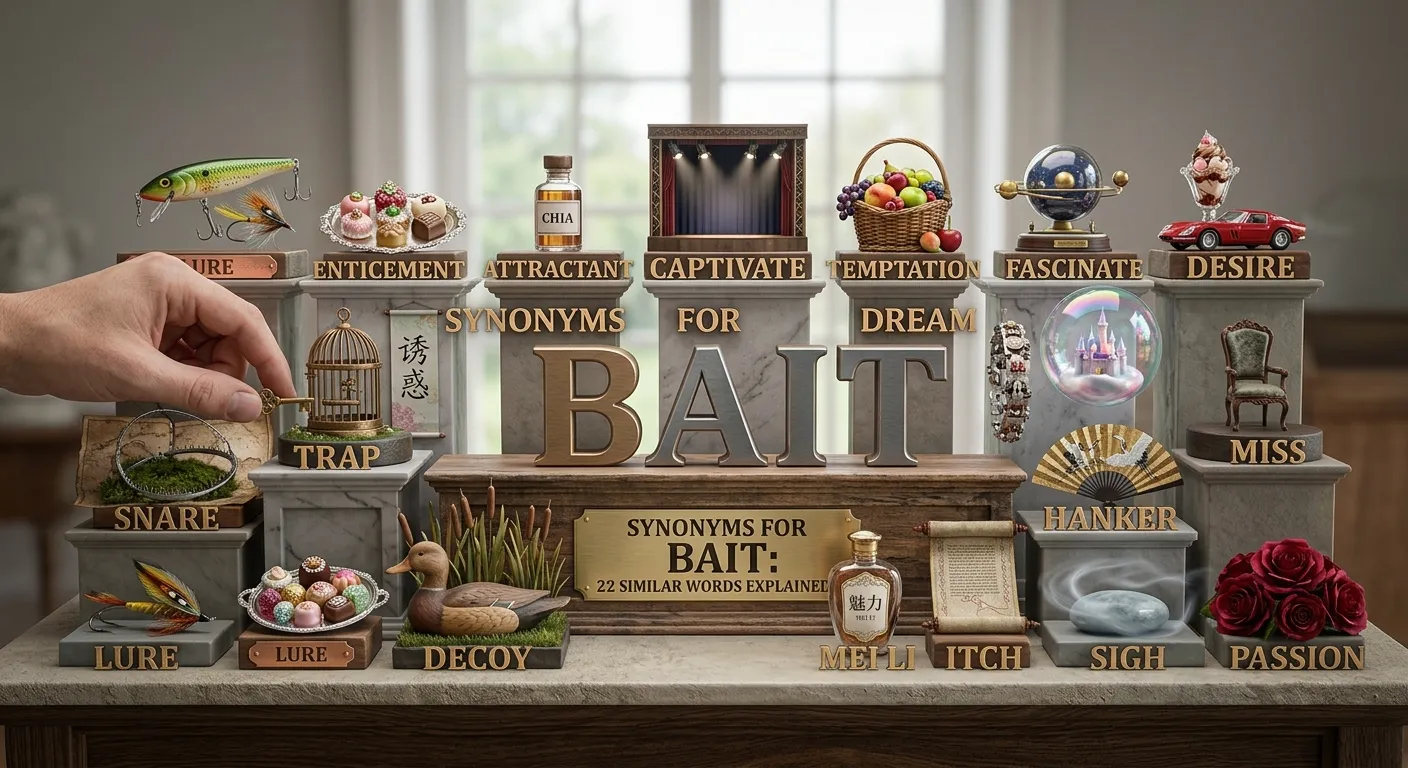
Hook, lure, trap, enticement, temptation, inducement, decoy, provocation are among the useful synonyms for bait, but the best choice depends on whether you mean food used to catch an animal, something that attracts a person, or an action meant to provoke a reaction.
Bait is something used to attract a person, animal, or fish, often to catch, tempt, or trick it. Imagine someone fishing beside a quiet lake. They place a small piece of food on a hook and wait for a fish to bite. That food is bait. The word is also common in everyday speech. Someone may use a tempting offer as bait to attract customers, or a rude comment as bait to make another person angry. Learning synonyms for bait helps English learners choose words that match the exact meaning and tone they want. It also helps content writers avoid repetition and make their writing more precise. In this article, we will explore the meaning, examples, grammar, history, pronunciation, word forms, synonyms, antonyms, and semantic categories of bait.
Meaning of Bait
Definition
Bait (noun/verb): Something used to attract, tempt, catch, or provoke someone or something.
Examples
- The fisherman put bait on the hook.
- The advertisement used a free gift as bait to attract customers.
Connotative Meaning
Connotation: The feeling or idea that a word suggests beyond its basic meaning.
- Positive tone: Can suggest an attractive offer or tempting opportunity.
- Negative tone: Often suggests deception, manipulation, or provocation.
- Neutral tone: Can simply refer to food used to catch fish or animals.
Etymology
The word bait has a long history in English and is closely linked to the idea of food used to attract an animal.
- Old English (450–1100): Related to Scandinavian forms such as Old Norse beit, meaning “food” or “something to eat.”
- Middle English (1100–1500): Bait developed as a word for food placed to attract or catch an animal.
- Modern English (1500–Present): The word expanded to include things that attract, tempt, deceive, or provoke people.
Pronunciation (IPA)
- IPA: /beɪt/
- Syllables: bait (1 syllable)
Affixation Pattern of Bait
- Root: bait
- Prefix: None
- Suffix: None in the base form
Word formations
- bait: noun/verb
- baits: noun plural / verb
- baited: verb, past tense/past participle; adjective
- baiting: noun/verb form
- baiter: noun, a person who baits
22 Synonyms of Bait With Meaning & Examples
1. Lure (Noun/Verb)
Meaning: Something that attracts someone or something by offering an appealing reward.
Examples:
- The bright light was a lure for insects.
- The company used discounts to lure new customers.
2. Decoy (Noun)
Meaning: A person or thing used to attract or distract someone from the real target.
Examples:
- The hunters used a wooden duck as a decoy.
- The fake website was a decoy to distract users.
3. Enticement (Noun)
Meaning: Something that encourages someone to do something by making it seem attractive.
Examples:
- The free gift was an enticement for shoppers.
- The promise of money was an enticement to join the scheme.
4. Temptation (Noun)
Meaning: Something that makes someone strongly want to do or have something.
Examples:
- The chocolate cake was too great a temptation.
- The discount was a temptation for many buyers.
5. Trap (Noun)
Meaning: Something designed to catch, trick, or deceive someone.
Examples:
- The mouse entered the trap for the cheese.
- The fake offer was a trap.
6. Hook (Noun)
Meaning: Something that attracts attention or interest.
Examples:
- The free trial was the hook that attracted customers.
- The opening line was a strong hook for readers.
7. Attraction (Noun)
Meaning: Something that draws people or animals toward it.
Examples:
- The smell of food was an attraction for the dog.
- The special offer was an attraction for tourists.
8. Incentive (Noun)
Meaning: Something that encourages someone to take action.
Examples:
- The bonus was an incentive for workers.
- Free delivery can be an incentive to buy online.
9. Inducement (Noun)
Meaning: Something offered to persuade someone to do something.
Examples:
- The company offered a bonus as an inducement.
- The discount acted as an inducement to purchase.
10. Allurement (Noun)
Meaning: Something attractive that draws people toward it.
Examples:
- The allurement of wealth attracted many people.
- The island’s beauty was a powerful allurement for visitors.
11. Tempt (Verb)
Meaning: To make someone want something or want to do something.
Examples:
- The smell of fresh bread tempted me.
- The low price tempted her to buy the dress.
12. Attractant (Noun)
Meaning: Something that attracts an animal, person, or other target.
Examples:
- The researchers placed an attractant near the camera.
- The food served as an attractant for the fish.
13. Provocation (Noun)
Meaning: An action or remark intended to make someone react angrily.
Examples:
- His comment was a deliberate provocation.
- She ignored the provocation and stayed calm.
14. Challenge (Noun)
Meaning: Something said or done to encourage a person to react or respond.
Examples:
- His question sounded like a challenge.
- She accepted the comment as a challenge.
15. Stimulus (Noun)
Meaning: Something that causes a response or encourages activity.
Examples:
- The reward provided a strong stimulus to work harder.
- The advertisement was a stimulus for customer interest.
16. Prompt (Noun)
Meaning: Something that causes or encourages a response or action.
Examples:
- The question was a prompt for discussion.
- The message served as a prompt to respond.
17. Persuasion (Noun)
Meaning: The act of encouraging someone to believe or do something.
Examples:
- The salesperson used persuasion to close the deal.
- Gentle persuasion worked better than pressure.
18. Appeal (Noun)
Meaning: Something that attracts interest, attention, or desire.
Examples:
- The product has strong appeal for young buyers.
- The promise of adventure was part of its appeal.
19. Attraction Device (Noun Phrase)
Meaning: Something designed to draw attention or interest.
Examples:
- The free sample was an attraction device for shoppers.
- The colorful display worked as an attraction device.
20. Draw (Noun/Verb)
Meaning: Something that attracts people or encourages them to come closer.
Examples:
- The festival was a major draw for tourists.
- The discount drew many customers into the store.
21. Carrot (Noun)
Meaning: A reward or benefit offered to encourage someone to act.
Examples:
- The company offered a bonus as a carrot.
- Free tickets were the carrot that attracted customers.
22. Provocative Remark (Noun Phrase)
Meaning: A statement designed to make someone react, especially emotionally.
Examples:
- His comment was a provocative remark.
- She refused to respond to the provocative remark.
Usage note: These synonyms are not interchangeable in every sentence. Lure, decoy, and trap fit physical or deceptive attraction well, while incentive and carrot focus on rewards. Provocation is better when bait means something used to make a person react.
Prototype Meaning
The most typical meaning of bait is something placed or offered to attract and catch a person or animal. People often imagine a piece of food attached to a fishing hook. In modern language, however, bait can also be an attractive offer, a deceptive object, or a comment designed to provoke someone.
Prototype Categorization
- Fishing and hunting: lure, decoy, attractant, trap: These words work well when something is used to catch or draw an animal.
- Attraction and temptation: enticement, temptation, allurement, appeal, lure: These describe something attractive that makes people want to act.
- Rewards and persuasion: incentive, inducement, carrot, persuasion: These are useful when a benefit is offered to encourage action.
- Attention and engagement: hook, draw, attraction, stimulus, prompt: These fit marketing, writing, media, and communication.
- Provocation: provocation, challenge, provocative remark: These fit situations where bait is used to make someone react.
- Deception: decoy, trap, lure: These suggest that the attraction may hide a trick or unwanted outcome.
This categorization helps writers choose a synonym based on purpose, context, and emotional tone, rather than replacing bait with a random similar word.
Antonyms of Bait
- Warning (Noun): Information that alerts someone to possible danger or deception.
- Deterrent (Noun): Something that discourages a person or animal from taking action.
- Repellent (Noun): Something that drives away or prevents approach.
- Discouragement (Noun): Something that reduces the desire to act.
- Avoidance (Noun): The act of staying away from something.
- Deterrence (Noun): The act or effect of preventing an action through fear or disadvantage.
Short Questions and Answers
Q: What does bait mean?
Bait means something used to attract, tempt, catch, or provoke someone or something.
Q: When should bait be used?
Use bait when something is deliberately offered or used to attract a target, catch something, or provoke a reaction.
Q: Is bait positive or negative?
It depends on context. Bait can be neutral when referring to fishing, but it often has a negative tone when it suggests manipulation, deception, or provocation.
Q: How is it different from similar words?
Bait is a broad word for something used to attract or provoke. Lure focuses on attraction, decoy on distraction or deception, incentive on reward, and provocation on causing a reaction.
Conclusion
Learning bait and its synonyms can make your English more accurate and expressive. Words such as lure, decoy, temptation, enticement, incentive, hook, and provocation may be related to bait, but they do not all have the same meaning. Choosing the right synonym depends on the situation and the kind of attraction involved.
This skill helps English learners expand their vocabulary and communicate ideas more clearly. It also helps writers avoid repeating the same word in articles, stories, advertisements, and other content. By learning synonyms in semantic groups, you can understand their small differences more easily. Practice a few new words each day, create your own sentences, and use them in real conversations. Regular practice will strengthen your vocabulary, improve your writing and speaking, and build confidence in English.
Synonyms for abrupt: 24 Words to know

Amna Akhtar is a writer dedicated to making English easier to understand. She creates research-informed guides on grammar, vocabulary, spelling differences, antonyms, and synonyms, combining careful research with clear, practical explanations. She is also the co-author of the peer-reviewed research article “Determinants of Jobs Satisfaction of Female Teachers: An Evidence from District Hafizabad, Pakistan,”