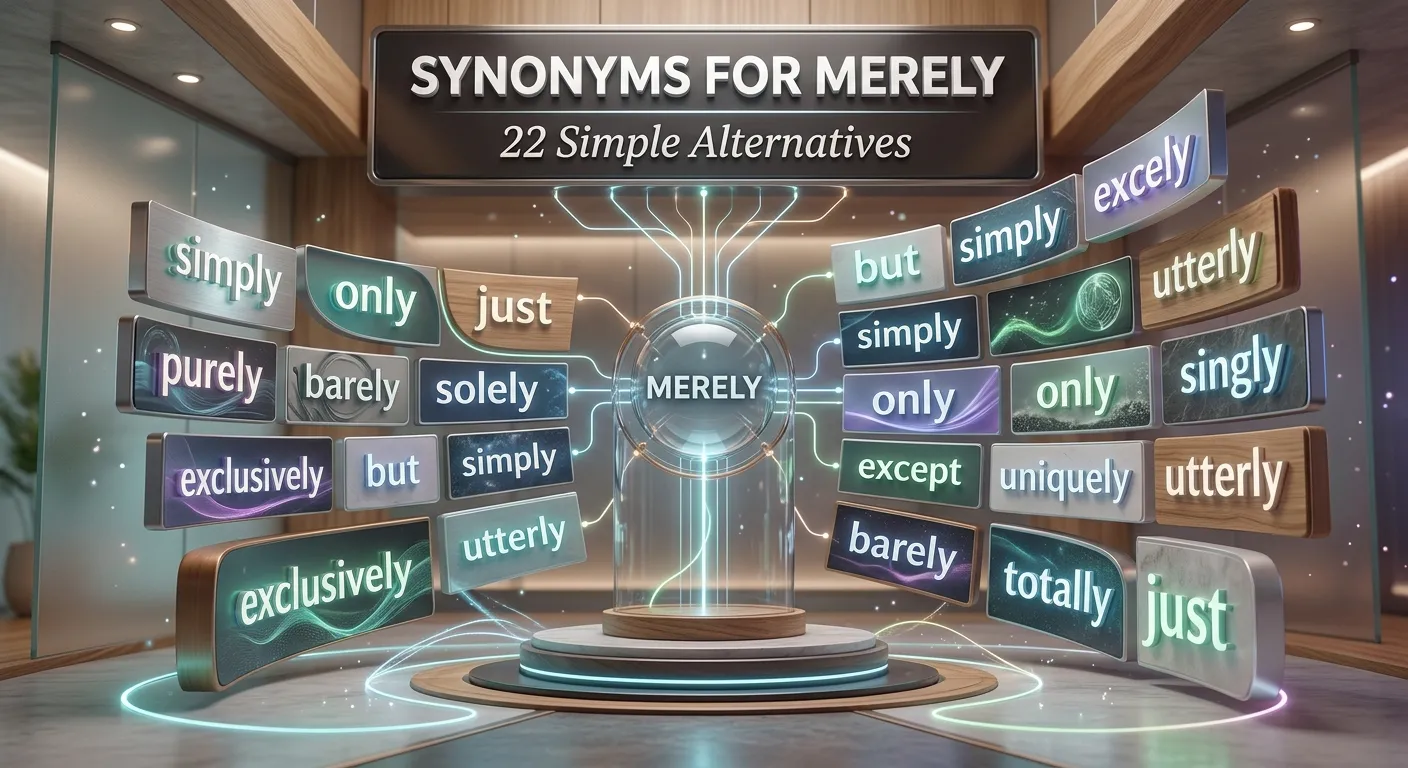
Only, just, simply, solely, purely, exclusively, barely, and nothing but can replace merely in different contex.
Merely means “only” or “just,” and it is often used to show that something is limited or less important than it may first appear. Imagine a student saying, “I was merely asking a question,” after someone thinks she was challenging the teacher. Here, merely makes it clear that her action had a simple purpose. The word is common in both everyday and formal English because it helps speakers and writers add a sense of limitation or simplicity.
Learning synonyms for merely gives English learners more ways to express the same idea without repeating one word. It also helps content writers choose the right level of emphasis. This article explores the meaning, synonyms, examples, grammar, history, pronunciation, and semantic categories of merely.
Meaning of Merely
Definition
Merely (Adverb): Used to mean only, just, or simply, often to show that something is less important or extensive than expected.
Examples
- I was merely trying to help.
- She is merely a beginner, so she still has much to learn.
Connotative Meaning
Connotation means the feeling or idea that a word suggests beyond its basic meaning.
- Positive tone: Can suggest simplicity, modesty, or a limited claim.
- Negative tone: Can make something sound unimportant, insignificant, or dismissive.
- Neutral tone: Simply shows that something is limited to a particular fact, action, or amount.
Etymology
The word merely developed from mere, meaning “nothing more than” or “only.”
- Old English (450–1100): The modern word mere has roots connected to Old French and Latin rather than a direct Old English form. Old English commonly used other expressions to convey the idea of “only.”
- Middle English (1100–1500): Mere entered English through Anglo-French and Old French, from Latin merus, meaning “pure,” “unmixed,” or “nothing more than.”
- Modern English (1500–Present): Merely developed by adding the adverbial ending -ly to mere. It came to mean “only,” “simply,” or “just.”
Pronunciation (IPA)
- IPA: /ˈmɪəli/ (British), /ˈmɪrli/ (American)
- Syllables: mere-ly
Affixation Pattern of Merely
- Root: mere
- Prefix: None
- Suffix: -ly
- Word formations:
- mere: adjective
- merely: adverb
- mereness: noun, rare
- merest: adjective, superlative form
22 Synonyms of Merely with Meaning & Examples
1. Only (Adverb)
Meaning: Used to show that something is limited to one person, thing, action, or condition.
Examples:
- I only wanted to ask a question.
- She has only one hour to finish the task.
2. Just (Adverb)
Meaning: Used to mean only or simply.
Examples:
- I was just trying to help.
- He is just a child.
3. Simply (Adverb)
Meaning: Used to emphasize that something is nothing more than what is stated.
Examples:
- She was simply asking for information.
- It was simply a misunderstanding.
4. Solely (Adverb)
Meaning: Entirely or only because of one person, thing, or reason.
Examples:
- The decision was made solely by the manager.
- The fund exists solely to support students.
5. Purely (Adverb)
Meaning: Only or completely for a particular reason.
Examples:
- I asked purely out of curiosity.
- The decision was purely practical.
6. Exclusively (Adverb)
Meaning: Limited to one person, group, purpose, or thing.
Examples:
- The room is used exclusively by staff.
- This offer is available exclusively to members.
7. Barely (Adverb)
Meaning: Only just or by a very small amount.
Examples:
- He could barely hear the speaker.
- She had barely enough money for lunch.
Note: Barely is not a direct synonym for merely in every sentence. It usually expresses a very small amount or degree.
8. Justly (Adverb)
Meaning: In a fair or morally right way.
Examples:
- The workers were justly rewarded.
- The judge acted justly.
Note: Justly is not a synonym for merely. It is included to show an important spelling and meaning distinction: just can mean “merely,” but justly means “fairly.”
9. Simply (Adverb)
Meaning: In a straightforward or uncomplicated way, or only.
Examples:
- He simply wanted an explanation.
- The answer is simply “no.”
10. Purely (Adverb)
Meaning: Only for one specific purpose or reason.
Examples:
- She joined purely for educational reasons.
- His interest was purely academic.
11. Entirely (Adverb)
Meaning: Completely or wholly.
Examples:
- The choice was entirely yours.
- The problem was entirely avoidable.
Note: Entirely can replace merely only in some contexts because it usually means “completely,” not “only.”
12. Exclusively (Adverb)
Meaning: Only and not including anything or anyone else.
Examples:
- The event is exclusively for invited guests.
- The product is sold exclusively online.
13. Solely (Adverb)
Meaning: Only and without another person, thing, or reason being involved.
Examples:
- She was solely responsible for the report.
- The decision was based solely on the evidence.
14. Nothing but (Adverbial Phrase)
Meaning: Only or no more than the thing mentioned.
Examples:
- He is nothing but a beginner.
- The room contained nothing but old furniture.
15. No more than (Adverbial Phrase)
Meaning: Only a particular amount or degree.
Examples:
- It took no more than ten minutes.
- She was no more than a child at the time.
16. No less than (Adverbial Phrase)
Meaning: Used to emphasize that an amount or fact is surprisingly large or important.
Examples:
- The project cost no less than one million dollars.
- The discovery involved no less than five research teams.
Note: No less than usually adds emphasis and is not a direct replacement for merely.
17. At Most (Adverbial Phrase)
Meaning: Not more than a stated amount or level.
Examples:
- The journey will take at most two hours.
- There were at most ten people there.
18. Nothing More Than (Adverbial Phrase)
Meaning: Only or simply what has been stated.
Examples:
- It was nothing more than a small mistake.
- The message was nothing more than a warning.
19. In Name Only (Adverbial Phrase)
Meaning: Existing in title or appearance but not in actual function or reality.
Examples:
- He was the leader in name only.
- The building was a school in name only.
20. For No Other Reason Than (Adverbial Phrase)
Meaning: Only because of the stated reason.
Examples:
- She attended for no other reason than to support her friend.
- He called for no other reason than to say thank you.
21. And Nothing Else (Adverbial Phrase)
Meaning: Used to emphasize that there is no additional thing involved.
Examples:
- I need your signature and nothing else.
- She wanted an answer and nothing else.
22. Just Plain (Adverbial Phrase)
Meaning: Simply or completely, often used to emphasize a basic quality or fact.
Examples:
- The plan was just plain wrong.
- He was just plain tired.
Prototype Meaning
The most typical meaning of merely is “only” or “just.” When people hear merely, they often imagine a speaker reducing the importance, extent, or seriousness of something. For example, “It was merely a suggestion” tells the listener that it was only a suggestion and not a firm demand or decision.
Prototype Categorization
The 22 alternatives can be grouped into meaningful semantic categories:
- Direct “only” alternatives: only, just, simply, nothing but, nothing more than these are the closest choices when merely means “only.”
- Restriction and exclusivity: solely, exclusively, purely useful when something is limited to one purpose, person, group, or reason.
- Small amount or limited degree: barely, at most, no more than useful when the sentence focuses on quantity or degree rather than simple limitation.
- Emphasis and contrast: no less than, nothing more than, just plain useful when the writer wants to stress the size, importance, or nature of something.
- Special contextual phrases: in name only, for no other reason than, and nothing else this work in specific situations where a longer phrase gives a more precise meaning.
This grouping helps writers choose the closest alternative instead of treating every related word as an exact synonym. Only, just, and simply are usually the safest choices for everyday sentences.
Antonyms of Merely
Because merely means “only” or “just,” it has no single direct antonym. Depending on context, these words can express the opposite idea:
1. Significantly (Adverb)
In a way that is important or meaningful.
2. Substantially (Adverb)
To a large or important degree.
3. Completely (Adverb)
Fully or in every respect.
4. Mainly (Adverb)
Mostly or chiefly, rather than only in a limited sense.
5. Greatly (Adverb)
To a large degree.
Short Questions and Answers
What does merely mean?
Merely means only, just, or simply, often showing that something is limited or less important than expected.
When should merely be used?
Use merely when you want to emphasize that something is only what you say it is and nothing more.
Is merely positive or negative?
Merely is neutral by itself. However, it can sound dismissive when it makes a person, action, or idea seem less important.
How is it different from similar words?
Only, just, and simply are close to merely. Solely and exclusively focus more strongly on restriction, while barely usually means “only just” or “by a very small amount.”
Conclusion
Learning merely and its synonyms can make your English more flexible and precise. Words such as only, just, and simply are useful in everyday speech, while solely, purely, and exclusively often suit more formal writing. Phrases such as nothing but and nothing more than can also help you express limitation in a natural way. However, not every related word works in every sentence.
Understanding the small differences between these alternatives helps you choose the right word and avoid changing the intended meaning. A stronger vocabulary also reduces repetition and improves both writing and speaking. Practice a few synonyms each day, create your own examples, and compare them in different sentences. This simple habit can steadily build your English confidence.
Synonyms for virtual: 28 Words to Know

I am Clara Stephen, passionate about making English simple and easy to understand through clear synonym comparisons, vocabulary guides, and language tips. Through thoughtful, reliable content, I aim to be a trusted guide for anyone looking to expand their English vocabulary.







![]Synonyms for superfluous including unnecessary, redundant, excessive, and extraneous](https://synonymcanvas.com/wp-content/uploads/2026/09/synonyms-for-superfluous-150x150.webp)