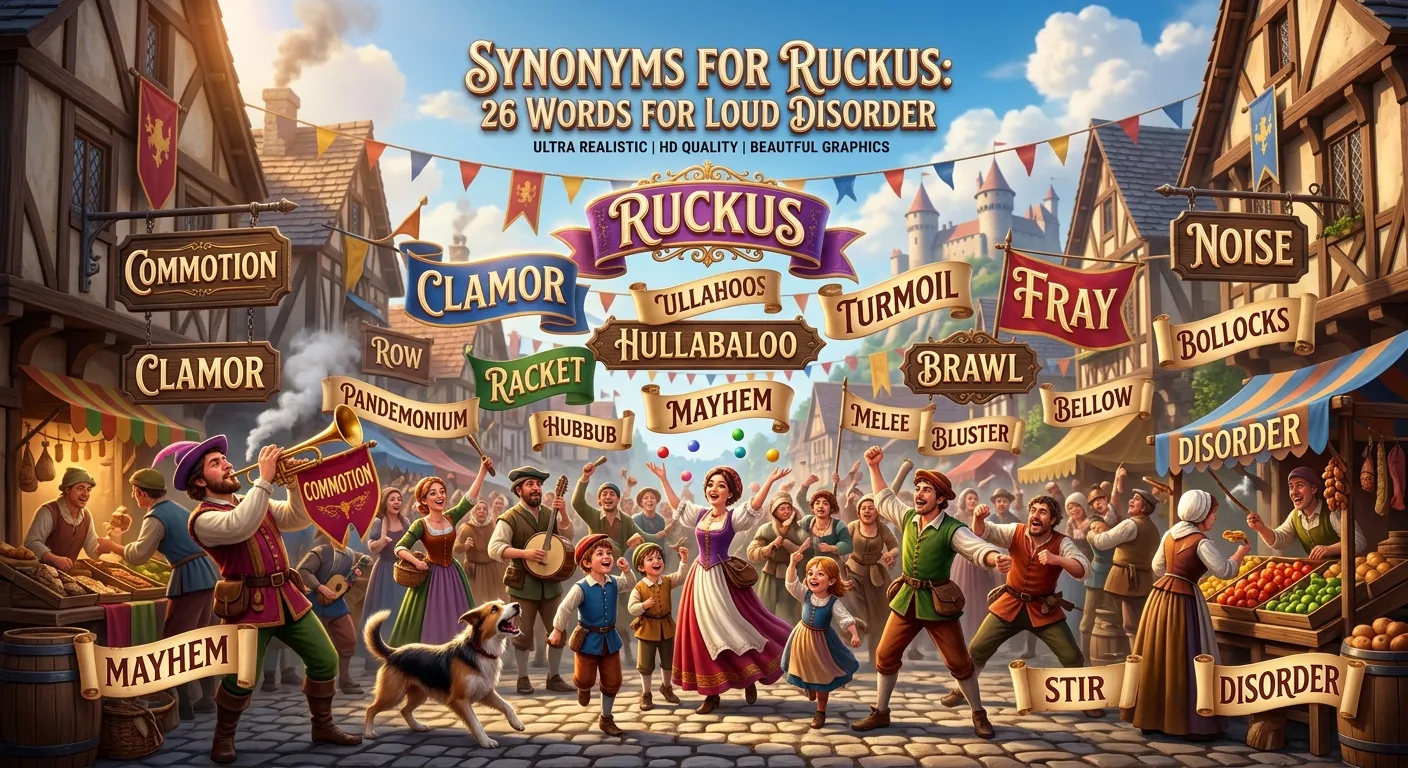
Ruckus (noun): a noisy disturbance, argument, or situation filled with loud and disorderly activity. Their synonyms are commotion, uproar, rumpus, disturbance, hullabaloo, hubbub, fracas, racket
Ruckus means a noisy disturbance or a situation filled with loud activity. Imagine a quiet school corridor suddenly filled with shouting after two students start arguing. Other students gather around, teachers rush over, and the calm hallway becomes loud and chaotic. You could call this a ruckus. The word is common in everyday English because it describes noisy trouble in a short and lively way. Learning synonyms for ruckus helps English learners describe different types and levels of noise, disorder, and conflict more accurately. It also helps content writers avoid repeating the same word. In this article, we will explore the meaning of ruckus and its alternatives through examples, grammar, etymology, pronunciation, and semantic categories so you can choose the right word for each situation.
Meaning of Ruckus
Definition
Ruckus (Noun): a noisy disturbance, argument, or situation involving a lot of loud activity.
Examples
- The children made a ruckus in the classroom.
- A loud ruckus broke out outside the stadium.
Connotative Meaning
(Connotation means the feeling or idea that a word suggests beyond its basic meaning.)
- Positive tone: Usually none, although it can sometimes describe lively, harmless fun.
- Negative tone: Noise, disorder, fighting, or unwanted disturbance.
- Neutral tone: A loud and noticeable disturbance without saying exactly what caused it.
Etymology
Ruckus is a relatively modern informal English word. Its exact origin is uncertain, but it is often connected with American English forms such as ruction, meaning a disturbance or quarrel.
- Old English (450–1100): Ruckus was not part of Old English. English used native words such as tumult or words related to noise and conflict instead.
- Middle English (1100–1500): The modern word ruckus had not yet developed. English vocabulary for disorder continued to grow through native and French influences.
- Modern English (1500–Present): Ruckus appeared in American English in the late 19th century and came to mean a noisy disturbance, commotion, or quarrel.
Pronunciation (IPA)
- IPA: /ˈrʌkəs/
- Syllables: ruck-us
Affixation Pattern of Ruckus
- Root: ruckus a word meaning a noisy disturbance
- Prefix: None
- Suffix: None
Word formations
- ruckus (noun): a noisy disturbance
- ruckuses (plural noun): more than one ruckus
Ruckus does not normally form a large family of standard English words.
26 Synonyms of Ruckus With Meaning & Examples
1. Commotion (Noun)
Meaning: A noisy or confused disturbance caused by many people or events.
Examples:
- A sudden commotion started near the entrance.
- The crowd caused a commotion after the announcement.
2. Uproar (Noun)
Meaning: A loud and often angry reaction from a group of people.
Examples:
- The decision caused an uproar among the fans.
- There was an uproar when the referee ended the match.
3. Rumpus (Noun)
Meaning: A noisy disturbance, especially one caused by children or a group of people.
Examples:
- The kids made a rumpus upstairs.
- Their loud rumpus woke the neighbors.
4. Disturbance (Noun)
Meaning: An event that interrupts peace or quiet.
Examples:
- Police arrived after a disturbance outside the shop.
- The loud music caused a disturbance.
5. Hullabaloo (Noun)
Meaning: A lot of noisy excitement or confusion.
Examples:
- The announcement created a hullabaloo in the office.
- There was a great hullabaloo over the missing cake.
6. Hubbub (Noun)
Meaning: A mixture of loud voices, sounds, and activity.
Examples:
- I could barely hear her over the hubbub.
- The market was full of hubbub.
7. Fracas (Noun)
Meaning: A noisy argument or fight.
Examples:
- A fracas broke out near the restaurant.
- The police stopped the fracas quickly.
8. Tumult (Noun)
Meaning: A state of great confusion, noise, or disorder.
Examples:
- The crowd descended into tumult.
- The sudden news caused tumult in the city.
9. Pandemonium (Noun)
Meaning: Complete confusion and noisy disorder.
Examples:
- Pandemonium broke out when the gates opened.
- The lost child caused pandemonium at the mall.
10. Bedlam (Noun)
Meaning: A place or situation filled with extreme noise and confusion.
Examples:
- The station became bedlam during the delay.
- The classroom was complete bedlam after the bell rang.
11. Racket (Noun)
Meaning: A loud and unpleasant noise.
Examples:
- The construction workers made a terrible racket.
- What is that awful racket outside?
12. Din (Noun)
Meaning: A loud, unpleasant mixture of sounds.
Examples:
- The din of traffic filled the street.
- We could not hear the speaker above the din.
13. Clamor (Noun)
Meaning: A loud mixture of voices or a strong public demand.
Examples:
- The clamor from the crowd grew louder.
- There was a clamor for better services.
14. Row (Noun)
Meaning: A noisy argument or quarrel.
Examples:
- The neighbors had a loud row last night.
- A row broke out over the parking space.
15. Brouhaha (Noun)
Meaning: A noisy or excited reaction to something.
Examples:
- The small mistake caused a huge brouhaha.
- There was a brouhaha over the new rule.
16. Mayhem (Noun)
Meaning: Extreme disorder, confusion, or violence.
Examples:
- The accident caused mayhem on the highway.
- The sudden storm created mayhem at the airport.
17. Chaos (Noun)
Meaning: A state in which everything is confused and disorganized.
Examples:
- The broken water pipe caused chaos in the building.
- The office was in complete chaos after the move.
18. Disorder (Noun)
Meaning: A lack of order that creates confusion or problems.
Examples:
- The protest turned into disorder.
- The manager tried to restore order after the disorder.
19. Fuss (Noun)
Meaning: Too much excitement, worry, or attention about something small.
Examples:
- Don’t make such a fuss over a tiny mistake.
- The children made a fuss when dinner was served late.
20. Stir (Noun)
Meaning: Excitement, concern, or activity caused by something unusual.
Examples:
- The celebrity’s visit caused quite a stir.
- The announcement created a stir online.
21. Ado (Noun)
Meaning: A lot of unnecessary excitement, worry, or activity.
Examples:
- There was much ado over the new policy.
- She left without making any ado.
22. Melee (Noun)
Meaning: A confused fight involving several people.
Examples:
- A melee broke out after the game.
- Security officers struggled to control the melee.
23. Riot (Noun)
Meaning: A violent disturbance involving a large group of people.
Examples:
- The protest turned into a riot.
- Police were sent to control the riot.
24. Outcry (Noun)
Meaning: A strong and often public expression of anger or protest.
Examples:
- The decision caused a public outcry.
- There was an outcry against the proposed changes.
25. Agitation (Noun)
Meaning: A state of worry, excitement, or public protest.
Examples:
- The issue caused considerable agitation.
- Political agitation spread throughout the region.
26. Turmoil (Noun)
Meaning: A state of great confusion, uncertainty, or disorder.
Examples:
- The company went through months of turmoil.
- The sudden change created turmoil within the team.
Usage note: These words are related to ruckus, but they are not perfect substitutes in every sentence. Racket focuses on noise, fracas on a fight, uproar on a loud reaction, and pandemonium on extreme confusion. Choose the synonym that matches the exact situation.
Prototype Meaning
The most typical meaning of ruckus is a loud and noticeable disturbance involving noise, excitement, confusion, or argument. When people hear the word, they often imagine a normally quiet place suddenly becoming noisy because people are shouting, arguing, celebrating, or creating trouble.
Prototype Categorization
The 26 synonyms can be grouped according to the kind of disturbance they describe:
- General noise and disturbance: commotion, disturbance, rumpus, hubbub useful for everyday noisy situations.
- Loud reactions: uproar, clamor, outcry, stir, brouhaha best when people react loudly to an event or decision.
- Noise itself: racket, din focus mainly on unpleasant or overwhelming sound.
- Arguments and fights: fracas, row, melee, riot suitable when conflict or physical confrontation is involved.
- Extreme confusion: pandemonium, bedlam, mayhem, chaos, turmoil stronger words for serious disorder.
- Mild trouble or excitement: fuss, ado, agitation useful when the situation is less severe or when people are making unnecessary noise or concern.
This grouping helps writers select a word based on the cause, intensity, and type of disturbance instead of treating every synonym as identical.
Antonyms of Ruckus
1. Peace (Noun)
A state of calm without conflict or disturbance.
2. Quiet (Noun/Adjective)
A state or condition with little or no noise.
3. Calm (Noun/Adjective)
A peaceful state without excitement or disorder.
4. Silence (Noun)
The absence of sound or noise.
5. Order (Noun)
A well-organized and controlled state.
6. Tranquility (Noun)
A state of peacefulness and calm.
7. Harmony (Noun)
A state in which people or things exist together peacefully.
Short Questions and Answers
Q: What does ruckus mean?
Ruckus means a noisy disturbance, argument, or situation involving loud and disorderly activity.
Q: When should ruckus be used?
Use ruckus in informal English when describing a noisy or disruptive situation, especially one involving several people.
Q: Is ruckus positive or negative?
It is usually negative because it suggests unwanted noise or disorder. However, it can sometimes describe harmless, lively activity in a humorous way.
Q: How is it different from similar words?
Ruckus is a broad informal word. Racket focuses on noise, fracas suggests a fight, uproar often describes a loud reaction, and pandemonium suggests extreme confusion.
Conclusion
Learning ruckus and its synonyms give you more precise ways to describe noise, conflict, excitement, and disorder. Words such as commotion, rumpus, and hubbub work well for general noisy situations, while fracas and melee are better for fights. Stronger words such as mayhem, bedlam, and pandemonium describe more serious confusion.
Understanding these differences can improve both speaking and writing because you can choose a word that matches the exact situation. It also prevents repetitive vocabulary in articles, stories, and everyday conversations. Practice by noticing these words in books, news reports, and conversations. Then create your own sentences with two or three new synonyms each day. Small daily practice can make your vocabulary stronger and your English more confident.
Synonyms for Hybrid: 28 Similar Words

Paul Emerson is a language writer specializing in English synonyms. His work focuses on distinguishing subtle differences in meaning and usage, helping readers select the most precise word for any given context.