Readers: People who read books, articles, newspapers, websites, or other written content and their synonyms are audience, bookworms, learners, subscribers, followers, viewers, readers.
Readers are people who read books, articles, newspapers, websites, stories, or other written material. Imagine someone opening a novel on a quiet evening and becoming so interested that they keep reading for hours. That person is a reader.
The word is widely used because reading is part of education, entertainment, research, news, and everyday communication. However, the best alternative depends on what the person reads and why they read it. Learning synonyms for readers helps English learners describe people more precisely and gives content writers more ways to talk about their target audience. In this article, we will explore the meaning of readers, its related words, examples, grammar, etymology, pronunciation, and semantic categories. This will help you choose the right word for different writing and communication situations.
Meaning of Readers
Definition
Readers (Noun): people who read written or printed material such as books, articles, newspapers, or online content.
Examples
- The magazine has thousands of readers around the world.
- The author writes simple stories for young readers.
Connotative Meaning
(Connotation means the feeling or idea that a word suggests beyond its basic meaning.)
- Positive tone: may suggest knowledge, curiosity, learning, or intellectual interest.
- Negative tone: usually has no negative meaning by itself, although context can suggest a critical attitude.
- Neutral tone: simply refers to people who read something.
Etymology
Readers comes from the verb read, which has very old Germanic roots. The noun reader developed to describe a person who reads.
- Old English (450–1100): Reader comes from Old English rǣdere, meaning a person who reads or interprets written material. It was related to rǣdan, meaning “to advise, interpret, or read.”
- Middle English (1100–1500): Forms such as redere and reader developed as English spelling changed. The word continued to refer to a person who reads.
- Modern English (1500–Present): Reader became widely used for people who read books, newspapers, magazines, and other written works. The plural form readers now also commonly refers to the audience of websites, publications, and digital content.
Pronunciation (IPA)
- IPA: /ˈriː.dərz/
- Syllables: read-ers
Affixation Pattern of Readers
- Root: read to look at and understand written language
- Prefix: None
- Suffix: -er forms a noun for a person who performs an action
- Plural suffix: -s shows more than one person
Word formations
- read (verb): to understand written words
- reader (noun): a person who reads
- readers (noun): more than one reader
- reading (noun/verb): the activity of reading
- readable (adjective): easy or suitable to read
- readership (noun): the group or number of people who read a publication
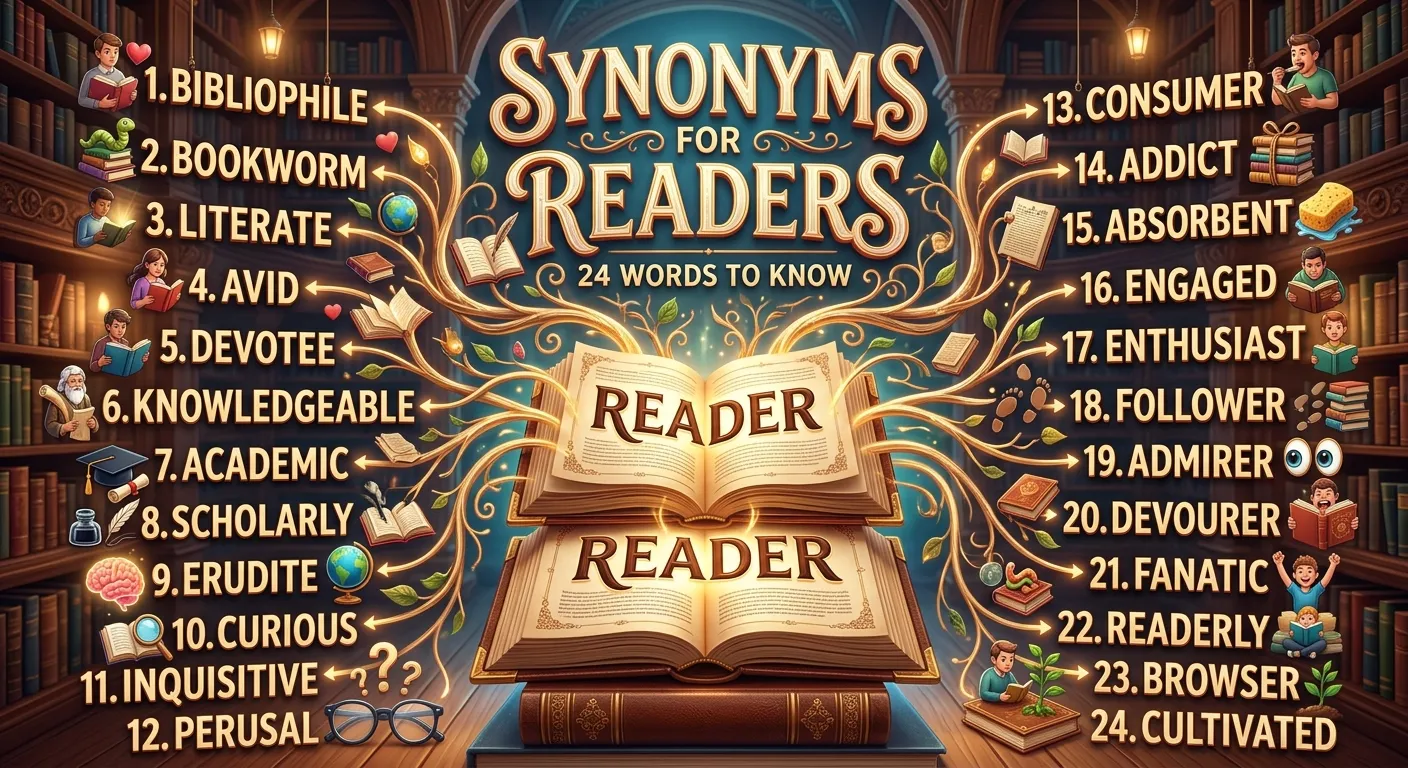
24 Synonyms of Readers With Meaning & Examples
1. Bookworms (Noun)
Meaning: People who enjoy reading books very much.
Examples:
- The library is popular with bookworms.
- These novels are perfect for young bookworms.
2. Audience (Noun)
Meaning: The group of people who read, watch, hear, or follow particular content.
Examples:
- The article was written for a young audience.
- Writers should understand their audience.
3. Readership (Noun)
Meaning: The group or number of people who read a particular publication or type of content.
Examples:
- The newspaper has a large readership.
- The magazine is trying to increase its readership.
4. Subscribers (Noun)
Meaning: People who pay for or sign up to receive a publication or service.
Examples:
- The newsletter has thousands of subscribers.
- New subscribers receive a welcome email.
5. Followers (Noun)
Meaning: People who regularly follow someone’s content, ideas, or publications.
Examples:
- The writer has many online followers.
- Her followers enjoy her weekly articles.
6. Learners (Noun)
Meaning: People who read or study information to gain knowledge or skills.
Examples:
- The guide was created for English learners.
- Young learners enjoyed the reading activity.
7. Students (Noun)
Meaning: People who study a subject, often using written educational material.
Examples:
- The textbook helps students improve their vocabulary.
- The teacher gave the students a short reading task.
8. Scholars (Noun)
Meaning: People who study a subject deeply, especially in an academic setting.
Examples:
- The research attracted scholars from several universities.
- Scholars examined the ancient manuscript.
9. Book Lovers (Noun Phrase)
Meaning: People who have a strong interest in books and reading.
Examples:
- The festival attracted many book lovers.
- Online communities connect book lovers around the world.
10. Bibliophiles (Noun)
Meaning: People who love books and reading.
Examples:
- The rare-book fair attracted bibliophiles.
- Many bibliophiles enjoy collecting old editions.
11. Literature Lovers (Noun Phrase)
Meaning: People who have a strong interest in literary works.
Examples:
- The event brought together literature lovers.
- Literature lovers discussed their favorite novels.
12. Consumers (Noun)
Meaning: People who use or consume a product, service, or form of content.
Examples:
- Digital consumers often read news on their phones.
- Content creators study what consumers want to read.
13. Content Consumers (Noun Phrase)
Meaning: People who regularly read, watch, or listen to published content.
Examples:
- Online content consumers prefer clear information.
- The website attracts millions of content consumers.
14. Visitors (Noun)
Meaning: People who visit a website, page, publication, or physical place.
Examples:
- Website visitors can read the guide for free.
- The article received thousands of visitors this month.
15. Users (Noun)
Meaning: People who use a website, application, platform, or service.
Examples:
- Website users can access the article without registering.
- The platform helps users find useful information.
16. Browsers (Noun)
Meaning: People who look through websites, books, stores, or other sources without necessarily reading everything closely.
Examples:
- Online browsers may quickly scan an article.
- The bookstore attracts many casual browsers.
17. Enthusiasts (Noun)
Meaning: People who have a strong interest in a particular subject or activity.
Examples:
- Language enthusiasts enjoy reading vocabulary guides.
- History enthusiasts often read books about ancient civilizations.
18. Learner-Readers (Noun)
Meaning: People who read mainly to develop knowledge or language skills.
Examples:
- The website provides simple material for learner-readers.
- Learner-readers can build vocabulary through short texts.
19. Book Club Members (Noun Phrase)
Meaning: People who belong to a group that reads and discusses books.
Examples:
- Book club members discussed the novel.
- The author spoke to local book club members.
20. Newspaper Readers (Noun Phrase)
Meaning: People who regularly read newspapers.
Examples:
- Newspaper readers followed the election coverage.
- Younger newspaper readers increasingly use digital editions.
21. Magazine Readers (Noun Phrase)
Meaning: People who regularly read magazines.
Examples:
- Magazine readers enjoyed the new travel section.
- The publication understands what its magazine readers want.
22. Subscribers (Noun)
Meaning: People who regularly receive a publication, newsletter, or digital content after signing up.
Examples:
- Our subscribers receive new articles every Friday.
- The publisher offered a bonus to loyal subscribers.
23. Followers of a Publication (Noun Phrase)
Meaning: People who regularly keep up with a particular publication or source.
Examples:
- Followers of the publication shared the new article.
- The writer listens to followers of the publication.
24. Literary Audience (Noun Phrase)
Meaning: A group of people interested in books, literature, or written works.
Examples:
- The novel attracted a wide literary audience.
- The author writes for a global literary audience.
Usage note: These alternatives are not all exact synonyms. Bookworm suggests a strong love of reading, readership refers to a group or number of readers, and audience is broader. Subscribers and followers describe people connected to a publication or creator, while students and learners focus on the purpose of reading.
Prototype Meaning
The most typical meaning of readers is people who read written content. When people hear the word, they usually imagine individuals reading books, newspapers, articles, magazines, stories, or online content. The word can describe casual readers, regular readers, students, or people who read for work or pleasure.
Prototype Categorization
The related terms can be grouped by the type of reader or reading situation:
- General reading audience: audience, readership, readers useful when discussing a group of people who consume written content.
- People who love books: bookworms, book lovers, bibliophiles, literature lovers best for people with a strong personal interest in books.
- Learning-focused readers: learners, students, scholars, learner-readers suitable when reading is connected with education or research.
- Digital content audiences: subscribers, followers, users, visitors, content consumers useful for websites, newsletters, blogs, and online platforms.
- Specific publication audiences: newspaper readers, magazine readers, book club members, literary audience useful when the type of content or reading community matters.
- Interest-based groups: enthusiasts useful when people read because of a strong interest in a particular subject.
This grouping helps writers choose a more precise term instead of using readers for every situation.
Antonyms of Readers
There is no single exact antonym for readers, because the word describes people rather than an action. However, these terms can express contrasting groups in certain contexts:
1. Nonreaders (Noun)
People who do not read a particular type of written material.
2. Illiterate People (Noun Phrase)
People who cannot read or write, although this term should be used carefully and only when it is factually appropriate.
3. Nonparticipants (Noun)
People who do not take part in a reading activity or program.
4. Listeners (Noun)
People who receive information mainly by hearing rather than reading.
5. Viewers (Noun)
People who receive or consume visual content rather than written content.
Short Questions and Answers
Q: What do readers mean?
Readers means people who read books, articles, newspapers, websites, stories, or other written material.
Q: When should readers be used?
Use readers when talking generally about people who read written content. It works for both physical and digital material.
Q: Is readers positive or negative?
Readers is a neutral word. Its tone depends on the context and the words used around it.
Q: How is it different from similar words?
Readers directly refers to people who read. Bookworms suggests a strong love of books, readership describes a group or number of readers, and audience can include people who consume other forms of content too.
Conclusion
Learning alternatives for readers can make your writing clearer and more specific. Words such as bookworms, bibliophiles, and book lovers describe people who enjoy books, while learners, students, and scholars focus on educational reading. In digital content, terms such as subscribers, followers, visitors, and users may be more suitable depending on the situation.
Understanding these differences helps English learners build a stronger vocabulary and helps writers describe their target groups accurately. It also reduces repetition in articles, reports, educational content, and marketing copy. Instead of replacing readers with any similar-looking word, think about who the people are and why they are reading. Regular vocabulary practice will help you make these choices naturally and communicate with greater confidence.
Synonyms for First Grade: 30 Similar Terms

I am Clara Stephen, passionate about making English simple and easy to understand through clear synonym comparisons, vocabulary guides, and language tips. Through thoughtful, reliable content, I aim to be a trusted guide for anyone looking to expand their English vocabulary.