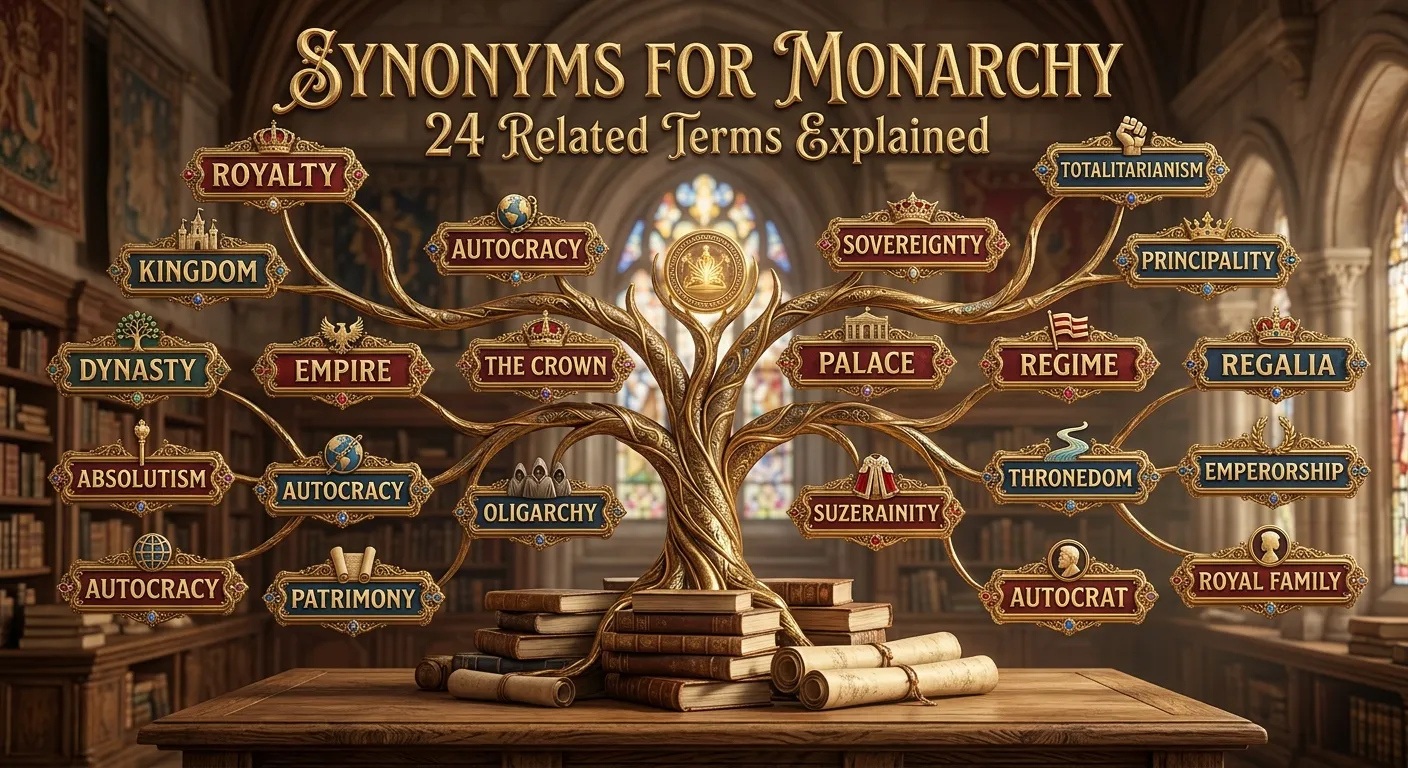
Monarchy means a system of government in which a king or queen is the head of state. Useful related terms include kingship, monarchism, royal rule, hereditary rule, kingdom, autocracy, absolutism, and dynastic rule.
Imagine visiting a country where a king or queen is the official head of state. The position may pass from one generation to the next, and the royal family may have either strong political power or a mostly ceremonial role. This system is called a monarchy. The word is common in history, politics, government, and social studies. Learning synonyms and related terms for monarchy helps English learners understand political writing and describe different forms of royal rule more precisely. It also helps content writers avoid repeating the same word.
However, words connected with monarchy do not always have exactly the same meaning. Some describe the system itself, while others describe royal authority, hereditary rule, or a specific type of monarchy. This article explores the meaning, pronunciation, etymology, word formation, 24 related terms, examples, semantic categories, antonyms, and common questions about monarchy.
Meaning of Monarchy
Definition
Monarchy (Noun): A system of government in which a country has a king or queen as its head of state.
It can also refer to a country or state ruled by a monarch.
Examples
- The country has a monarchy headed by a king.
- The monarchy has existed for hundreds of years.
Connotative Meaning
The word monarchy has a mostly neutral tone, but its feeling can change with context.
- Positive tone: It may suggest tradition, stability, heritage, ceremony, or national identity.
- Negative tone: It may suggest inherited privilege, unequal power, or lack of political choice.
- Neutral tone: It can simply describe a form of government involving a monarch.
(Connotation: the feeling or idea that a word suggests beyond its basic meaning.)
Etymology
The word monarchy comes through Middle English and Old French from Late Latin monarchia, which came from Greek monarkhia, meaning “rule by one.” The Greek word combines monos, meaning “alone” or “single,” and arkhein, meaning “to rule.”
- Old English (450–1100): Monarchy was not yet an English word. Ideas about kingship and royal rule were expressed with words such as cyning (king) and related Germanic terms.
- Middle English (1100–1500): The word entered English through French and Latin influence. Monarchie referred to a kingdom or territory ruled by a monarch.
- Modern English (1500–Present): Monarchy developed into the modern political term for government or a state headed by a monarch. Its first known English use is recorded in the 15th century.
Pronunciation (IPA)
- IPA: /ˈmɒn.ə.ki/ (UK), /ˈmɑː.nɚ.ki/ (US)
- Syllables: mon-ar-chy
Affixation Pattern of Monarchy
- Root: Greek monarch- rule by one
- Prefix: mon- / mono- one or single
- Suffix: -y forms an abstract noun
Word Formations
- Monarch (noun): a king, queen, or other sovereign ruler
- Monarchy (noun): government or a state ruled by a monarch
- Monarchies (plural noun): more than one monarchy
- Monarchical (adjective): relating to a monarch or monarchy
- Monarchic (adjective): relating to or characteristic of monarchy
- Monarchism (noun): support for or belief in monarchy
- Monarchist (noun): a person who supports monarchy
- Monarchically (adverb): in a monarchical way
24 Synonyms of Monarchy With Meaning & Examples
Important: Because monarchy is a specific political system, several terms below are close synonyms or related expressions rather than perfect substitutes. For example, kingship focuses on the position or rule of a king, while autocracy describes concentrated rule by one person and does not necessarily require a monarch.
1. Kingship (Noun)
Meaning: The position, authority, or rule of a king.
Examples:
- His family had held kingship for many generations.
- The ceremony marked the beginning of his kingship.
2. Monarchism (Noun)
Meaning: Support for or belief in government by a monarch.
Examples:
- Monarchism remained strong among some traditional groups.
- The movement promoted monarchism as a form of government.
3. Royal Rule (Noun Phrase)
Meaning: Government or authority exercised by a king or queen.
Examples:
- The country remained under royal rule for centuries.
- The people lived under royal rule before the republic was formed.
4. Monarchical Government (Noun Phrase)
Meaning: A government headed by a monarch.
Examples:
- The nation has a monarchical government.
- A monarchical government may be absolute or constitutional.
5. Monarchical System (Noun Phrase)
Meaning: A political system based on rule by a monarch.
Examples:
- The country replaced its monarchical system with a republic.
- The monarchical system had existed for generations.
6. Hereditary Rule (Noun Phrase)
Meaning: A system in which political leadership passes through a family or dynasty.
Examples:
- The country followed a tradition of hereditary rule.
- Hereditary rule kept the crown within the same family.
7. Dynastic Rule (Noun Phrase)
Meaning: Rule maintained by members of the same ruling family or dynasty.
Examples:
- The region experienced centuries of dynastic rule.
- Dynastic rule continued through several generations.
8. Royal Government (Noun Phrase)
Meaning: A government led or represented by a monarch.
Examples:
- The royal government introduced new reforms.
- Historians studied the policies of the royal government.
9. Kingdom (Noun)
Meaning: A country or territory ruled by a king or queen.
Examples:
- The ancient kingdom covered a large area.
- The kingdom was ruled by a powerful queen.
Usage note: Kingdom usually refers to the country or territory, while monarchy can refer to the system of government.
10. Crown (Noun)
Meaning: A symbolic term for the authority or institution of a monarch.
Examples:
- The Crown approved the appointment.
- He served the Crown for many years.
Usage note: Crown is often used as a metonym for royal authority or the institution of monarchy.
11. Royalty (Noun)
Meaning: Members of a royal family or the status of being royal.
Examples:
- Several members of the royalty attended the event.
- The palace welcomed foreign royalty.
Usage note: Royalty refers mainly to royal people or status, not the political system itself.
12. Sovereign Rule (Noun Phrase)
Meaning: Rule exercised by a sovereign ruler or supreme authority.
Examples:
- The territory remained under sovereign rule.
- The treaty changed the nature of sovereign rule.
13. One-Person Rule (Noun Phrase)
Meaning: A system in which one person holds supreme political authority.
Examples:
- The nation moved away from one-person rule.
- Historians described the period as one-person rule.
14. Autocracy (Noun)
Meaning: A system in which one person has very strong or unlimited political power.
Examples:
- The ruler turned the government into an autocracy.
- The country struggled under an autocracy.
Usage note: Autocracy is broader than monarchy because an autocratic ruler does not have to be a king or queen.
15. Absolutism (Noun)
Meaning: A system in which a ruler has very extensive or unlimited political power.
Examples:
- The king was associated with absolutism.
- The movement challenged royal absolutism.
16. Absolute Rule (Noun Phrase)
Meaning: Government in which one ruler has nearly unlimited power.
Examples:
- The country was once under absolute rule.
- The king exercised absolute rule over the territory.
17. Despotism (Noun)
Meaning: Government by a ruler who uses power in a harsh or oppressive way.
Examples:
- The people rebelled against the ruler’s despotism.
- The historian wrote about years of despotism.
18. Tyranny (Noun)
Meaning: Cruel or unfair rule by a person or small group with great power.
Examples:
- The people fought against the king’s tyranny.
- The revolution ended years of tyranny.
19. Monocracy (Noun)
Meaning: Government or rule by one person.
Examples:
- The political system was described as a form of monocracy.
- The theory focused on monocracy rather than shared government.
20. Caesarism (Noun)
Meaning: A political system in which a powerful leader has strong personal control over the state.
Examples:
- Historians used the term Caesarism to describe the ruler’s power.
- The writer compared the regime with Caesarism.
21. Czarism (Noun)
Meaning: A system of government associated with rule by a czar or tsar.
Examples:
- The revolution challenged czarism in Russia.
- Books about Russian history often discuss czarism.
22. Sultanate (Noun)
Meaning: A country or state ruled by a sultan.
Examples:
- The historic sultanate controlled important trade routes.
- The sultanate was governed by a hereditary ruler.
Usage note: A sultanate is a specific type of monarchy or monarchic state, not a general synonym for every monarchy.
23. Emirate (Noun)
Meaning: A territory or state ruled by an emir.
Examples:
- The emirate developed into a powerful regional state.
- The historic emirate was ruled by a hereditary leader.
Usage note: Like sultanate, emirate names a particular type of territory or state rather than monarchy in general.
24. Royal Dynasty (Noun Phrase)
Meaning: A succession of rulers from the same royal family.
Examples:
- The royal dynasty ruled the region for centuries.
- The museum displays objects from the ancient royal dynasty.
Usage note: A dynasty is a ruling family or succession, while a monarchy is the political system.
Prototype Meaning
The most typical meaning of monarchy is a system of government with a king or queen as the head of state. When people hear the word, they often imagine a royal family, a crown, a palace, and a position that may be inherited. Modern monarchies can differ greatly. In some, the monarch has little political power, while in others, the ruler may have much greater authority.
Prototype Categorization
The 24 terms can be grouped according to the aspect of monarchy they describe:
- Direct monarchy terms: monarchism, monarchical government, monarchical system, royal government these are closest to the general idea of monarchy.
- Royal authority and leadership: kingship, royal rule, sovereign rule, crown, royalty this focus on the monarch, royal authority, or institution.
- Inherited rule: hereditary rule, dynastic rule, royal dynasty, kingdom these emphasize succession, royal families, or the territory ruled by a monarch.
- One-person or concentrated rule: autocracy, absolutism, absolute rule, monocracy these focus on concentrated political power and may apply outside monarchy.
- Harsh or oppressive rule: despotism, tyranny these describe the way power is exercised and usually carry a negative meaning.
- Specific royal systems or historical forms: Caesarism, czarism, sultanate, emirate these refer to particular forms, rulers, or historical traditions.
This grouping helps writers choose the most accurate term. For example, kingship works when discussing a king’s position, kingdom when discussing a territory, and autocracy when discussing concentrated power.
Antonyms of Monarchy
- Republic (Noun): A system of government in which the head of state is not a hereditary monarch.
- Democracy (Noun): A system in which political power is exercised by the people, usually through elected representatives.
- Self-government (Noun): The ability of a people or country to govern itself.
- Self-rule (Noun): Control of government by the people or community itself.
- Elective government (Noun Phrase): Government in which leaders are chosen through elections.
- Popular sovereignty (Noun Phrase): The principle that political authority comes from the people.
Short Questions and Answers
Q: What does monarchy mean?
A: Monarchy means a system of government in which a country has a king or queen as its head of state. It can also mean a country governed by a monarch.
Q: When should monarchy be used?
A: Use monarchy when talking about a form of government or a country ruled by a monarch.
Q: Is monarchy positive or negative?
A: Monarchy is neutral. Its meaning can seem positive or negative depending on the writer’s view and the context.
Q: How is it different from similar words?
A: Monarchy names a system of government. Kingship refers to the position or rule of a king, kingdom usually refers to a country ruled by a king or queen, autocracy focuses on one person’s political power, and dynasty refers to a ruling family or succession.
Conclusion
Learning monarchy and its related terms help English learners understand political and historical writing with greater confidence. Words such as kingship, monarchism, royal rule, hereditary rule, dynastic rule, kingdom, autocracy, and absolutism describe different parts or forms of royal government. However, these terms are not always exact synonyms. Knowing the difference helps writers choose words that match their meaning.
You can use kingship when discussing a king’s position, kingdom for a royal territory, and monarchism for support of monarchy. Understanding these distinctions also reduces repetition and makes writing more precise. Try learning a few political vocabulary words each day and use them in your own sentences. Regular practice will strengthen your vocabulary, improve your writing and speaking, and build confidence in English.
Synonyms for Revamp: 22 Fresh Alternatives

Rose Vault is an English language author who specializes in synonyms, word nuances, and vocabulary building. She creates clear, well-researched content that helps readers express themselves with precision and confidence. Her goal is to make vocabulary learning simple, accurate, and accessible for everyone.