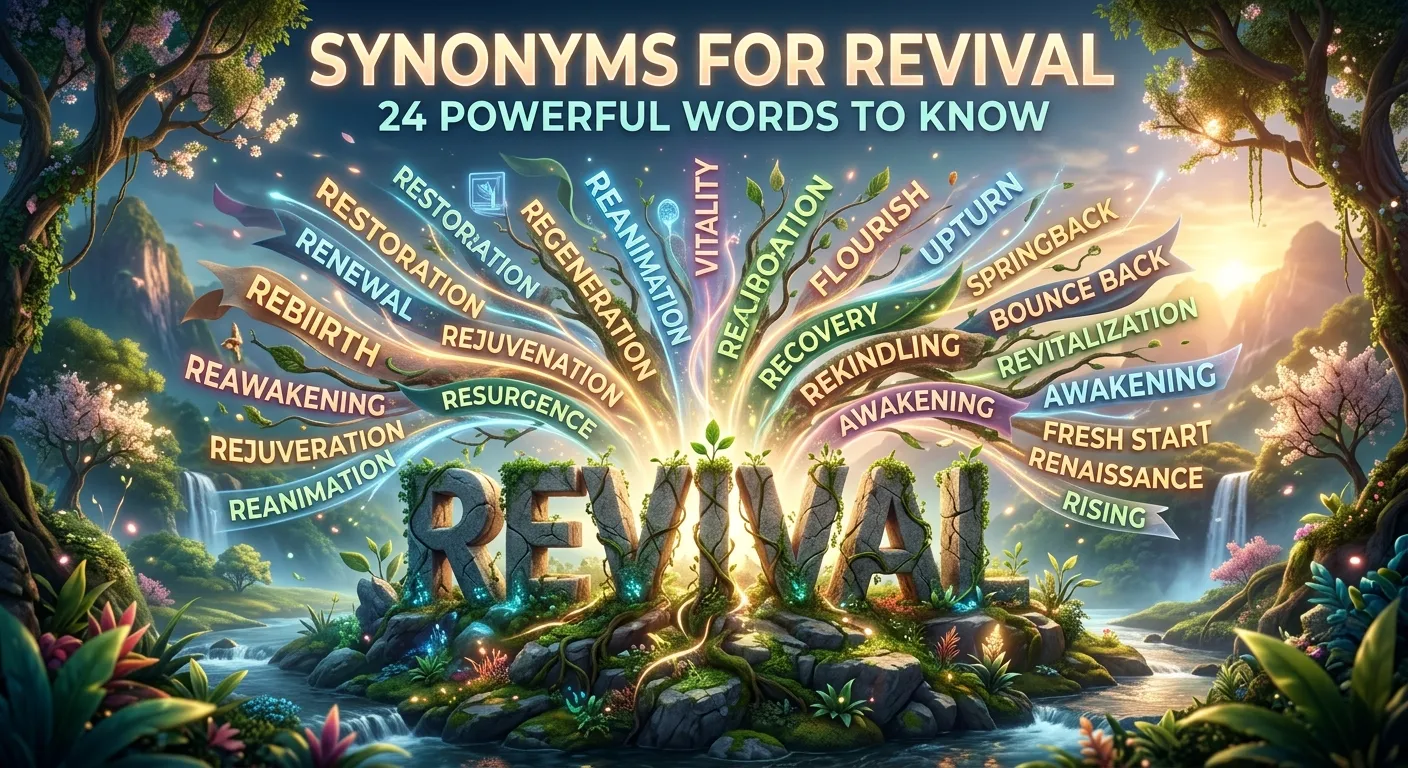
Renewal, resurgence, rebirth, renaissance, rejuvenation, restoration, revitalization, comeback, and reawakening are useful synonyms for revival, depending on the context.
Revival means the return of something to life, strength, activity, or popularity. Imagine an old theater in a small town that has been closed for years. One day, it opens again with new shows, fresh seats, and a new audience. This is a revival. The word is common in many areas of English, from culture and business to health, religion, and nature.
Learning synonyms for revival helps English learners choose words that express the exact idea they want. It also helps writers avoid using the same word again and again. In this article, we will explore the meaning of revival, its synonyms, examples, grammar, pronunciation, word history, and semantic categories. By the end, you will know which alternative works best for different situations.
Meaning of Revival
Definition
Revival (noun): The process of becoming active, strong, popular, or alive again after a period of decline or inactivity.
Examples
- The theater enjoyed a revival after many years of closure.
- There has been a revival of interest in traditional crafts.
Connotative Meaning
Connotation: The feelings or ideas that a word suggests beyond its basic meaning.
- Positive tone: Revival often suggests hope, renewal, growth, and a fresh beginning.
- Negative tone: In some contexts, it may suggest that something had become weak, forgotten, or outdated.
- Neutral tone: It can simply describe the return of an activity, trend, or condition.
Etymology
The word revival comes from revive, which ultimately comes from Latin revivere, meaning “to live again.” It developed through French and entered English as a word connected with returning to life or activity.
- Old English (450–1100): The modern word revival was not yet established, although Old English had words and expressions related to living, life, and becoming alive again.
- Middle English (1100–1500): Forms related to revive entered English through French and Latin influence. The idea of living again became associated with returning to life or strength.
- Modern English (1500–Present): Revival developed as a noun meaning a return to life, activity, popularity, or strength. Its meaning later expanded to areas such as religion, fashion, music, theater, and business.
Pronunciation (IPA)
- IPA: /rɪˈvaɪ.vəl/
- Syllables: re-viv-al
Affixation Pattern of Revival
- Root: viv / vive : related to “live” or “life”
- Prefix: re-: means “again” or “back”
- Suffix: -al: forms a noun related to an action, process, or result
- Word formations:
- revive: verb
- revival: noun
- revived: adjective / past participle
- reviving: adjective / present participle
- reviver: noun
- revivalist: noun
- revivalism: noun
24 Synonyms of Revival With Meaning & Examples
1. Renewal (Noun)
Meaning: The process of making something fresh, active, or strong again.
Examples:
- The city began a renewal of its old neighborhoods.
- The garden showed signs of renewal after the rain.
2. Resurgence (Noun)
Meaning: A sudden or strong return of something after a period of decline.
Examples:
- There has been a resurgence of interest in folk music.
- The brand experienced a resurgence after its new campaign.
3. Rebirth (Noun)
Meaning: A complete return to life, activity, or popularity.
Examples:
- The project marked the rebirth of the old community center.
- The artist’s new album brought a rebirth to her career.
4. Renaissance (Noun)
Meaning: A period of renewed interest, growth, or cultural activity.
Examples:
- The city is experiencing a cultural renaissance.
- Digital art has gone through a renaissance in recent years.
5. Rejuvenation (Noun)
Meaning: The process of becoming fresh, energetic, or active again.
Examples:
- The park received a complete rejuvenation.
- A short break gave her a sense of rejuvenation.
6. Restoration (Noun)
Meaning: The process of returning something to its former condition or strength.
Examples:
- The restoration of the historic building took two years.
- The treatment helped with the restoration of his strength.
7. Revitalization (Noun)
Meaning: The process of giving new life, energy, or strength to something.
Examples:
- The project supports the revitalization of the downtown area.
- The company needs revitalization after several difficult years.
8. Regeneration (Noun)
Meaning: The process of growing again or becoming active and healthy again.
Examples:
- The forest showed natural regeneration after the fire.
- The program supports the regeneration of damaged land.
9. Reawakening (Noun)
Meaning: A return of interest, awareness, emotion, or activity.
Examples:
- The book caused a reawakening of public interest in history.
- Spring brought a reawakening of life to the village.
10. Resuscitation (Noun)
Meaning: The act of bringing someone or something back to life or activity.
Examples:
- The patient required immediate resuscitation.
- The organization needed financial resuscitation after years of losses.
11. Recovery (Noun)
Meaning: The process of returning to a normal or healthy condition after difficulty.
Examples:
- The business is showing signs of recovery.
- Her quick recovery surprised everyone.
12. Comeback (Noun)
Meaning: A return to success, popularity, or public attention.
Examples:
- The singer made a successful comeback.
- The old fashion trend is making a comeback.
13. Return (Noun)
Meaning: The act of coming back or becoming active again.
Examples:
- The return of live performances attracted large crowds.
- Fans celebrated the return of the popular show.
14. Resurrection (Noun)
Meaning: A return to life, use, importance, or popularity after disappearance or decline.
Examples:
- The designer gave the old style a resurrection.
- The film received a surprising resurrection decades later.
15. Reappearance (Noun)
Meaning: The act of appearing again after being absent.
Examples:
- The reappearance of the bird excited local researchers.
- The character’s reappearance surprised the audience.
16. Reemergence (Noun)
Meaning: The return of something after it has been absent or less noticeable.
Examples:
- The reemergence of traditional art has attracted young people.
- Scientists are studying the reemergence of the species.
17. Reinstatement (Noun)
Meaning: The act of restoring someone or something to a former position or condition.
Examples:
- The worker received reinstatement after the investigation.
- The policy’s reinstatement was announced on Monday.
18. Reinvigoration (Noun)
Meaning: The process of giving new energy, strength, or enthusiasm to something.
Examples:
- The new leader brought reinvigoration to the organization.
- The team needed reinvigoration after a poor season.
19. Reanimation (Noun)
Meaning: The act of bringing something back to life or activity.
Examples:
- The story describes the reanimation of an ancient creature.
- The campaign led to the reanimation of public interest.
20. Renewal of Interest (Noun Phrase)
Meaning: A fresh increase in people’s attention toward something.
Examples:
- The documentary caused a renewal of interest in local history.
- The exhibition brought a renewal of interest in the artist’s work.
21. Revivalism (Noun)
Meaning: Strong support for bringing back older beliefs, styles, traditions, or practices.
Examples:
- The movement encouraged cultural revivalism.
- Architectural revivalism became popular in the region.
22. Restoration of Popularity (Noun Phrase)
Meaning: The process of becoming popular again after losing attention.
Examples:
- The singer enjoyed a restoration of popularity after the award.
- The product experienced a restoration of popularity among young buyers.
23. Rebirth of Interest (Noun Phrase)
Meaning: A fresh and strong interest in something that had been neglected.
Examples:
- The museum sparked a rebirth of interest in ancient art.
- The festival created a rebirth of interest in folk traditions.
24. Reinvigoration (Noun)
Meaning: The act of making something energetic, lively, or effective again.
Examples:
- The new design brought reinvigoration to the website.
- Fresh ideas led to the reinvigoration of the project.
Prototype Meaning
The most typical meaning of revival is the return of something after it has become weak, inactive, forgotten, or less popular. When people hear the word, they often imagine something becoming active or successful again. It may refer to a person recovering, an old fashion becoming popular, a business improving, or a cultural tradition returning.
Prototype Categorization
The 24 synonyms can be grouped by the type of “return” they describe:
- General return or renewal: renewal, return, rebirth, resurgence useful when something becomes active or important again.
- Growth and fresh energy: rejuvenation, revitalization, regeneration, reinvigoration best when something gains new strength or energy.
- Culture and popularity: renaissance, revivalism, comeback useful for art, fashion, music, traditions, and public trends.
- Life and medical contexts: resuscitation, reanimation, resurrection, recovery best when the focus is life, health, or a return from a serious condition.
- Appearance and presence: reappearance, reemergence useful when something becomes visible or present again.
- Restoring a former state: restoration, reinstatement best when something is returned to an earlier condition, role, or position.
- Interest and attention: renewal of interest, rebirth of interest, restoration of popularity useful when people begin paying attention to something again.
This categorization helps writers select a synonym based on what is returning and how it is returning, rather than replacing revival with a random similar word.
Antonyms of Revival
Decline (Noun)
A decrease in strength, activity, quality, or popularity.
Deterioration (Noun)
The process of becoming worse or weaker.
Decay (Noun)
The gradual loss of strength, quality, or condition.
Decline (Verb)
To become weaker, less successful, or less popular.
Extinction (Noun)
The complete disappearance of something.
Stagnation (Noun)
A state in which there is little or no growth, change, or activity.
Demise (Noun)
The end or failure of something.
Abandonment (Noun)
The act of leaving or giving up something.
Short Questions and Answers
Q: What does revival mean?
A: Revival means the return of life, strength, activity, popularity, or interest after a period of decline or inactivity.
Q: When should revival be used?
A: Use revival when something returns after becoming weak, inactive, forgotten, or less popular. It works in contexts such as culture, business, religion, health, fashion, and entertainment.
Q: Is revival positive or negative?
A: Revival is usually positive because it suggests a return of life, energy, success, or interest. However, its exact tone depends on the context.
Q: How is it different from similar words?
A: Revival is a broad term. Resurgence often suggests a strong return, restoration focuses on returning something to an earlier condition, renaissance suggests renewed cultural or intellectual activity, and comeback often describes a return to popularity or success.
Conclusion
Learning revival and its synonyms can make your English more precise and flexible. Words such as renewal, resurgence, rebirth, restoration, renaissance, rejuvenation, revitalization, and comeback may express similar ideas, but each has its own use and tone. Choosing the right synonym helps you explain whether something has become popular again, regained strength, returned to an earlier state, or simply appeared again.
This skill is useful for students, teachers, content writers, and everyday speakers. It also helps you avoid repeating the same word in your writing. Try learning two or three new synonyms each day and use them in your own sentences. With regular practice, your vocabulary will grow, your writing will become stronger, and your confidence in English will improve.
Synonyms for bait: 22 Similar Words Explained

Paul Emerson is a language writer specializing in English synonyms. His work focuses on distinguishing subtle differences in meaning and usage, helping readers select the most precise word for any given context.