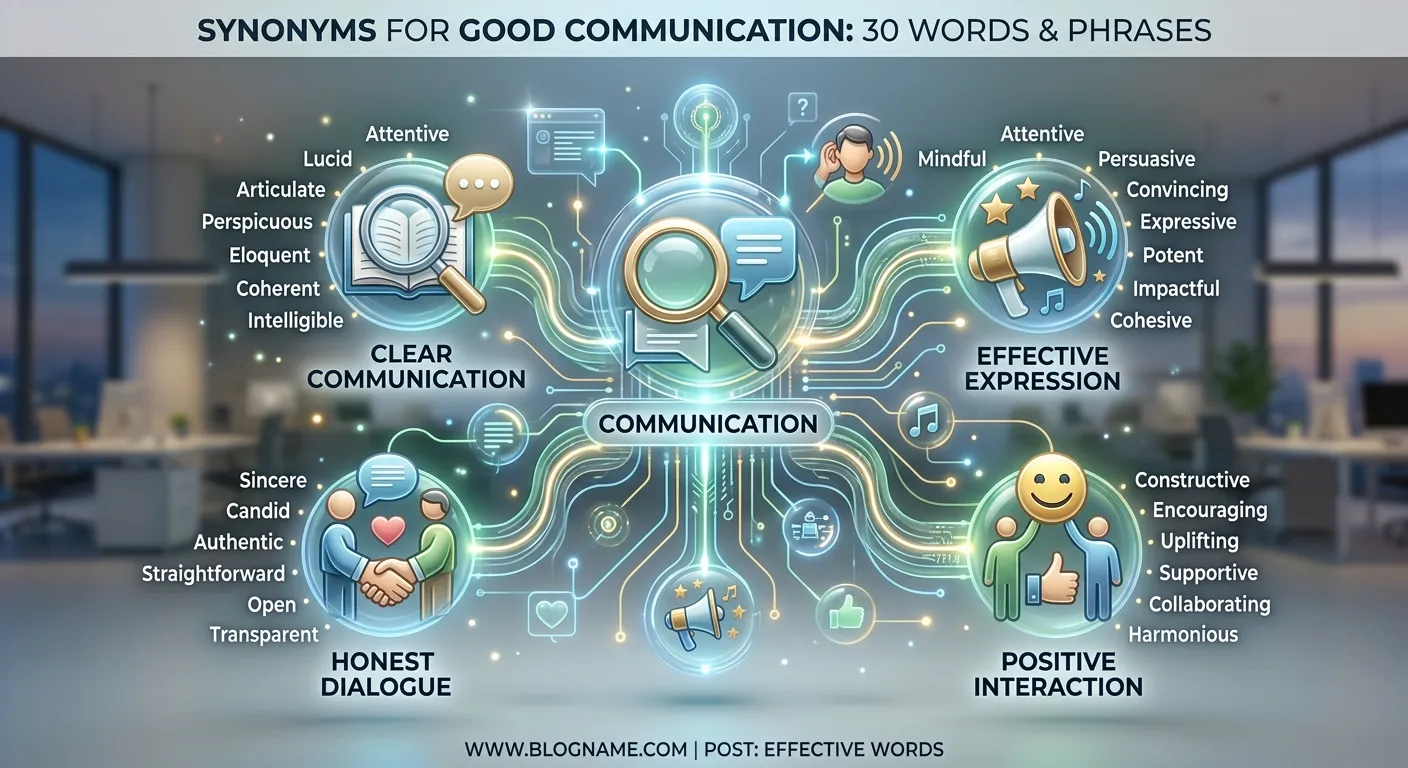
Good communication: The clear, effective, and respectful exchange of ideas, information, or feelings and their synonyms are effective communication, clear communication, open communication, strong communication, healthy communication.
Good communication means sharing ideas, information, and feelings in a clear and effective way. For example, when a teacher explains a difficult lesson in simple words and listens to students’ questions, that is good communication. The phrase is commonly used in education, workplaces, relationships, and everyday life because clear communication helps people understand one another and avoid confusion.
Learning synonyms for good communication can help English learners build a stronger vocabulary and help writers avoid repeating the same phrase. Different alternatives can also show different qualities, such as clarity, openness, respect, or teamwork. In this article, we will explore the meaning of good communication, useful alternatives, examples, grammar, word history, pronunciation, word formation, and semantic categories. This will help you choose the best expression for each situation.
Meaning of Good Communication
Definition
Good communication (noun phrase): The clear, effective, and respectful exchange of ideas, information, or feelings between people.
Examples
- Good communication helps teams solve problems quickly.
- Teachers need good communication skills to explain ideas clearly.
Connotative Meaning
Connotation: The feeling or idea that a word or phrase suggests beyond its basic meaning.
- Positive tone: Good communication suggests clarity, trust, cooperation, respect, and understanding.
- Negative tone: The phrase itself is positive, but poor communication can suggest confusion, conflict, or misunderstanding.
- Neutral tone: It can simply describe communication that works well and achieves its purpose.
Etymology
The phrase good communication combines the adjective good with the noun communication.
- Old English (450–1100): Good comes from Old English gōd, meaning “having the right qualities” or “desirable.” The word communication was not part of Old English in its modern form.
- Middle English (1100–1500): Good continued to develop in Middle English, while communication entered English through Anglo-French and Old French from Latin roots.
- Modern English (1500–Present): Communication developed from Latin communicare, meaning “to share” or “make common.” Today, good communication commonly refers to communication that is clear, effective, respectful, and easy to understand.
Pronunciation (IPA)
- IPA: /ɡʊd kəˌmjuːnɪˈkeɪʃən/
- Syllables: good com-mu-ni-ca-tion
Affixation Pattern of Good Communication
Because good communication is a phrase rather than a single word, its parts have separate word formations.
- Root of good: Old English gōd
- Prefix: None
- Suffix: None in good
Communication:
- Root: Latin communic- meaning “share” or “make common”
- Prefix: None
- Suffix: -ation, forming a noun related to an action or process
Word formations:
- Good: adjective
- Goodness: noun
- Better: comparative adjective/adverb
- Best: superlative adjective/adverb
- Communicate: verb
- Communication: noun
- Communicative: adjective
- Communicator: noun
- Communicatively: adverb
- Miscommunication: noun
- Communicational: adjective
30 Synonyms of Good Communication with Meaning & Examples
1. Effective Communication (Noun Phrase)
Meaning: Communication that successfully delivers a message and creates understanding.
Examples:
- Effective communication is important in every workplace.
- Good leaders use effective communication to guide their teams.
2. Clear Communication (Noun Phrase)
Meaning: Communication that is easy to understand and does not cause confusion.
Examples:
- Clear communication can prevent mistakes.
- The manager used clear communication when explaining the new policy.
3. Open Communication (Noun Phrase)
Meaning: Communication in which people feel free to share ideas, concerns, and opinions.
Examples:
- Open communication builds trust between employees and managers.
- Parents should encourage open communication with their children.
4. Strong Communication (Noun Phrase)
Meaning: Communication that is effective, confident, and useful.
Examples:
- Strong communication is an important leadership skill.
- Her strong communication skills helped the team succeed.
5. Positive Communication (Noun Phrase)
Meaning: Communication that uses a constructive, respectful, and encouraging approach.
Examples:
- Positive communication can improve workplace relationships.
- Teachers should use positive communication with their students.
6. Direct Communication (Noun Phrase)
Meaning: Communication that expresses a message clearly and without unnecessary indirect language.
Examples:
- Direct communication can save time.
- He prefers direct communication when discussing problems.
7. Honest Communication (Noun Phrase)
Meaning: Communication that expresses information and feelings truthfully.
Examples:
- Honest communication is important in close relationships.
- Their honest communication helped them solve the issue.
8. Respectful Communication (Noun Phrase)
Meaning: Communication that shows consideration for other people’s views and feelings.
Examples:
- Respectful communication helps people discuss difficult topics.
- The team uses respectful communication during disagreements.
9. Two-Way Communication (Noun Phrase)
Meaning: Communication in which both sides share information and respond to each other.
Examples:
- Two-way communication encourages students to ask questions.
- Good meetings require two-way communication.
10. Constructive Communication (Noun Phrase)
Meaning: Communication that helps solve problems or improve a situation.
Examples:
- Constructive communication can turn criticism into useful feedback.
- The manager encouraged constructive communication during the meeting.
11. Meaningful Communication (Noun Phrase)
Meaning: Communication that has value, purpose, or emotional importance.
Examples:
- Meaningful communication strengthens relationships.
- We had a meaningful communication about our future goals.
12. Smooth Communication (Noun Phrase)
Meaning: Communication that happens easily without major confusion or difficulty.
Examples:
- Good planning led to smooth communication between the departments.
- Shared notes helped ensure smooth communication.
13. Clear Dialogue (Noun Phrase)
Meaning: An exchange of ideas in which both sides understand the message well.
Examples:
- Clear dialogue helped the two groups reach an agreement.
- The meeting encouraged clear dialogue between teachers and parents.
14. Open Dialogue (Noun Phrase)
Meaning: A free and honest exchange of ideas and opinions.
Examples:
- The organization encourages open dialogue among employees.
- Open dialogue can help resolve disagreements.
15. Healthy Communication (Noun Phrase)
Meaning: Communication that supports understanding, respect, trust, and healthy relationships.
Examples:
- Healthy communication is important in every relationship.
- The workshop teaches couples about healthy communication.
16. Good Dialogue (Noun Phrase)
Meaning: A useful and effective exchange between people.
Examples:
- The meeting created good dialogue between the two groups.
- Good dialogue can help people understand different views.
17. Fluent Communication (Noun Phrase)
Meaning: Communication that happens smoothly and with ease.
Examples:
- Language practice can improve fluent communication.
- The course helps students develop fluent communication skills.
18. Concise Communication (Noun Phrase)
Meaning: Communication that gives the needed information in a short and clear way.
Examples:
- Concise communication is useful in professional emails.
- The report uses concise communication to explain the results.
19. Precise Communication (Noun Phrase)
Meaning: Communication that uses exact and accurate words.
Examples:
- Technical work requires precise communication.
- Precise communication reduces the chance of errors.
20. Transparent Communication (Noun Phrase)
Meaning: Communication that is open, clear, and not designed to hide important information.
Examples:
- Transparent communication can build trust with customers.
- The company promised transparent communication during the change.
21. Collaborative Communication (Noun Phrase)
Meaning: Communication in which people exchange ideas to achieve a shared goal.
Examples:
- Collaborative communication helps teams work together.
- The project succeeded because of collaborative communication.
22. Assertive Communication (Noun Phrase)
Meaning: Communication that expresses needs or opinions clearly while respecting others.
Examples:
- Assertive communication helps employees express their concerns.
- She used assertive communication during the discussion.
23. Empathetic Communication (Noun Phrase)
Meaning: Communication that shows understanding of another person’s feelings or point of view.
Examples:
- Empathetic communication can comfort someone who is upset.
- Nurses need strong empathetic communication skills.
24. Active Communication (Noun Phrase)
Meaning: Communication that involves active participation and attention from the people involved.
Examples:
- Active communication keeps team members informed.
- The class encourages active communication between students.
25. Productive Communication (Noun Phrase)
Meaning: Communication that leads to useful progress or results.
Examples:
- The meeting became productive communication between the departments.
- Productive communication helped the team find a solution.
26. Efficient Communication (Noun Phrase)
Meaning: Communication that delivers information effectively without wasting time or effort.
Examples:
- Email can support efficient communication within a large company.
- Efficient communication helps teams complete tasks faster.
27. Respectful Dialogue (Noun Phrase)
Meaning: An exchange of ideas in which people treat each other with respect.
Examples:
- Respectful dialogue is important during disagreements.
- The debate showed how respectful dialogue can work.
28. Effective Dialogue (Noun Phrase)
Meaning: A conversation that successfully creates understanding or progress.
Examples:
- The meeting encouraged effective dialogue between both sides.
- Effective dialogue helped resolve the conflict.
29. Strong Interpersonal Communication (Noun Phrase)
Meaning: The ability to communicate well with other people in social or professional situations.
Examples:
- Managers need strong interpersonal communication skills.
- Strong interpersonal communication can improve teamwork.
30. Good Rapport (Noun Phrase)
Meaning: A friendly and trusting relationship that makes communication easier.
Examples:
- The teacher developed good rapport with her students.
- Good rapport made communication between the coach and players easier.
Prototype Meaning
The most typical meaning of good communication is the clear and effective exchange of information between people. When people hear this phrase, they usually imagine someone who speaks clearly, listens carefully, responds appropriately, and respects the other person’s point of view. Good communication is not only about speaking well; it also includes listening, understanding, asking questions, and choosing the right words.
Prototype Categorization
The 30 alternatives can be grouped into useful semantic categories:
- Clarity and accuracy: clear communication, clear dialogue, concise communication, precise communication best when the focus is on easy, exact, and understandable messages.
- Openness and honesty: open communication, open dialogue, honest communication, transparent communication useful when people need to share ideas, concerns, or information freely.
- Respect and relationships: respectful communication, respectful dialogue, healthy communication, empathetic communication, good rapport best for relationships and situations where emotions matter.
- Effectiveness and results: effective communication, effective dialogue, productive communication, efficient communication useful in professional, academic, and goal-focused contexts.
- Teamwork and participation: two-way communication, collaborative communication, active communication best when several people need to exchange ideas and work together.
- Confidence and directness: strong communication, direct communication, assertive communication useful when communication needs to be confident, clear, and purposeful.
- Conversation and interaction: good dialogue, smooth communication, fluent communication useful when describing the flow and quality of conversations.
This categorization helps writers choose the most precise alternative instead of replacing good communication with a phrase that does not fit the context.
Antonyms of Good Communication
1. Poor Communication (Noun Phrase)
Meaning: Communication that fails to create clear understanding.
2. Ineffective Communication (Noun Phrase)
Meaning: Communication that does not achieve its intended purpose.
3. Miscommunication (Noun)
Meaning: A failure to understand a message correctly.
4. Unclear Communication (Noun Phrase)
Meaning: Communication that is difficult to understand.
5. Broken Communication (Noun Phrase)
Meaning: Communication that has stopped or is no longer working well.
6. One-Way Communication (Noun Phrase)
Meaning: Communication in which information mainly moves in one direction.
7. Confusing Communication (Noun Phrase)
Meaning: Communication that makes a message difficult to understand.
8. Communication Breakdown (Noun Phrase)
Meaning: A situation in which people can no longer communicate effectively.
Short Questions and Answers
Q: What does good communication mean?
A: Good communication means sharing information, ideas, or feelings clearly, effectively, and respectfully.
Q: When should good communication be used?
A: Use good communication when talking about communication that helps people understand each other, work together, solve problems, or build relationships.
Q: Is good communication positive or negative?
A: Good communication has a positive meaning. It suggests clarity, understanding, respect, cooperation, and effective interaction.
Q: How is it different from similar words?
A: Good communication is a broad phrase. Clear communication focuses on understanding, open communication focuses on sharing freely, assertive communication focuses on expressing needs confidently, and empathetic communication focuses on understanding feelings.
Conclusion
Learning good communication and its alternatives can make your English more precise and natural. The phrase covers many useful ideas, including clarity, respect, openness, teamwork, and understanding. Words and phrases such as effective communication, clear communication, open dialogue, respectful communication, and assertive communication allow you to describe these qualities more precisely.
Using different expressions also prevents repetition in essays, articles, emails, and everyday conversations. For English learners, knowing these alternatives can make both speaking and writing more confident. The key is to choose a phrase that matches your exact meaning rather than using every synonym in the same way. Try learning two or three alternatives each day and write your own sentences with them. With regular practice, your vocabulary will become richer, clearer, and more flexible.
Synonyms for ensure resume: 30 Strong Alternatives

I’m Leo Jackson, an English writer with a soft spot for the peculiarities of language and vocabulary. Specializes in exploring the nuances of English synonyms, helping students, writers, and professionals choose the right word with confidence. My guides combine careful research with clear, practical explanations.