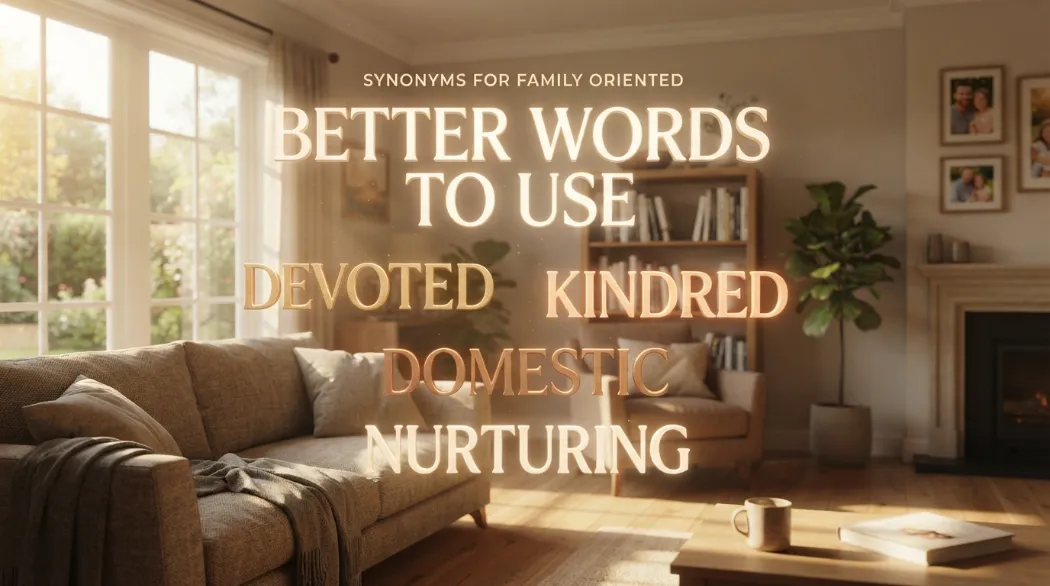
Family-centered, family-minded, family-focused, family-first, home-loving, familial, kin-oriented, and devoted to family are useful alternatives to family oriented, depending on the context.
Family oriented describes a person, lifestyle, activity, or environment that gives importance to family and family relationships. Imagine someone who plans weekends around their children, enjoys family gatherings, and makes time for relatives even during a busy week. You might describe that person as family oriented. The phrase is common because it gives a simple way to express strong family values and priorities.
Learning synonyms for family oriented helps English learners express these ideas with more variety and accuracy. It also helps content writers choose words that match the tone of a sentence. In this article, we will explore the meaning, synonyms, examples, grammar, history, pronunciation, and semantic categories of family oriented so you can use the phrase and its alternatives with confidence.
Meaning of Family Oriented
Definition
Family oriented (adjective): Giving strong importance to family relationships, family activities, and family needs.
Examples
- She is very family oriented and spends most weekends with her parents and children.
- He wants to build a family-oriented life in a quiet community.
Connotative Meaning
Connotation means the feeling or idea that a word suggests beyond its basic meaning.
- Positive tone: Caring, loyal, supportive, loving, and committed to family.
- Negative tone: It can sometimes suggest that a person gives too much attention to family or avoids activities outside family life.
- Neutral tone: Simply describes a person, place, activity, or lifestyle that places importance on family.
Etymology
The phrase family oriented combines the words family and oriented.
- Old English (450–1100): Family ultimately traces to Latin familia, meaning a household or group of household members. English received the word through French.
- Middle English (1100–1500): Forms related to family developed in English with the sense of a household, relatives, or people connected by kinship.
- Modern English (1500–Present): Oriented comes from orient, originally connected with the east or the direction of sunrise. Over time, orient developed the figurative meaning “to direct” or “to adjust toward.” Family-oriented therefore means directed toward or centered on family.
The adjective family-oriented became a natural modern English expression for people, lifestyles, products, activities, and communities that emphasize family.
Pronunciation (IPA)
- IPA: /ˈfæməli ˈɔːriəntɪd/
- Syllables: fam-i-ly or-i-ent-ed
The pronunciation of oriented may vary slightly between British and American English.
Affixation Pattern of Family Oriented
- Root: family + orient
- Prefix: None
- Suffix: -ed in oriented
- Word formations:
- family: noun
- familial: adjective
- familiar: adjective
- orient: verb/noun
- orientation: noun
- oriented: adjective
- family-oriented: compound adjective
- family-orientedness: noun, uncommon
24 Synonyms of Family Oriented with Meaning & Examples
1. Family-centered (Adjective)
Meaning: Focused strongly on family relationships and family life.
Examples:
- They live a family-centered lifestyle.
- The community provides a family-centered environment.
2. Family-minded (Adjective)
Meaning: Thinking about and caring deeply about family.
Examples:
- She is a family-minded person.
- His family-minded nature makes him very dependable.
3. Family-focused (Adjective)
Meaning: Giving special attention to the needs and interests of families.
Examples:
- The program offers family-focused support.
- They created a family-focused event for local residents.
4. Family-first (Adjective)
Meaning: Putting family needs and relationships before many other priorities.
Examples:
- She follows a family-first approach to life.
- His family-first attitude influences many of his decisions.
5. Family-loving (Adjective)
Meaning: Showing strong love and affection toward one’s family.
Examples:
- He is a family-loving father.
- Her family-loving nature is clear from the way she cares for everyone.
6. Home-loving (Adjective)
Meaning: Enjoying home life and spending time with family at home.
Examples:
- She is a home-loving person who enjoys quiet evenings.
- His home-loving nature makes him happy to stay in with his family.
7. Family-oriented (Adjective)
Meaning: Giving importance to family and family activities.
Examples:
- They are a family-oriented couple.
- She prefers a family-oriented lifestyle.
8. Kin-oriented (Adjective)
Meaning: Focused on relatives and extended family relationships.
Examples:
- The community has a strongly kin-oriented culture.
- His decisions are often kin-oriented and closely connected to his relatives.
9. Familial (Adjective)
Meaning: Related to family or the relationships between family members.
Examples:
- They share a strong familial bond.
- The story explores familial relationships.
10. Domestic (Adjective)
Meaning: Related to the home or family rather than public or outside activities.
Examples:
- She enjoys a peaceful domestic life.
- The novel focuses on domestic relationships.
11. Home-centered (Adjective)
Meaning: Organized mainly around home and family life.
Examples:
- They prefer a home-centered lifestyle.
- His home-centered routine gives him more time with his children.
12. Family-devoted (Adjective)
Meaning: Showing strong commitment and care toward one’s family.
Examples:
- She is a family-devoted mother.
- He remained family-devoted throughout his career.
13. Family-conscious (Adjective)
Meaning: Aware of and attentive to the needs of families.
Examples:
- The company has a family-conscious approach.
- They are looking for a family-conscious community.
14. Family-friendly (Adjective)
Meaning: Suitable or welcoming for families, especially children.
Examples:
- We found a family-friendly restaurant.
- The hotel offers a family-friendly environment.
Note: Family-friendly is related to family oriented, but it usually describes something that is suitable for families rather than a person who prioritizes family.
15. Child-centered (Adjective)
Meaning: Focused mainly on the needs and development of children.
Examples:
- The school uses a child-centered approach.
- They created a child-centered family environment.
16. Family-supportive (Adjective)
Meaning: Providing care, help, or conditions that support family life.
Examples:
- The workplace has family-supportive policies.
- They provide family-supportive services for employees.
17. Family-focused (Adjective)
Meaning: Designed or organized with family needs as a major concern.
Examples:
- The clinic offers family-focused care.
- They planned a family-focused community event.
18. Familial-minded (Adjective)
Meaning: Concerned with family relationships and family responsibilities.
Examples:
- His familial-minded approach affects his choices.
- She has a strongly familial-minded outlook.
19. Family-committed (Adjective)
Meaning: Strongly committed to caring for and supporting family members.
Examples:
- He is deeply family-committed.
- Her family-committed lifestyle shapes her priorities.
20. Family-loving (Adjective)
Meaning: Loving and caring toward family members.
Examples:
- Everyone knows him as a family-loving man.
- Her family-loving personality makes gatherings special.
21. Home-oriented (Adjective)
Meaning: Focused on home life and activities within the home.
Examples:
- She has a home-oriented lifestyle.
- His home-oriented routine suits his quiet personality.
22. Relationship-centered (Adjective)
Meaning: Giving strong importance to close personal relationships.
Examples:
- She has a relationship-centered approach to life.
- His relationship-centered values include loyalty and support.
23. Community-minded (Adjective)
Meaning: Caring about the well-being and needs of a wider community.
Examples:
- She is a community-minded person who helps her neighbors.
- His community-minded attitude extends beyond his family.
Note: This is a broader alternative. It can include family values but does not specifically mean family oriented.
24. Nurturing (Adjective)
Meaning: Caring for, supporting, and encouraging the growth of others.
Examples:
- She has a warm and nurturing personality.
- His nurturing nature makes him a caring parent.
Note: Nurturing describes a caring quality rather than a direct focus on family, so it works best when the context is already about family relationships.
Prototype Meaning
The prototype meaning of family oriented is a person who places family relationships, time, care, and responsibilities high among their life priorities. When people hear the phrase, they often imagine someone who enjoys spending time with parents, children, siblings, or relatives and makes important decisions with family needs in mind.
Prototype Categorization
The 24 alternatives can be grouped into several semantic categories:
- Direct family-focus terms: family-centered, family-minded, family-focused, family-first, family-committed best when the main idea is putting family at the center of life.
- Love and care terms: family-loving, family-devoted, nurturing useful when the sentence highlights affection, support, or emotional care.
- Home and lifestyle terms: home-loving, home-centered, home-oriented, domestic suitable when the focus is on home life and family routines.
- Family relationship terms: familial, kin-oriented, relationship-centered useful for discussing bonds between relatives or close relationships.
- Family suitability terms: family-friendly, child-centered, family-supportive best for places, services, policies, programs, or environments designed around family needs.
- Broader social terms: community-minded useful when the idea extends beyond the immediate family to neighbors and the wider community.
This grouping helps writers choose a synonym based on the exact idea they want to express instead of replacing family oriented with a word that only partly matches its meaning.
Antonyms of Family Oriented
1. Self-centered (Adjective)
Focused mainly on one’s own needs and interests.
2. Self-focused (Adjective)
Concerned mainly with oneself rather than family or other people.
3. Independent (Adjective)
Comfortable making decisions and living without depending heavily on family.
4. Solitary (Adjective)
Preferring to spend time alone rather than with family or groups.
5. Antisocial (Adjective)
Avoiding social interaction; in everyday use, often describing someone who does not enjoy social contact.
6. Individualistic (Adjective)
Giving strong importance to personal freedom and individual goals.
Short Questions and Answers
Q: What does family-oriented mean?
A: Family oriented means giving strong importance to family relationships, family time, and family needs.
Q: When should family oriented be used?
A: Use family oriented when describing a person, lifestyle, community, activity, or environment that places importance on family.
Q: Is family oriented positive or negative?
A: It is usually positive or neutral because it often suggests care, loyalty, and commitment to family. Its effect can change with context.
Q: How is it different from similar words?
A: Family-centered and family-focused are close in meaning, while family-friendly usually means suitable for families. Familial means related to family, and home-loving emphasizes enjoyment of home life.
Conclusion
Learning family oriented and its synonyms gives English learners more ways to describe family values, relationships, lifestyles, and priorities. Words such as family-centered, family-minded, family-focused, and family-first are useful when family is the main focus.
Other choices, such as familial, nurturing, and home-loving, highlight different parts of the same general idea. Using the right synonym can make your writing clearer and help you avoid repeating the same phrase. It can also make your speaking sound more natural and precise. Try learning two or three new alternatives each day and use them in your own sentences. With regular practice, your vocabulary will grow and your confidence in English will become stronger.
What Are Synonyms for Happy? 26 Joyful Alternatives

Rose Vault is an English language author who specializes in synonyms, word nuances, and vocabulary building. She creates clear, well-researched content that helps readers express themselves with precision and confidence. Her goal is to make vocabulary learning simple, accurate, and accessible for everyone.







![]Synonyms for superfluous including unnecessary, redundant, excessive, and extraneous](https://synonymcanvas.com/wp-content/uploads/2026/09/synonyms-for-superfluous-150x150.webp)