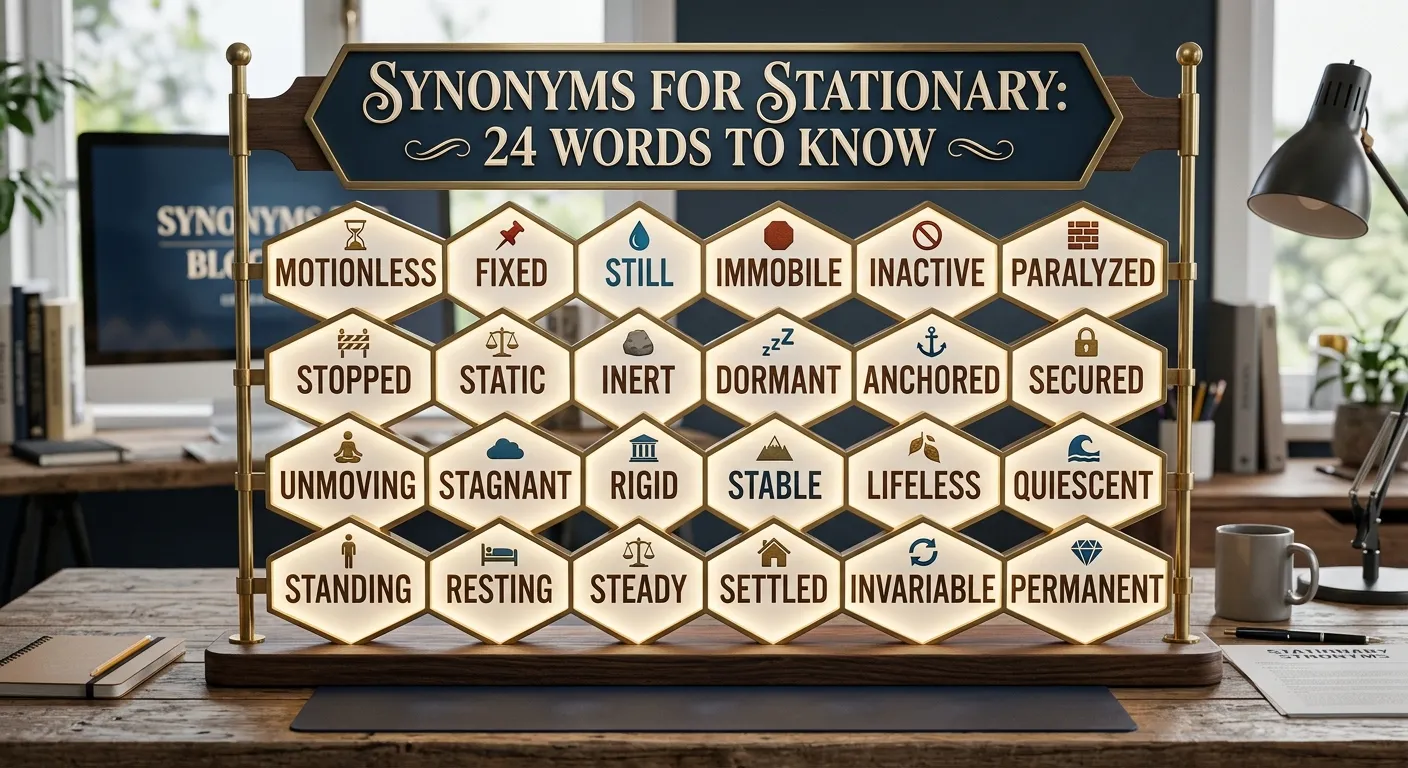
Stationary means not moving or staying in one place. Common synonyms include still, motionless, immobile, static, fixed, unmoving, at rest, and stable.
Imagine waiting at a bus stop while several cars move past you. You are standing in one place, so you are stationary, while the cars are moving. The word stationary is commonly used to describe people, objects, vehicles, or things that remain in the same position. Learning synonyms for stationary helps English learners describe movement and position more clearly. It also helps writers avoid using the same word again and again.
However, not every synonym has exactly the same meaning. Some words describe complete lack of movement, while others suggest stability or a fixed position. In this article, you will learn the meaning, pronunciation, history, word forms, 24 useful synonyms, examples, antonyms, and semantic categories of stationary so you can choose the right word for each situation.
Meaning of Stationary
Definition
Stationary (adjective): Not moving or remaining in the same place or position.
Examples
- The car remained stationary at the red light.
- Please keep the camera stationary while taking the photo.
Connotative Meaning
The word stationary usually has a neutral tone. Its meaning depends on the situation.
- Positive tone: It can suggest stability, control, or steadiness.
- Negative tone: It may suggest a lack of progress or movement in some contexts.
- Neutral tone: It simply describes something that is not moving.
(Connotation: the feeling or idea that a word suggests in addition to its basic meaning.)
Etymology
The word stationary is connected to station, which comes from Latin statio, meaning “a standing place” or “position.”
- Old English (450–1100): The modern word stationary was not yet used in English, but related ideas of standing and remaining in a place were expressed through older Germanic words.
- Middle English (1100–1500): English developed words related to station through French and Latin influence.
- Modern English (1500–Present): Stationary developed from station with the suffix -ary, taking the meaning “remaining in one place” or “not moving.”
The word is closely related to station, stationary, and stationed. Do not confuse stationary with stationery, which refers to writing materials such as paper, envelopes, and pens.
Pronunciation (IPA)
- IPA: /ˈsteɪʃəneri/
- Syllables: sta-tion-ar-y
Affixation Pattern of Stationary
- Root: station: a place, position, or stopping point
- Prefix: None
- Suffix: -ary: relating to or connected with
Word Formations
- Station (noun): a place where someone or something stops or stays
- Station (verb): to place someone or something in a particular position
- Stationed (verb/adjective): placed in a particular location
- Stationary (adjective): not moving or changing position
- Stationarily (adverb): in a stationary manner; this form is uncommon
24 Synonyms of Stationary With Meaning & Examples
1. Still (Adjective)
Meaning: Not moving or making a movement.
Examples:
- The lake was still in the early morning.
- Please keep your head still during the examination.
2. Motionless (Adjective)
Meaning: Completely without movement.
Examples:
- The statue stood motionless in the garden.
- The animal remained motionless when it heard the noise.
3. Immobile (Adjective)
Meaning: Unable or unwilling to move.
Examples:
- His injured leg kept him immobile.
- The heavy machine was immobile on the floor.
4. Static (Adjective)
Meaning: Staying in one position without movement or change.
Examples:
- The image remained static on the screen.
- The machine has a static part that does not move.
5. Fixed (Adjective)
Meaning: Firmly placed in one position.
Examples:
- The shelf is fixed to the wall.
- Her eyes remained fixed on the door.
6. Unmoving (Adjective)
Meaning: Not moving at all.
Examples:
- The boat was unmoving on the quiet water.
- He stood unmoving near the entrance.
7. At Rest (Phrase)
Meaning: In a position where there is no movement.
Examples:
- The ball was at rest on the ground.
- The bicycle remained at rest beside the wall.
8. Motionless (Adjective)
Meaning: Completely still and without movement.
Examples:
- The guard stood motionless outside the building.
- The bird stayed motionless on the branch.
9. Stationed (Adjective)
Meaning: Placed or positioned in a particular location.
Examples:
- Two officers were stationed near the gate.
- A security guard was stationed outside the office.
10. Unstirring (Adjective)
Meaning: Completely still and showing no movement.
Examples:
- The water was unstirring beneath the bridge.
- The room remained unstirring and quiet.
11. Sedentary (Adjective)
Meaning: Involving little physical movement.
Examples:
- Office work can be quite sedentary.
- A sedentary lifestyle may involve sitting for long periods.
12. Inactive (Adjective)
Meaning: Not moving, operating, or taking action.
Examples:
- The old machine has been inactive for months.
- The volcano is currently inactive.
13. Stable (Adjective)
Meaning: Firm and unlikely to move or change suddenly.
Examples:
- Make sure the ladder is stable before climbing.
- The table remained stable on the uneven floor.
14. Steady (Adjective)
Meaning: Firm and not shaking or changing position.
Examples:
- Keep your hand steady while drawing the line.
- The camera must remain steady for a clear picture.
15. Unchanged (Adjective)
Meaning: Remaining in the same state or condition.
Examples:
- The position of the object remained unchanged.
- The situation has stayed unchanged since yesterday.
16. Firm (Adjective)
Meaning: Securely positioned and not easily moved.
Examples:
- The box was firm on the shelf.
- Make sure the chair is firm before sitting down.
17. Immovable (Adjective)
Meaning: Impossible or very difficult to move.
Examples:
- The large rock was immovable.
- The object seemed immovable despite their efforts.
18. Rigid (Adjective)
Meaning: Unable to bend, move, or change easily.
Examples:
- The metal frame was rigid and strong.
- The structure remained rigid during the test.
19. Frozen (Adjective)
Meaning: Completely stopped or unable to move.
Examples:
- The computer screen appeared frozen.
- He stood frozen with surprise.
20. Paused (Adjective)
Meaning: Temporarily stopped from moving or operating.
Examples:
- The video was paused at the same point.
- The machine remained paused during the inspection.
21. Parked (Adjective)
Meaning: A vehicle that has been stopped and left in a particular place.
Examples:
- My car is parked outside the building.
- Several buses were parked near the station.
22. Quiescent (Adjective)
Meaning: Temporarily inactive or completely still.
Examples:
- The volcano remained quiescent for many years.
- The system was quiescent during the night.
23. Inert (Adjective)
Meaning: Not moving or not capable of active movement.
Examples:
- The machine was completely inert after the power failure.
- The object remained inert on the floor.
24. Unmoving (Adjective)
Meaning: Remaining in the same position without moving.
Examples:
- The figure stood unmoving in the doorway.
- The car remained unmoving for several minutes.
Note: Some synonyms above overlap in meaning, but they are not interchangeable in every sentence. For example, parked is mainly used for vehicles, while sedentary usually describes a lifestyle or activity involving little movement.
Prototype Meaning
The most typical meaning of stationary is remaining in one place without moving. When people hear this word, they usually imagine a person, vehicle, object, or machine that has stopped and stays in the same position. For example, a car waiting at a traffic light is stationary until the light changes.
Prototype Categorization
The 24 synonyms can be grouped according to the type of stillness or lack of movement they express:
- Complete lack of movement: still, motionless, unmoving, immobile, immovable, unstirring best when something does not move at all.
- Fixed or stable position: fixed, stable, steady, firm, rigid useful when something stays securely in one position.
- Temporary stopping: paused, frozen, at rest useful when movement has stopped for a period of time.
- Lack of activity: static, inactive, inert, quiescent, unchanged often used for systems, situations, processes, or conditions.
- Specific situations: parked, stationed, sedentary these words fit particular contexts rather than every use of stationary.
This grouping helps writers choose a synonym based on why something is not moving, rather than simply replacing stationary with any similar word.
Antonyms of Stationary
- Moving (adjective): Changing position or location.
- Mobile (adjective): Able to move easily from one place to another.
- Moving forward (phrase): Continuing to progress or advance.
- Active (adjective): Engaged in movement or action.
- Dynamic (adjective): Characterized by constant activity, movement, or change.
- Mobile (adjective): Capable of being moved or changing position.
Short Questions and Answers
Q: What does stationary mean?
A: Stationary means not moving or remaining in the same place or position.
Q: When should stationary be used?
A: Use stationary when you want to describe a person, object, vehicle, or thing that remains in one position instead of moving.
Q: Is stationary positive or negative?
A: Stationary is usually neutral. It can sound positive when it suggests stability, but it can sound negative when it suggests a lack of progress.
Q: How is it different from similar words?
A: Stationary is a general word for something that is not moving. Motionless suggests complete lack of movement, fixed suggests being firmly positioned, static can suggest no movement or change, and parked is mainly used for vehicles.
Conclusion
Learning stationary and its synonyms gives English learners more ways to describe position, movement, and stillness. Words such as still, motionless, immobile, static, fixed, stable, steady, and unmoving can make writing more precise and interesting. However, choosing the right synonym depends on context. A car can be parked, a person can be stationary, a machine can be inactive, and an object can be immovable. Understanding these small differences helps you avoid awkward word choices. Using synonyms also strengthens speaking and writing, reduces repetition, and builds confidence in English. Try learning a few new words each day and use them in your own sentences. Regular practice will gradually make your vocabulary richer, clearer, and more natural.
Synonyms for allegiance: 24 Powerful Alternatives

I’m Leo Jackson, an English writer with a soft spot for the peculiarities of language and vocabulary. Specializes in exploring the nuances of English synonyms, helping students, writers, and professionals choose the right word with confidence. My guides combine careful research with clear, practical explanations.