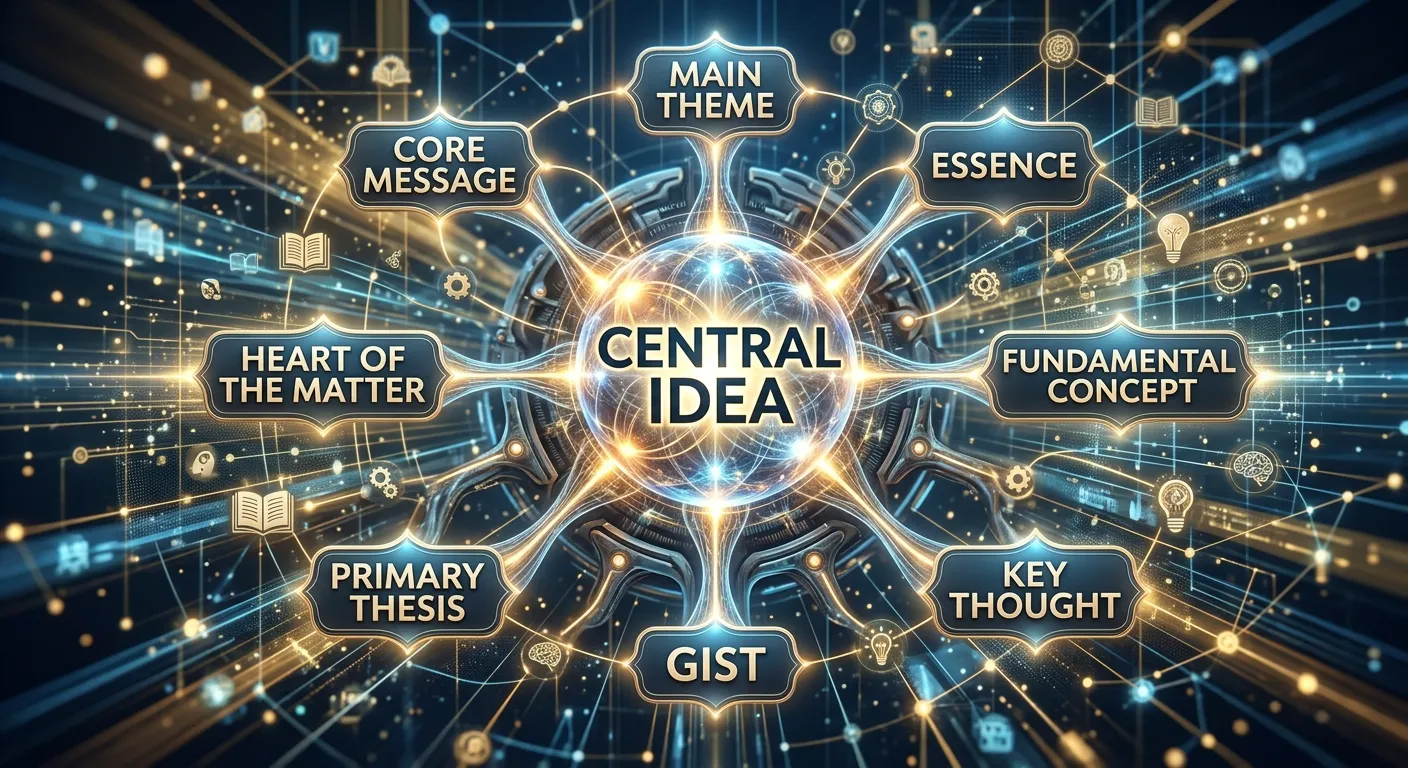
Central idea: The main point, core thought, or key message of a text, speech, story, or discussion
Central idea means the main point or most important thought in a piece of writing, speech, story, or discussion. For example, imagine a student reading a short story about a family that learns to work together. The student may say that the central idea is that teamwork helps people overcome problems. This phrase is commonly used in schools, essays, books, articles, and everyday discussions.
Learning synonyms for central idea helps English learners understand different ways to express the same general thought. It also helps writers avoid repeating the same phrase. However, not every synonym fits every situation. Some words are better for academic writing, while others work well for stories, speeches, or casual conversations. In this article, we will explore the meaning of central idea, its synonyms, examples, grammar, history, pronunciation, and semantic categories to help you choose the right word with confidence.
Meaning of Central Idea
Definition
Central idea (noun phrase): The main point, thought, or message that a text, speech, story, or discussion focuses on.
Examples
- The central idea of the article is the importance of healthy habits.
- The teacher asked the students to identify the central idea of the story.
Connotative Meaning
Connotation (the feeling or idea that a word suggests beyond its basic meaning):
- Positive tone: Suggests importance, clarity, purpose, or strong focus.
- Negative tone: Usually neutral, but it may suggest oversimplification if a complex subject is reduced to one idea.
- Neutral tone: Refers objectively to the main thought or point of something.
Etymology
The phrase central idea is made from two words: central and idea.
- Old English (450–1100): The exact modern phrase did not exist in Old English. Central ultimately traces to Latin centralis, meaning “of the center,” while idea comes from Greek idea, meaning “form,” “appearance,” or “concept.”
- Middle English (1100–1500): Both words entered English through historical borrowing. Idea came into English through Latin and French influence, while central developed through French and Latin forms.
- Modern English (1500–Present): Central developed the broader sense of something most important or at the center of attention. Idea came to mean a thought, concept, or mental notion. Together, central idea became a common expression for the main thought of a text, speech, or subject.
Pronunciation (IPA)
- IPA: /ˈsɛntrəl aɪˈdiːə/
- Syllables: cen-tral i-de-a
Affixation Pattern of Central Idea
Because central idea is a two-word noun phrase, its parts have different word formations.
- Root: centr- and ide-
- Prefix: None in central idea
- Suffix: -al in central; -a in idea
Word formations
- center: noun/verb
- central: adjective
- centrally: adverb
- centrality: noun
- idea: noun
- ideal: adjective/noun
- ideation: noun
- ideational: adjective
30 Synonyms of Central Idea With Meaning & Examples
1. Main Idea (Noun Phrase)
Meaning: The most important point or thought in a text or discussion.
Examples:
- The main idea of the passage is easy to understand.
- Write one sentence that explains the main idea.
2. Core Idea (Noun Phrase)
Meaning: The basic and most important idea at the heart of something.
Examples:
- The core idea of the project is simple.
- The author builds the article around one core idea.
3. Main Point (Noun Phrase)
Meaning: The most important point someone wants to communicate.
Examples:
- What is the main point of this paragraph?
- She explained her main point clearly.
4. Key Idea (Noun Phrase)
Meaning: An important idea that helps explain a subject.
Examples:
- The teacher highlighted three key ideas.
- Freedom is a key idea in the novel.
5. Gist (Noun)
Meaning: The general or most important meaning of something.
Examples:
- I understood the gist of the article.
- Can you tell me the gist of the story?
6. Theme (Noun)
Meaning: A main subject or recurring idea explored in a text, especially a literary work.
Examples:
- Friendship is a major theme in the novel.
- The story explores the theme of courage.
7. Thesis (Noun)
Meaning: The main claim or position that a writer presents and supports.
Examples:
- Her thesis argues that education improves social mobility.
- The essay has a clear thesis.
8. Message (Noun)
Meaning: The main lesson, meaning, or idea that a work communicates.
Examples:
- The message of the story is to value honesty.
- The film has a powerful message about family.
9. Focus (Noun)
Meaning: The main subject or area receiving attention.
Examples:
- The focus of the article is climate change.
- The discussion shifted its focus to education.
10. Essence (Noun)
Meaning: The most basic or important quality or meaning of something.
Examples:
- The essence of the story is hope.
- This sentence captures the essence of her argument.
11. Crux (Noun)
Meaning: The most important or difficult point of an issue.
Examples:
- The crux of the problem is poor communication.
- The crux of his argument is fairness.
12. Kernel (Noun)
Meaning: The central or essential part of an idea.
Examples:
- There is a useful kernel of truth in the story.
- The kernel of her argument was easy to identify.
13. Substance (Noun)
Meaning: The main or important content of something.
Examples:
- The substance of the speech was about equality.
- We discussed the substance of the proposal.
14. Subject (Noun)
Meaning: The person, thing, or idea that a text or discussion is mainly about.
Examples:
- The subject of the article is renewable energy.
- History is the main subject of the lecture.
15. Topic (Noun)
Meaning: The particular subject being discussed, studied, or written about.
Examples:
- The topic of the essay is online learning.
- Today’s topic is environmental protection.
16. Premise (Noun)
Meaning: An idea or statement on which an argument or story is based.
Examples:
- The novel begins with an unusual premise.
- The argument rests on a questionable premise.
17. Proposition (Noun)
Meaning: An idea or statement that is presented for consideration or discussion.
Examples:
- The writer presents an interesting proposition.
- We need to examine the proposition carefully.
18. Argument (Noun)
Meaning: A main claim or position supported by reasons and evidence.
Examples:
- Her main argument is that schools need better resources.
- The author develops a strong argument throughout the essay.
19. Tenet (Noun)
Meaning: A principle or belief that is considered important within a system or group.
Examples:
- Equality is a central tenet of the organization.
- Respect is an important tenet of their philosophy.
20. Principle (Noun)
Meaning: A basic belief or rule that guides thought or behavior.
Examples:
- Honesty is a key principle of the organization.
- The book explores the principle of fairness.
21. Thought (Noun)
Meaning: An idea or opinion formed in the mind.
Examples:
- The essay develops one important thought.
- His main thought was that change takes time.
22. Notion (Noun)
Meaning: An idea, belief, or understanding about something.
Examples:
- The book challenges the notion that success comes easily.
- She rejected the notion that money guarantees happiness.
23. Takeaway (Noun)
Meaning: The main lesson or useful point that someone gains from something.
Examples:
- My main takeaway from the lecture was the value of practice.
- The biggest takeaway is that preparation matters.
24. Throughline (Noun)
Meaning: A central idea or connecting element that continues through a story or discussion.
Examples:
- Trust is the throughline of the entire novel.
- Education provides a clear throughline in the documentary.
25. Motif (Noun)
Meaning: A repeated idea, image, or element that has a particular meaning in a literary or artistic work.
Examples:
- Water is a recurring motif in the poem.
- The author uses the journey as a motif.
26. Leitmotif (Noun)
Meaning: A recurring idea or element that is strongly associated with a person, subject, or situation.
Examples:
- Hope becomes a leitmotif throughout the novel.
- Music creates a recurring leitmotif in the film.
27. Thrust (Noun)
Meaning: The main purpose, direction, or emphasis of an argument or piece of writing.
Examples:
- The thrust of the article is the need for reform.
- The thrust of her speech was easy to understand.
28. Import (Noun)
Meaning: The meaning, importance, or significance of something.
Examples:
- The import of his words was clear.
- She understood the import of the decision.
29. Purport (Noun)
Meaning: The main meaning or general intention of something.
Examples:
- I understood the purport of the author’s statement.
- The purport of the speech was to encourage cooperation.
30. Concept (Noun)
Meaning: A general idea or understanding of something.
Examples:
- The concept of equality is central to the discussion.
- The writer explains a difficult concept in simple language.
Prototype Meaning
The most typical meaning of central idea is the main thought or point that a text, story, speech, or discussion is built around. When people hear this phrase, they usually imagine looking at a piece of writing and asking, “What is this mostly about?” In school reading tasks, central idea often refers to the most important idea that connects the supporting details.
Prototype Categorization
The 30 synonyms above can be grouped by their closest meaning and typical use:
- Main-point terms: main idea, core idea, main point, key idea, gist best when identifying the most important information in a text or discussion.
- Literary terms: theme, message, motif, leitmotif, throughline useful when discussing stories, novels, poems, films, and other creative works.
- Academic and argumentative terms: thesis, proposition, premise, argument, tenet, principle useful in essays, research, debates, and formal writing.
- Meaning and importance terms: essence, crux, kernel, substance, import, purport useful when focusing on the essential meaning or significance of an idea.
- Subject and focus terms: subject, topic, focus, concept, thought, notion useful when referring to what a text, conversation, or discussion centers on.
- Practical communication terms: message, takeaway, thrust useful when explaining the lesson, purpose, or main direction of communication.
This categorization helps writers choose a synonym based on context, rather than simply replacing central idea with any similar word. For example, thesis is more suitable for an academic argument, while theme is usually better for a literary work.
Antonyms of Central Idea
There is no single exact antonym for central idea, because the phrase describes the main point rather than a simple quality. However, these terms can express ideas that are secondary, less important, or outside the main focus:
Peripheral Idea (Noun Phrase)
Meaning: An idea that is outside the main focus of a text or discussion.
Minor Point (Noun Phrase)
Meaning: A less important point that supports or adds detail to the main point.
Detail (Noun)
Meaning: A small piece of information that supports a larger idea.
Tangent (Noun)
Meaning: A subject or idea that moves away from the main topic.
Irrelevant Point (Noun Phrase)
Meaning: An idea that has little or no connection to the main subject.
Short Questions and Answers
Q: What does central idea mean?
A: Central idea means the main point or most important thought in a text, story, speech, or discussion.
Q: When should central idea be used?
A: Use central idea when you want to identify the main thought that connects and organizes the supporting details of something.
Q: Is central idea positive or negative?
A: Central idea is neutral. Its meaning depends on the context in which it is used.
Q: How is it different from similar words?
A: Central idea is a broad term for the main thought. Theme often refers to a recurring idea in literature, while thesis usually refers to a claim that an academic writer supports with evidence. Gist means the general meaning, and topic identifies what something is about rather than necessarily stating its main point.
Conclusion
Learning central idea and its synonyms gives English learners more ways to understand and express important ideas. Words such as main idea, core idea, key idea,theme thesis, message, essence, and takeaway may be similar, but each works best in a particular context. Knowing these differences can make writing clearer and more precise. A strong vocabulary also helps speakers explain their thoughts without repeating the same words. For students, understanding these terms can make reading and writing tasks easier. For content writers, they can make articles more natural and engaging. Keep practicing by noticing these words in books, articles, lessons, and conversations. With regular practice, choosing the right synonym will become easier and your English confidence will grow.
Synonyms for First Grade: 30 Similar Terms

I am Clara Stephen, passionate about making English simple and easy to understand through clear synonym comparisons, vocabulary guides, and language tips. Through thoughtful, reliable content, I aim to be a trusted guide for anyone looking to expand their English vocabulary.