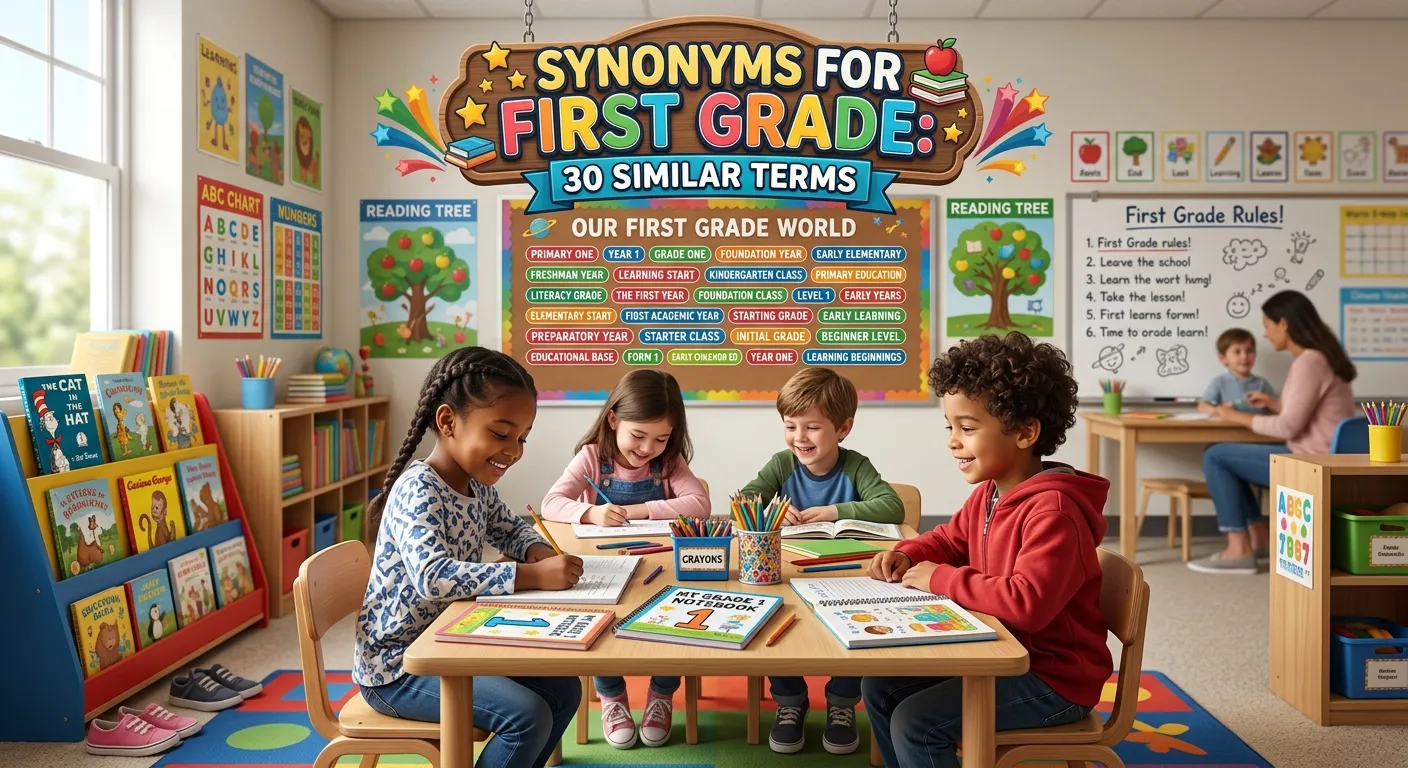
First grade means Grade 1, Year One, Primary One, or the first year of elementary or primary school.
First grade is the first year of formal elementary school in many education systems. Imagine a child entering school after kindergarten and beginning to read simple books, write sentences, and learn basic math. That school year is often called first grade.
The term is common in American English and is used when talking about a child’s early school education. Learning synonyms and related expressions for first grade can help English learners, teachers, parents, and content writers use more varied and accurate language. However, the best alternative depends on the country and education system. In this article, we explain the meaning of first grade and explore 30 useful alternatives and related terms. We also cover grammar, etymology, pronunciation, word formation, examples, and semantic categories.
Meaning of First Grade
Definition
First grade (Noun phrase):
First grade means the first year of elementary or primary school, usually for children around six or seven years old.
Examples
- My daughter will start first grade this fall.
- Children in first grade learn basic reading and math skills.
Connotative Meaning
Connotation: the feeling or idea that a word suggests beyond its direct meaning.
- Positive tone: First grade can suggest a new beginning, learning, growth, and excitement.
- Negative tone: It may sometimes suggest the challenges of starting formal school.
- Neutral tone: It can simply identify a particular year or level of elementary education.
Etymology
The phrase first grade combines the ordinal adjective first with the noun grade.
- Old English (450–1100): First comes from Old English fyrst, meaning earliest or foremost. Grade was not yet used in its modern educational sense.
- Middle English (1100–1500): First developed through Middle English forms such as first. Grade entered English from French grade, ultimately related to Latin gradus, meaning step or degree.
- Modern English (1500–Present): Grade developed the meaning of a level or stage in education. First grade became a common term for the first year of elementary schooling, especially in American English.
Pronunciation (IPA)
- IPA: /ˌfɝːst ˈɡreɪd/
- Syllables: first grade 2 syllables
Affixation Pattern of First Grade
- Root: first and grade
- Prefix: None
- Suffix: None in the phrase first grade
- Word formations:
- first: adjective/adverb/ordinal number
- firstly: adverb
- grade: noun/verb
- graded: adjective/verb
- grading: noun/verb
- grader: noun
- grade-level: adjective/noun modifier
30 Synonyms of First Grade with Meaning & Examples
Note: Some alternatives below are close equivalents, while others are education-system terms used in specific countries. They are not interchangeable in every context.
1. First Year (Noun Phrase)
Meaning: The first year of a particular stage of education.
Examples:
- She is in her first year of elementary school.
- The first year can be exciting for young learners.
2. Year One (Noun Phrase)
Meaning: The first year or level of a school program.
Examples:
- My son starts Year One next month.
- Year One students practice basic reading skills.
3. Grade 1 (Noun Phrase)
Meaning: A numbered term for the first level of elementary education.
Examples:
- She is a Grade 1 student.
- The Grade 1 class has twenty students.
4. First Class (Noun Phrase)
Meaning: The first class or level in some school systems.
Examples:
- He entered first class at the age of six.
- Students in first class learn basic skills.
5. Primary One (Noun Phrase)
Meaning: The first year of primary school in some education systems.
Examples:
- Her child is starting Primary One.
- Primary One students are learning to read.
6. Elementary Year One (Noun Phrase)
Meaning: The first year of elementary education.
Examples:
- The child is enrolled in elementary Year One.
- Elementary Year One focuses on basic skills.
7. Elementary Level One (Noun Phrase)
Meaning: The first level of elementary schooling.
Examples:
- He teaches elementary Level One students.
- The elementary Level One program includes reading and math.
8. Early Elementary School (Noun Phrase)
Meaning: The first few years of elementary education.
Examples:
- She teaches children in early elementary school.
- Reading skills are important in early elementary school.
9. Lower Primary (Noun Phrase)
Meaning: The early years of primary education.
Examples:
- Children in lower primary study basic subjects.
- She works with lower primary learners.
10. Primary Level One (Noun Phrase)
Meaning: The first level of primary education.
Examples:
- He teaches Primary Level One.
- Primary Level One students need simple learning activities.
11. Elementary First Year (Noun Phrase)
Meaning: The first year of elementary school.
Examples:
- The child is entering elementary first year.
- Teachers prepare special activities for elementary first-year students.
12. First School Year (Noun Phrase)
Meaning: The first year a child attends a particular level of school.
Examples:
- Her first school year was full of new experiences.
- Children need support during their first school year.
13. Beginning Grade (Noun Phrase)
Meaning: An early level in a school grading system.
Examples:
- The school offers programs for the beginning grades.
- Reading instruction starts in the beginning grades.
14. Entry Grade (Noun Phrase)
Meaning: The grade at which students enter a particular school stage.
Examples:
- The entry grade is designed for young learners.
- Parents must register children before the entry grade begins.
15. Entry Level (Noun Phrase)
Meaning: The first level of a course, program, or educational stage.
Examples:
- This is an entry-level class for young children.
- Students begin with the entry level before moving up.
16. Beginning Level (Noun Phrase)
Meaning: The earliest level of a learning program.
Examples:
- Children start at the beginning level.
- The beginning level teaches basic concepts.
17. Foundation Year (Noun Phrase)
Meaning: An introductory year that builds basic knowledge and skills.
Examples:
- The foundation year helps children develop learning habits.
- Reading is a key part of the foundation year.
18. Foundation Level (Noun Phrase)
Meaning: An early educational level where basic skills are developed.
Examples:
- Students begin at the foundation level.
- The foundation level focuses on essential skills.
19. Introductory Grade (Noun Phrase)
Meaning: An early grade that introduces children to formal learning.
Examples:
- The introductory grade teaches basic classroom skills.
- Children learn routines in the introductory grade.
20. Elementary Entry Level (Noun Phrase)
Meaning: The starting level of elementary education.
Examples:
- Children enter through the elementary entry level.
- The elementary entry level supports early learning.
21. Primary Entry Level (Noun Phrase)
Meaning: The starting level of primary school.
Examples:
- The school accepts children at the primary entry level.
- Teachers assess students at the primary entry level.
22. First-Level Class (Noun Phrase)
Meaning: A class at the first level of an educational program.
Examples:
- She teaches a first-level class.
- The first-level class focuses on basic literacy.
23. First-Year Class (Noun Phrase)
Meaning: A class made up of students in their first school year.
Examples:
- The first-year class visited the library.
- Teachers prepared games for the first-year class.
24. Beginning Class (Noun Phrase)
Meaning: A class designed for students who are just starting a level of learning.
Examples:
- He teaches a beginning class for young learners.
- The beginning class practices simple words.
25. Early Primary (Noun Phrase)
Meaning: The early years of primary education.
Examples:
- Reading is taught during early primary.
- She has experience teaching early primary children.
26. Early Elementary (Noun Phrase)
Meaning: The first years of elementary school.
Examples:
- The activity is suitable for early elementary students.
- Early elementary learners need clear instructions.
27. Primary Year One (Noun Phrase)
Meaning: The first year of primary school.
Examples:
- Her daughter is entering Primary Year One.
- Primary Year One introduces children to formal school routines.
28. School Year One (Noun Phrase)
Meaning: The first numbered year in a school program.
Examples:
- The children are in School Year One.
- School Year One includes basic reading and writing.
29. First Elementary Grade (Noun Phrase)
Meaning: The first grade within an elementary school system.
Examples:
- He teaches the first elementary grade.
- Students in the first elementary grade learn basic math.
30. First Primary Year (Noun Phrase)
Meaning: The first year of primary education.
Examples:
- The child will begin her first primary year soon.
- Teachers prepare young learners for their first primary year.
Prototype Meaning
The most typical meaning of first grade is the first formal year of elementary school. People usually imagine young children, often around six or seven years old, beginning structured lessons in reading, writing, mathematics, and other basic subjects. In American English, first grade is the standard term, while other countries may use terms such as Year One or Primary One.
Prototype Categorization
- Direct equivalents: Grade 1, first year, Year One, first class, Primary One. These are the closest alternatives, but the preferred term depends on the education system.
- Primary-school terms: Primary Level One, Primary Year One, lower primary, early primary, first primary year. These are useful when discussing primary education.
- Elementary-school terms: elementary first year, elementary level one, early elementary, first elementary grade. These work best in contexts using the term elementary school.
- Beginning-level terms: entry level, beginning level, entry grade, beginning grade, beginning class. These describe starting points but may not specifically mean first grade.
- Foundation terms: foundation year, foundation level, introductory grade. These emphasize the basic skills developed at the beginning of education.
This grouping helps writers avoid treating every alternative as an exact synonym. First grade, Year One, and Primary One may refer to similar school levels, but their use varies by country.
Antonyms of First Grade
1. Final Grade (Noun Phrase)
Meaning: The last grade or year in a particular school stage.
2. Final Year (Noun Phrase)
Meaning: The last year of a course or school program.
3. Last Grade (Noun Phrase)
Meaning: The highest or final grade in a sequence.
4. Advanced Level (Noun Phrase)
Meaning: A higher level that requires more developed knowledge or skills.
Short Questions and Answers
Q: What does first grade mean?
A: First grade means the first year of elementary or primary school, usually for young children around six or seven years old.
Q: When should first grade be used?
A: Use first grade when referring to the first year of elementary education, especially in American English.
Q: Is first grade positive or negative?
A: First grade is neutral. It simply identifies a school level, although it may suggest excitement, growth, or the challenges of starting school depending on the context.
Q: How is it different from similar words?
A: First grade is mainly an American English term. Year One, Primary One, and First Class can describe similar levels in other education systems, but their exact meaning varies by country.
Conclusion
Learning alternatives to first grade helps English learners and writers understand how school levels are described in different education systems. Terms such as Grade 1, Year One, and Primary One may refer to a similar stage, while expressions such as early elementary and lower primary describe broader groups.
It is important to choose the term that matches the country and school system being discussed. Using the right expression can make writing clearer and more natural. Teachers, students, parents, and content writers can improve their vocabulary by learning these differences and using each term in the correct context. Practice these expressions in simple sentences, and you will become more confident when discussing children’s education in English.
Synonyms for central idea: 30 Easy Alternatives

Rose Vault is an English language author who specializes in synonyms, word nuances, and vocabulary building. She creates clear, well-researched content that helps readers express themselves with precision and confidence. Her goal is to make vocabulary learning simple, accurate, and accessible for everyone.