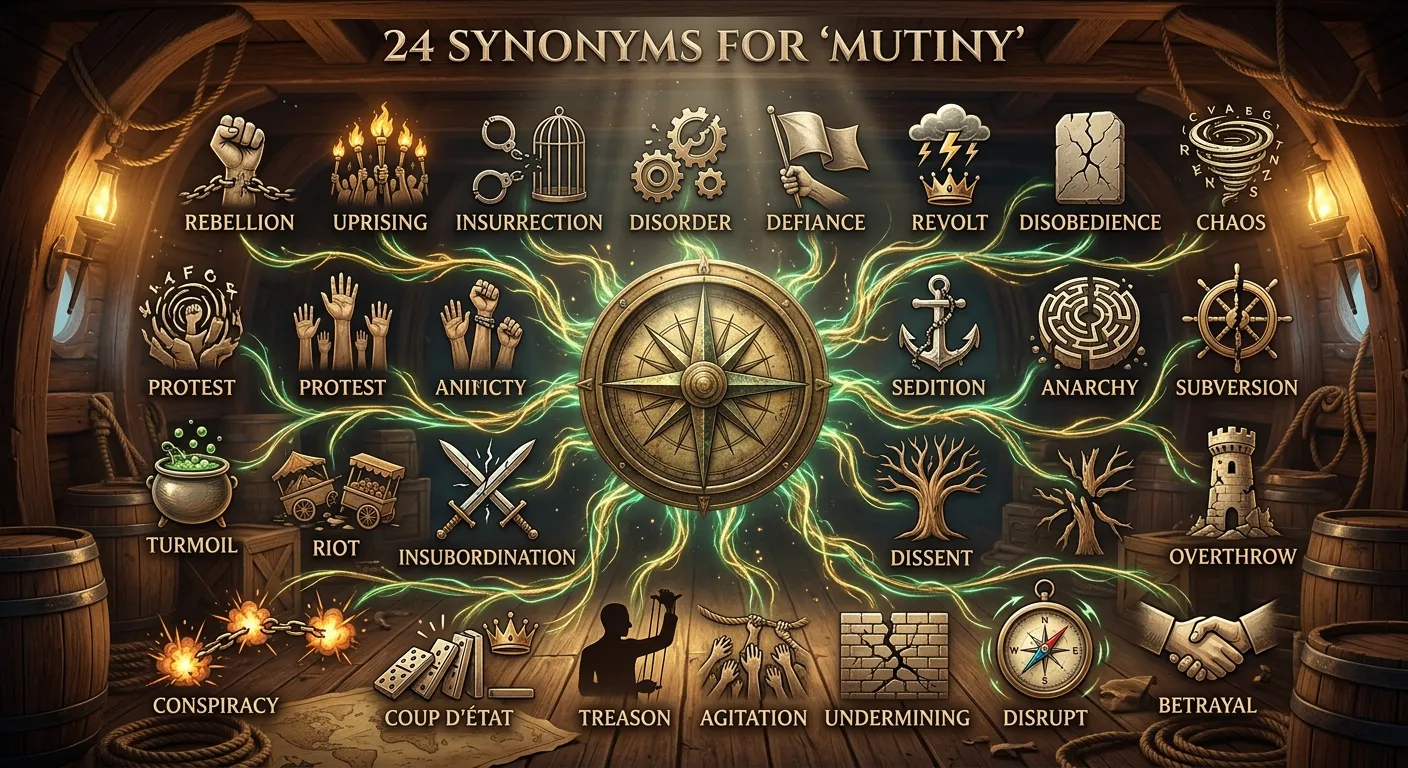
Snippet: Rebellion, revolt, uprising, insurrection, defiance, disobedience, resistance, and insubordination are common synonyms for mutiny, depending on the context.
Mutiny means an organized refusal by soldiers, sailors, or other people under authority to obey their leaders or follow orders. Imagine a group of sailors who refuse to follow their captain because they strongly oppose his decisions. If they openly challenge his command and take control of the ship, their action may be called a mutiny. The word is often used when people in a military, naval, or disciplined group rebel against authority. Learning synonyms for mutiny helps English learners understand the different shades of rebellion, resistance, and disobedience. It also helps content writers avoid repeating the same word. In this article, we explore the meaning, synonyms, examples, grammar, etymology, pronunciation, word formation, and semantic categories of mutiny so you can choose the right word for each situation.
Meaning of Mutiny
Definition
Mutiny (noun/verb): An organized refusal by people under authority to obey their leader or follow orders.
Examples
- The sailors planned a mutiny against their captain.
- The soldiers were punished for trying to mutiny against their commander.
Connotative Meaning
Connotation: The feeling or idea that a word suggests beyond its basic meaning.
- Positive tone: Rarely positive, but it may suggest courage or resistance when the authority is seen as unjust.
- Negative tone: Usually suggests disloyalty, disorder, rebellion, or a refusal to obey.
- Neutral tone: In historical or factual writing, mutiny can simply describe an organized act of rebellion.
Etymology
The word mutiny entered English through French and is linked to the idea of rebellion and disobedience.
- Old English (450–1100): Mutiny was not an Old English word. Its direct development came much later through French.
- Middle English (1100–1500): The related French forms developed around ideas of rebellion, revolt, and unruly behavior.
- Modern English (1500–Present): Mutiny became established in English in the 16th century, especially for rebellion by soldiers or sailors against their commanders.
Pronunciation (IPA)
- IPA: /ˈmjuːtəni/
- Syllables: mu-ti-ny
Affixation Pattern of Mutiny
- Root: mutin-
- Prefix: None
- Suffix: -y in the noun mutiny
Word formations
- Mutiny: noun/verb
- Mutinous: adjective
- Mutinously: adverb
- Mutinousness: noun
- Mutineer: noun
- Mutinied: verb, past tense
- Mutinies: noun/verb, plural or third-person singular
- Mutinying: verb, present participle
24 Synonyms of Mutiny With Meaning & Examples
1. Rebellion (Noun)
Meaning: An organized act of resistance against a government, leader, or authority.
Examples:
- The soldiers joined a rebellion against their commander.
- The king struggled to control the growing rebellion.
2. Revolt (Noun/Verb)
Meaning: An attempt to resist or overthrow someone in authority.
Examples:
- The workers planned a revolt against their harsh leader.
- The prisoners decided to revolt against the guards.
3. Uprising (Noun)
Meaning: A public or organized act of resistance against authority.
Examples:
- The government quickly responded to the uprising.
- The soldiers feared that an uprising would spread.
4. Insurrection (Noun)
Meaning: A violent or organized attempt to oppose established authority.
Examples:
- The government tried to stop the insurrection.
- Several officers were accused of supporting the insurrection.
5. Insurgency (Noun)
Meaning: An organized campaign against an established authority.
Examples:
- The region faced years of insurgency.
- The army was sent to control the growing insurgency.
6. Rebellion (Noun)
Meaning: Resistance to authority, control, or established rules.
Examples:
- The leader feared another rebellion among his troops.
- Their actions were viewed as open rebellion.
7. Insurgence (Noun)
Meaning: An act or movement of rising against authority.
Examples:
- The insurgence threatened the stability of the region.
- Officials tried to prevent further insurgence.
8. Defiance (Noun)
Meaning: Open refusal to obey or respect someone in authority.
Examples:
- His refusal was an act of defiance.
- The soldiers showed defiance toward their commander.
9. Disobedience (Noun)
Meaning: Failure or refusal to obey an order or rule.
Examples:
- The captain punished the crew for their disobedience.
- Repeated disobedience can lead to serious consequences.
10. Insubordination (Noun)
Meaning: Refusal to obey someone who has authority over you.
Examples:
- The officer was disciplined for insubordination.
- His behavior was considered serious insubordination.
11. Resistance (Noun)
Meaning: Opposition to someone or something that has power or control.
Examples:
- The crew organized resistance against the unfair orders.
- The government faced strong resistance.
12. Defection (Noun)
Meaning: Leaving a group, organization, or side to join an opposing one.
Examples:
- The commander’s defection shocked the army.
- Several soldiers were suspected of defection.
13. Sedition (Noun)
Meaning: Speech or actions that encourage opposition against lawful authority.
Examples:
- The leaders were accused of sedition.
- The government investigated the group’s alleged sedition.
14. Dissidence (Noun)
Meaning: Strong disagreement with an established authority or system.
Examples:
- Political dissidence grew among the citizens.
- The leader tried to silence military dissidence.
15. Noncompliance (Noun)
Meaning: Failure or refusal to follow a rule, order, or request.
Examples:
- The officer reported the crew’s noncompliance.
- Continued noncompliance could result in punishment.
16. Noncooperation (Noun)
Meaning: Refusal to work with or obey another person or organization.
Examples:
- The workers showed noncooperation with management.
- Their noncooperation delayed the mission.
17. Opposition (Noun)
Meaning: Active disagreement or resistance against someone or something.
Examples:
- The commander faced strong opposition from his crew.
- Their opposition became more organized over time.
18. Defiance (Noun)
Meaning: Bold resistance to authority or control.
Examples:
- Her refusal was seen as an act of defiance.
- The soldiers openly expressed their defiance.
19. Dissension (Noun)
Meaning: Disagreement or conflict within a group.
Examples:
- Dissension spread among the officers.
- The captain struggled to control the growing dissension.
20. Discord (Noun)
Meaning: Serious disagreement or lack of harmony within a group.
Examples:
- Discord developed among the crew.
- The political crisis created discord within the organization.
21. Turmoil (Noun)
Meaning: A state of confusion, disorder, or great conflict.
Examples:
- The army descended into turmoil after the leadership changed.
- The mutiny created political turmoil.
22. Recalcitrance (Noun)
Meaning: Strong and stubborn refusal to obey authority.
Examples:
- The officer was frustrated by the crew’s recalcitrance.
- His recalcitrance made the situation harder to control.
23. Insurgence (Noun)
Meaning: An organized act of rising against established authority.
Examples:
- The insurgence challenged the existing leadership.
- Authorities struggled to contain the insurgence.
24. Recalcitrance (Noun)
Meaning: Persistent resistance to authority or rules.
Examples:
- The commander punished the crew for their recalcitrance.
- His recalcitrance caused serious problems within the unit.
Usage note: Not every synonym above is a perfect substitute for mutiny. Rebellion, revolt, insubordination, disobedience, and defiance are often closer in meaning, while words such as turmoil and discord describe conditions that may result from or surround a mutiny.
Prototype Meaning
The prototype meaning of mutiny is an organized refusal to obey a person in command. When people hear the word, they often imagine soldiers or sailors turning against their commander, refusing orders, or attempting to take control. The idea of authority and collective disobedience is central to the word.
Prototype Categorization
The 24 synonyms can be grouped by their main meaning and use:
- Direct rebellion: rebellion, revolt, uprising, insurrection, insurgence These words describe active resistance against authority.
- Refusal to obey: disobedience, insubordination, noncompliance, noncooperation, recalcitrance These focus on refusing orders, rules, or control.
- Open resistance: defiance, resistance, opposition, dissidence These emphasize disagreement or active opposition.
- Political or organized resistance: insurgency, sedition, defection These are useful in political, military, or historical contexts.
- Internal disagreement: dissension, discord These describe conflict within a group rather than a complete mutiny.
- Unstable conditions: turmoil This describes the disorder that may follow a mutiny rather than the act itself.
This categorization helps writers choose a word based on how strong the resistance is, who is involved, and whether the focus is on disobedience, political rebellion, or internal conflict.
Antonyms of Mutiny
1. Obedience (Noun)
Following an order, rule, or authority willingly.
2. Compliance (Noun)
Acting according to a rule, request, or order.
3. Loyalty (Noun)
Strong support and faithfulness toward a person, group, or leader.
4. Submission (Noun)
Accepting the authority or control of another person.
5. Cooperation (Noun)
Working willingly with others toward a shared goal.
6. Allegiance (Noun)
Loyal support or commitment to a person, group, or authority.
7. Discipline (Noun)
The ability to follow rules and obey authority.
Short Questions and Answers
Q: What does mutiny mean?
A: Mutiny means an organized refusal to obey a person in authority, especially by soldiers or sailors.
Q: When should mutiny be used?
A: Use mutiny when members of a military, naval, or similarly controlled group collectively refuse orders or rebel against their leader.
Q: Is mutiny positive or negative?
A: Mutiny usually has a negative connotation because it suggests disobedience and rebellion. However, its emotional meaning can depend on whether the authority being challenged is viewed as unfair or abusive.
Q: How is it different from similar words?
A: Mutiny usually involves people under a specific authority, especially soldiers or sailors. Rebellion and revolt are broader terms, while insubordination often describes an individual’s refusal to obey an authority figure.
Conclusion
Learning mutiny and its synonyms can make your English more precise and expressive. Words such as rebellion, revolt, uprising, defiance, resistance, disobedience, and insubordination share ideas with mutiny, but they do not always work in the same situations. Understanding their small differences helps you choose the right word for military, political, historical, or everyday contexts.
A strong synonym vocabulary also prevents repetition and makes your writing more natural. For English learners, studying these words can improve both speaking and writing confidence. Try learning two or three new synonyms each day, then use them in your own sentences. With regular practice, you will become better at recognizing meaning, tone, and context and will be able to communicate your ideas with greater accuracy.
Synonyms for at least: 30 Useful Alternatives

I’m Leo Jackson, an English writer with a soft spot for the peculiarities of language and vocabulary. Specializes in exploring the nuances of English synonyms, helping students, writers, and professionals choose the right word with confidence. My guides combine careful research with clear, practical explanations.