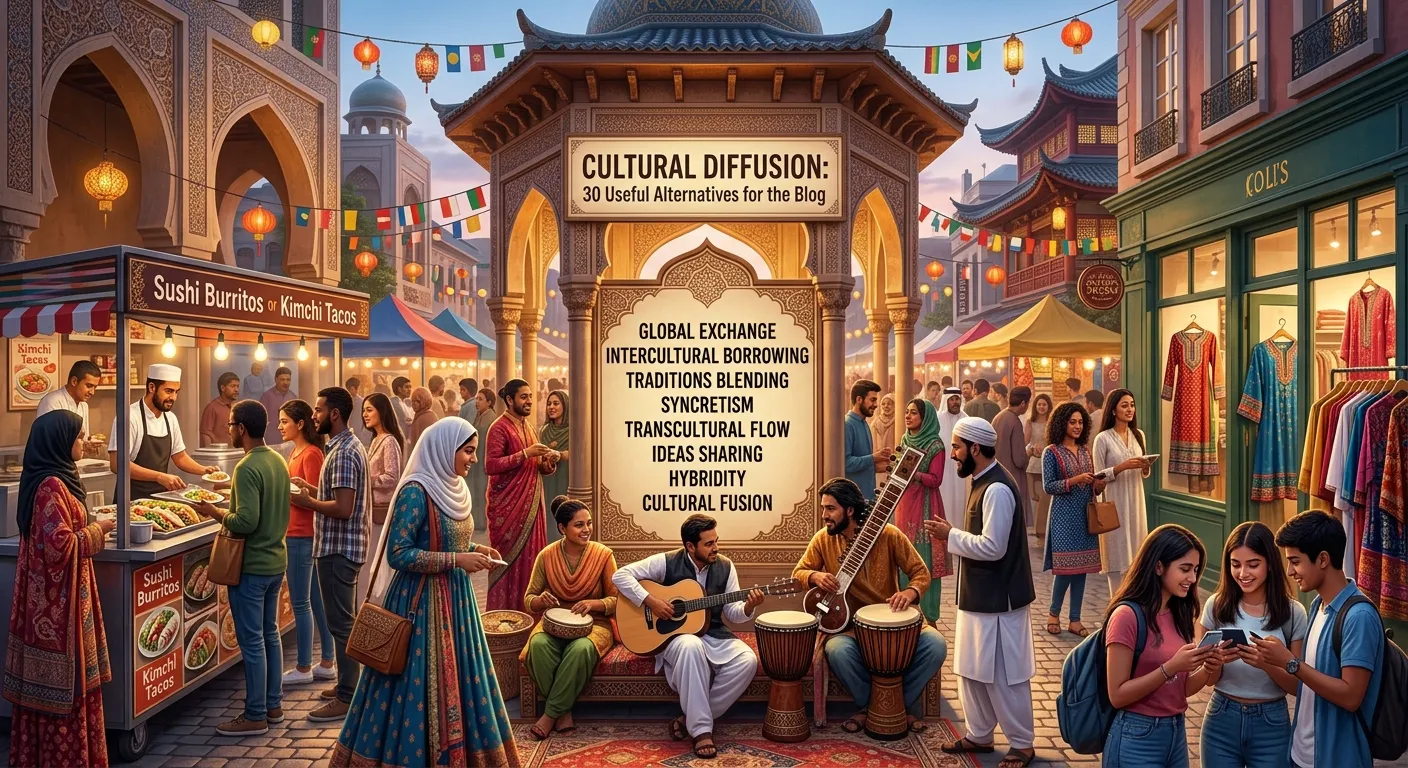
Cultural diffusion: The spread of ideas, customs, beliefs, and practices from one culture or society to another.
Quick Answer
Cultural diffusion is the spread of ideas, customs, beliefs, languages, foods, technologies, and traditions from one culture to another. For example, when a traditional food from one country becomes popular in another country, it can be an example of cultural diffusion. The term is commonly used in sociology, anthropology, geography, history, and cultural studies. Learning synonyms for cultural diffusion helps English learners understand different ways to describe cultural exchange and the movement of ideas between societies. It also helps students and content writers avoid repeating the same technical phrase. However, terms such as cultural exchange, cultural transmission, and cross-cultural influence can emphasize slightly different parts of the process. This article explains the meaning of cultural diffusion with 30 useful alternatives, examples, etymology, pronunciation, word formation, antonyms, and semantic categories.
Meaning of Cultural Diffusion
Definition
Cultural diffusion (Noun Phrase): The spread of cultural ideas, beliefs, customs, practices, or technologies from one society or group to another.
Examples
- Cultural diffusion has helped popularize foods and music across the world.
- Social media has greatly increased cultural diffusion between countries.
Connotative Meaning
(Connotation: the feeling or idea that a word suggests beyond its basic meaning.)
- Positive tone: Cultural connection, diversity, learning, cooperation, and shared understanding.
- Negative tone: Cultural loss, unwanted influence, or the weakening of local traditions in some contexts.
- Neutral tone: A factual description of how cultural traits move between groups.
Etymology
Cultural diffusion is a modern academic term formed from two English words: cultural and diffusion.
- Old English (450–1100): The modern phrase cultural diffusion did not exist. However, culture ultimately developed from Latin cultura, meaning “cultivation” or “tending.”
- Middle English (1100–1500): Culture entered English through French from Latin and was first linked mainly with cultivation and improvement. The word diffusion also entered English through French and Latin.
- Modern English (1500–Present): Culture developed its modern social meaning, while diffusion came to mean spreading or dispersing. Cultural diffusion became an academic term for the spread of cultural traits between societies, especially in anthropology and related social sciences.
Pronunciation (IPA)
- IPA: /ˈkʌltʃər dɪˈfjuːʒən/
- Syllables: cul-tur-al dif-fu-sion
Affixation Pattern of Cultural Diffusion
- Root: culture: a society’s shared beliefs, customs, practices, and way of life; diffuse — to spread or scatter
- Prefix: dif- in diffusion: historically related to the idea of spreading apart
- Suffix: -al in cultural and -ion in diffusion
- Word formations:
- culture: noun
- cultural: adjective
- culturally: adverb
- cultured: adjective
- diffuse: verb/adjective
- diffusion: noun
- diffusive: adjective
- cultural diffusion: noun phrase
- culturally diffuse: adjective phrase
30 Synonyms of Cultural Diffusion With Meaning & Examples
1. Cultural Exchange (Noun Phrase)
Meaning: The sharing of ideas, customs, traditions, or practices between different cultures.
Examples:
- Travel encourages cultural exchange between countries.
- Food is an important part of cultural exchange.
2. Cultural Transmission (Noun Phrase)
Meaning: The process of passing cultural knowledge, values, and practices from one person or group to another.
Examples:
- Language plays an important role in cultural transmission.
- Families are central to cultural transmission.
3. Cultural Spread (Noun Phrase)
Meaning: The movement of cultural ideas or practices from one group to another.
Examples:
- Trade helped the cultural spread of new customs.
- Migration increased the cultural spread of languages.
4. Cultural Dissemination (Noun Phrase)
Meaning: The distribution of cultural ideas, beliefs, or practices among different groups.
Examples:
- The internet has accelerated cultural dissemination.
- Books helped the cultural dissemination of new ideas.
5. Cultural Circulation (Noun Phrase)
Meaning: The movement of cultural ideas, products, or practices between different places and groups.
Examples:
- Global media has increased cultural circulation.
- Music is an important form of cultural circulation.
6. Cultural Interaction (Noun Phrase)
Meaning: Contact and communication between people from different cultures.
Examples:
- Tourism creates opportunities for cultural interaction.
- Schools can encourage positive cultural interaction.
7. Cross-Cultural Exchange (Noun Phrase)
Meaning: The sharing of cultural ideas and practices between different cultural groups.
Examples:
- The festival promotes cross-cultural exchange.
- Students benefit from cross-cultural exchange.
8. Cross-Cultural Influence (Noun Phrase)
Meaning: The effect that one culture has on another.
Examples:
- Music often shows strong cross-cultural influence.
- The city’s food reflects cross-cultural influence.
9. Cultural Influence (Noun Phrase)
Meaning: The effect of one culture’s ideas, customs, or practices on another group.
Examples:
- Migration increased foreign cultural influence.
- The region shows strong cultural influence from neighboring countries.
10. Cultural Integration (Noun Phrase)
Meaning: The process of cultures becoming connected while interacting within the same society.
Examples:
- Schools can support cultural integration.
- Migration can lead to greater cultural integration.
11. Cultural Adaptation (Noun Phrase)
Meaning: The process of adjusting cultural practices or behaviors when interacting with another culture.
Examples:
- Migration often requires cultural adaptation.
- Cultural adaptation can take time for newcomers.
12. Cultural Assimilation (Noun Phrase)
Meaning: The process in which a group adopts many cultural traits of another group.
Examples:
- Language change can be part of cultural assimilation.
- The policy encouraged cultural assimilation.
13. Cultural Convergence (Noun Phrase)
Meaning: The process by which different cultures become more similar through interaction.
Examples:
- Global media has encouraged cultural convergence.
- Fashion is an example of cultural convergence.
14. Cultural Contact (Noun Phrase)
Meaning: Interaction between people or societies with different cultural traditions.
Examples:
- Trade created long periods of cultural contact.
- Migration increased cultural contact between communities.
15. Cultural Transfer (Noun Phrase)
Meaning: The movement of cultural ideas, practices, or knowledge from one group to another.
Examples:
- Migration can lead to cultural transfer.
- Art often shows evidence of cultural transfer.
16. Cultural Borrowing (Noun Phrase)
Meaning: The adoption of cultural elements from another group.
Examples:
- Language change often involves cultural borrowing.
- Food traditions can spread through cultural borrowing.
17. Cultural Adoption (Noun Phrase)
Meaning: The process of accepting and using practices or ideas from another culture.
Examples:
- The cultural adoption of foreign foods changed local cuisine.
- Music can spread through cultural adoption.
18. Cultural Sharing (Noun Phrase)
Meaning: The exchange of cultural knowledge, customs, ideas, or practices.
Examples:
- Festivals provide opportunities for cultural sharing.
- Online communities encourage cultural sharing.
19. Cultural Migration (Noun Phrase)
Meaning: The movement of cultural practices and ideas between places, often through migrating people.
Examples:
- Food traditions can spread through cultural migration.
- Language patterns may change because of cultural migration.
20. Cultural Mobility (Noun Phrase)
Meaning: The movement of cultural practices, ideas, or expressions between social or geographic settings.
Examples:
- Digital media has increased cultural mobility.
- Global travel encourages cultural mobility.
21. Cultural Dissemination (Noun Phrase)
Meaning: The process of spreading cultural information, values, or practices across groups.
Examples:
- Education can support cultural dissemination.
- Social media has transformed cultural dissemination.
22. Cultural Diffusionism (Noun)
Meaning: An anthropological approach that emphasizes the spread of cultural traits between societies.
Examples:
- Early anthropologists debated cultural diffusionism.
- Cultural diffusionism focuses on the movement of cultural traits.
23. Cultural Hybridization (Noun Phrase)
Meaning: The creation of new cultural forms by combining elements from different cultures.
Examples:
- Modern music often shows cultural hybridization.
- Food can develop through cultural hybridization.
24. Cultural Syncretism (Noun Phrase)
Meaning: The blending of different cultural or religious traditions into a combined form.
Examples:
- The region’s traditions show cultural syncretism.
- Music can develop through cultural syncretism.
25. Cultural Blending (Noun Phrase)
Meaning: The combination of elements from different cultures.
Examples:
- The city’s cuisine reflects cultural blending.
- Migration can encourage cultural blending.
26. Cultural Fusion (Noun Phrase)
Meaning: The combination of cultural elements from different groups into a new or shared form.
Examples:
- The restaurant specializes in cultural fusion.
- The music represents cultural fusion.
27. Cross-Cultural Transmission (Noun Phrase)
Meaning: The movement of cultural knowledge or practices between different cultural groups.
Examples:
- Trade supported cross-cultural transmission of technology.
- Language is important in cross-cultural transmission.
28. Cultural Interchange (Noun Phrase)
Meaning: The mutual exchange of ideas, practices, and traditions between cultures.
Examples:
- Travel promotes cultural interchange.
- The region has a long history of cultural interchange.
29. Cultural Exchange Process (Noun Phrase)
Meaning: The process through which different groups share and adopt cultural traits.
Examples:
- Migration can speed up the cultural exchange process.
- Trade has influenced the cultural exchange process for centuries.
30. Cross-Cultural Diffusion (Noun Phrase)
Meaning: The spread of cultural traits across different cultural or social groups.
Examples:
- Global communication has increased cross-cultural diffusion.
- Food and language are common examples of cross-cultural diffusion.
Prototype Meaning
The most typical meaning of cultural diffusion is the spread of cultural traits from one society or group to another. When people hear this term, they often imagine ideas, foods, languages, clothing, music, beliefs, technologies, or customs moving between cultures. This movement can happen through trade, migration, travel, communication, education, conquest, or modern media. The key idea is that a cultural element moves beyond the group where it originally developed.
Prototype Categorization
The 30 alternatives can be grouped into meaningful semantic categories:
- Direct terms for cultural spread: cultural exchange, cultural transmission, cultural spread, cultural dissemination, cultural circulation these are the closest alternatives when describing the movement of cultural traits.
- Cultural interaction and contact: cultural interaction, cross-cultural exchange, cultural contact, cultural interchange, cultural sharing emphasize communication and contact between cultures.
- Cultural influence and movement: cultural influence, cross-cultural influence, cultural transfer, cultural migration, cultural mobility focus on how cultural traits move or affect another group.
- Cultural adoption and change: cultural integration, cultural adaptation, cultural assimilation, cultural adoption, cultural borrowing describe what happens when groups take in or adjust to cultural traits from another culture.
- Increasing cultural similarity: cultural convergence, cultural blending, cultural fusion, cultural hybridization, cultural syncretism emphasizes the mixing or combining of cultural elements.
- Academic and technical terms: cultural diffusionism, cross-cultural transmission, cross-cultural diffusion useful in academic writing and anthropology.
- Process-focused expressions: cultural exchange process emphasizes the ongoing process through which cultures share and adopt traits.
This categorization helps writers choose the best term based on whether they want to emphasize spreading, sharing, influence, adoption, interaction, or cultural blending.
Antonyms of Cultural Diffusion
1. Cultural Isolation (Noun Phrase)
A condition in which a culture has little contact or exchange with other cultures.
2. Cultural Separation (Noun Phrase)
A state in which cultural groups remain distinct with limited interaction.
3. Cultural Preservation (Noun Phrase)
The protection of cultural traditions from major outside influence or change.
4. Cultural Insularity (Noun Phrase)
A condition of being isolated from outside cultural influences.
5. Cultural Homogeneity (Noun Phrase)
A condition in which people within a society share highly similar cultural traits.
6. Cultural Resistance (Noun Phrase)
Opposition to adopting cultural ideas or practices from another group.
Short Questions and Answers
Q: What does cultural diffusion mean?
A: Cultural diffusion means the spread of ideas, customs, beliefs, technologies, or other cultural traits from one group or society to another.
Q: When should cultural diffusion be used?
A: Use cultural diffusion when discussing how cultural traits move between societies or groups through contact, migration, trade, travel, media, or other forms of interaction.
Q: Is cultural diffusion positive or negative?
A: Cultural diffusion is neutral. It can have positive effects, such as cultural learning and diversity, but it can also create concerns about cultural loss or unwanted outside influence.
Q: How is it different from similar words?
A: Cultural diffusion focuses on the spread of cultural traits while Cultural exchange emphasizes two-way sharing, while cultural assimilation focuses on one group adopting many traits of another culture. Cultural hybridization emphasizes the creation of new cultural forms by combining different influences.
Conclusion
Learning cultural diffusion and its related terms gives English learners and students a stronger vocabulary for discussing culture and society. Terms such as cultural exchange, cultural transmission, and cultural dissemination focus on the spread of cultural traits, while cultural assimilation, cultural integration, and cultural adaptation describe different results of cultural contact. Other terms, such as cultural fusion and cultural hybridization, highlight the mixing of cultural elements. Knowing these differences helps writers avoid repetition while keeping their meaning accurate. This is especially useful for students of sociology, anthropology, geography, history, and cultural studies. Try learning a few terms each day and use them in your own sentences. Regular practice can improve vocabulary, strengthen academic writing and speaking, and build confidence when discussing complex cultural topics.

I am Clara Stephen, passionate about making English simple and easy to understand through clear synonym comparisons, vocabulary guides, and language tips. Through thoughtful, reliable content, I aim to be a trusted guide for anyone looking to expand their English vocabulary.