At least: Used to show the smallest amount, number, degree, or level that is possible, expected, or acceptable.
Quick Answer
At least is a common English phrase used to show a minimum amount, number, degree, or condition. Imagine a teacher telling her students, “Read at least ten pages tonight.” She means that ten pages is the minimum, but students can read more. The phrase is useful because it lets speakers set a lower limit without giving an exact upper limit. English learners and content writers often need alternatives to at least to avoid repetition and make their writing more precise. However, not every alternative works in every sentence because at least can also express a positive point, correction, or reassurance. In this article, you will learn the meaning of at least, its synonyms and contextual alternatives, examples, grammar, history, pronunciation, word formation, and semantic categories. These differences will help you choose the best expression for each situation.
Meaning of At Least
Definition
At least (adverbial phrase):
Used to show the smallest amount, number, degree, or condition that is possible or acceptable.
Examples
- You need at least five dollars to buy the ticket.
- She studies at least two hours every evening.
Connotative Meaning
Connotation means the feeling or idea that a word or phrase suggests beyond its basic meaning.
- Positive tone: At least can highlight something good in an otherwise difficult situation.
- Negative tone: It can sometimes suggest that an amount or result is only a minimum.
- Neutral tone: It simply states a lower limit or minimum requirement.
Etymology
The phrase at least developed from two Old English words. At comes from Old English æt, meaning “at” or “in.” Least comes from the superlative form of little, from Old English lǣst, meaning “smallest” or “least.”
- Old English (450–1100): At was æt, while least was related to lǣst, the superlative form of little.
- Middle English (1100–1500): Forms related to at and least continued to develop, and the phrase became established in uses expressing a minimum or lowest degree.
- Modern English (1500–Present): At least became a standard English phrase used for minimum amounts, numbers, degrees, and sometimes emphasis or reassurance.
Pronunciation (IPA)
- IPA: /ət liːst/
- Syllables: at least
Affixation Pattern of At Least
At least is a fixed phrase rather than a single word, so it does not have a normal prefix-and-suffix pattern.
- Root: least related to Old English lǣst, meaning “smallest” or “lowest.”
- Prefix: None
- Suffix: None
- Word formations:
- Little: adjective, adverb, determiner, noun
- Lesser: adjective
- Least: adjective, adverb, determiner, pronoun
- At least: adverbial phrase
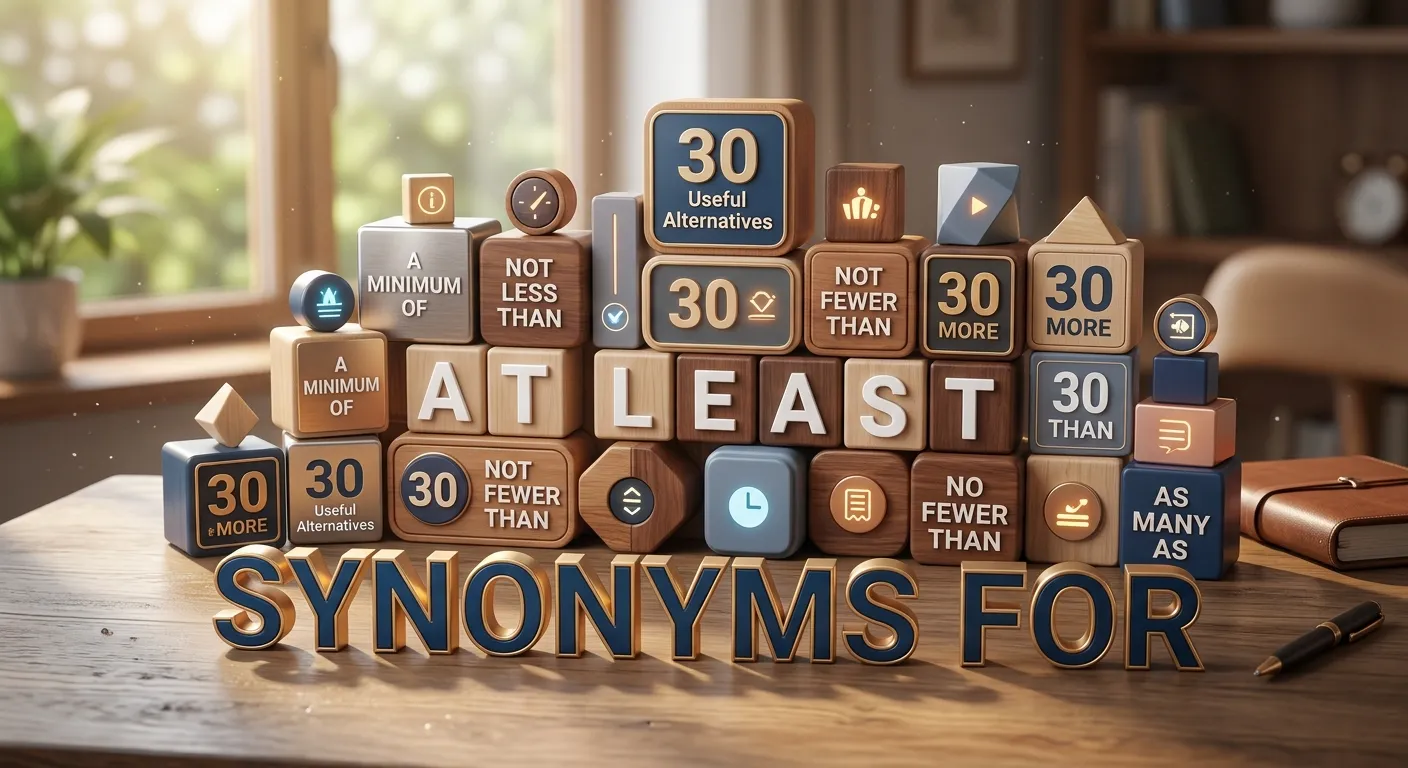
30 Synonyms of At Least With Meaning & Examples
Note: Because at least has several uses, some alternatives below are close equivalents rather than exact substitutes. Always choose one that fits the sentence.
1. At a Minimum (Adverbial Phrase)
Meaning: Used to state the smallest amount or number that is required or expected.
Examples:
- You need at a minimum three references.
- The project will take at a minimum two weeks.
2. At the Minimum (Adverbial Phrase)
Meaning: Used to indicate the lowest possible amount or level.
Examples:
- We need at the minimum ten volunteers.
- The repair will cost at the minimum $500.
3. At the Least (Adverbial Phrase)
Meaning: Used to express a minimum amount or degree.
Examples:
- Bring at the least two copies.
- The journey will take at the least three hours.
4. At a Low Estimate (Adverbial Phrase)
Meaning: Used when giving a cautious minimum estimate.
Examples:
- The repairs will cost $1,000 at a low estimate.
- At a low estimate, the project needs six months.
5. At the Lowest (Adverbial Phrase)
Meaning: Used to refer to the smallest possible level or amount.
Examples:
- The price is at the lowest $50.
- At the lowest, we will need five workers.
6. No Fewer Than (Determiner Phrase)
Meaning: Used before a countable plural noun to show a minimum number.
Examples:
- The school has no fewer than 500 students.
- She wrote no fewer than ten pages.
7. No Less Than (Determiner Phrase)
Meaning: Used to show that an amount or number is not below a stated level.
Examples:
- The box weighs no less than 20 kilograms.
- He spent no less than three hours on the task.
8. Not Less Than (Determiner Phrase)
Meaning: Used to state that something must equal or exceed a certain amount.
Examples:
- Applicants must be not less than 18 years old.
- The container holds not less than five liters.
9. A Minimum of (Determiner Phrase)
Meaning: Used before a number or amount to show the lowest required level.
Examples:
- We need a minimum of ten chairs.
- The course requires a minimum of six weeks.
10. A Lower Limit of (Noun Phrase)
Meaning: The smallest amount or level allowed or expected.
Examples:
- The test has a lower limit of 40 points.
- The system has a lower limit of ten users.
11. A Bare Minimum of (Noun Phrase)
Meaning: The smallest amount that is just enough.
Examples:
- We have a bare minimum of supplies.
- Bring a bare minimum of three documents.
12. A Minimum Requirement of (Noun Phrase)
Meaning: The smallest amount or standard that must be met.
Examples:
- The job has a minimum requirement of two years’ experience.
- There is a minimum requirement of 70 points.
13. No Fewer Than Required (Phrase)
Meaning: Used to emphasize that a stated number meets the minimum requirement.
Examples:
- Submit no fewer than required copies.
- The team provided no fewer than required documents.
14. Not Under (Prepositional Phrase)
Meaning: Used informally to say that an amount or number is not below a stated level.
Examples:
- The project cost not under $10,000.
- There were not under 100 guests at the event.
15. Or More (Phrase)
Meaning: Used after a number to show that the amount can be higher.
Examples:
- Bring five copies or more.
- The process may take two hours or more.
16. Or Above (Phrase)
Meaning: Used to show that a number or level can be equal to or higher than the stated amount.
Examples:
- Applicants must score 80 or above.
- Temperatures may reach 30°C or above.
17. And Up (Phrase)
Meaning: Used after a number or price to show that higher amounts are possible.
Examples:
- Tickets cost $20 and up.
- The packages start at $100 and up.
18. At the Very Least (Adverbial Phrase)
Meaning: Used to emphasize the smallest amount or the least favorable acceptable result.
Examples:
- You should at the very least call her.
- At the very least, we need another day.
19. At the Bare Minimum (Adverbial Phrase)
Meaning: Used to emphasize the smallest amount that is just enough.
Examples:
- You should at the bare minimum check the figures.
- At the bare minimum, we need two assistants.
20. At the Lowest Estimate (Adverbial Phrase)
Meaning: Used to give the smallest expected estimate.
Examples:
- At the lowest estimate, the work will cost $2,000.
- The repair will take three days at the lowest estimate.
21. If Nothing Else (Adverbial Phrase)
Meaning: Used to point out one positive or certain fact when other things are uncertain or disappointing.
Examples:
- The trip was tiring, but if nothing else, we saw the mountains.
- He may not win, but if nothing else, he gained experience.
22. In Any Case (Adverbial Phrase)
Meaning: Used to state something that remains true regardless of other circumstances.
Examples:
- In any case, we should finish the report today.
- The plan may change, but in any case, we must prepare.
23. Anyway (Adverb)
Meaning: Used to return to a point or emphasize something that remains relevant.
Examples:
- It was expensive, but anyway, we enjoyed the trip.
- Anyway, we learned something useful.
24. At Any Rate (Adverbial Phrase)
Meaning: Used to introduce a fact or point that remains true despite other circumstances.
Examples:
- The plan may change, but at any rate, we have enough time.
- At any rate, she completed the task.
25. In Any Event (Adverbial Phrase)
Meaning: Used to say that something is true regardless of what happens.
Examples:
- In any event, we need to make a decision.
- The weather may change, but in any event, the event will continue.
26. At the Very Least Possible (Phrase)
Meaning: Used to emphasize the smallest possible result or amount.
Examples:
- We should expect at the very least possible a short delay.
- The change will take at the very least possible several days.
27. At Minimum (Adverbial Phrase)
Meaning: A shortened form used to state the lowest amount or level.
Examples:
- The process takes at minimum two days.
- You need at minimum three documents.
28. To Say the Least (Adverbial Phrase)
Meaning: Used to emphasize that something is stronger, more surprising, or more extreme than the words suggest.
Examples:
- His reaction was unusual, to say the least.
- The experience was difficult, to say the least.
29. Not Below (Prepositional Phrase)
Meaning: Used to indicate that an amount or level does not fall under a stated point.
Examples:
- The temperature must remain not below 10°C.
- The score should be not below 70 points.
30. Upwards of (Prepositional Phrase)
Meaning: Used to indicate an amount that is more than a stated number, especially in formal writing.
Examples:
- Upwards of 1,000 people attended the event.
- The project attracted upwards of $2 million in funding.
Prototype Meaning
The most typical meaning of at least is “not less than” or “a minimum of.” When people hear this phrase, they usually imagine a lower limit. For example, “You need at least five books” means five is the minimum number, but the person may have more. However, at least can also mean that something is a positive point in a difficult situation, as in “At least we tried.”
Prototype Categorization
The 30 alternatives fall into several semantic groups. Knowing these groups helps writers choose an expression based on meaning, grammar, and tone.
- Minimum amount or number: at a minimum, at the minimum, at the least, a minimum of, no fewer than, no less than best for stating a lower limit.
- Formal minimum expressions: not less than, not below, a lower limit of, a minimum requirement of useful in rules, reports, instructions, and technical writing.
- Minimum emphasis: at the very least, at the bare minimum useful when stressing what is absolutely necessary.
- Higher-than-a-number expressions: or more, or above, and up, upwards of show that an amount may exceed the stated number.
- Cautious estimates: at a low estimate, at the lowest estimate useful when giving the smallest expected cost, time, or amount.
- Reassurance or qualification: if nothing else, anyway, in any case, at any rate, in any event these can replace at least only when it means “one positive or certain point remains.”
- Emphasis and understatement: to say the least used when the speaker suggests that the real situation is stronger than the words just used.
Antonyms of At Least
1. At Most (Adverbial Phrase)
Used to show the highest possible amount or number.
2. At Most Possible (Phrase)
Used to indicate the greatest amount that could occur.
3. No More Than (Determiner Phrase)
Used to show that something does not exceed a stated amount.
4. At the Most (Adverbial Phrase)
Used to indicate the maximum possible amount.
5. Up to (Prepositional Phrase)
Used to show a maximum limit.
6. A Maximum of (Noun Phrase)
Used to state the highest permitted or expected amount.
Short Questions and Answers
Q: What does at least mean?
A: At least usually means “not less than” or “a minimum of.” It can also introduce a positive point in an otherwise difficult situation.
Q: When should at least be used?
A: Use at least when you want to state a minimum amount, number, degree, or requirement. You can also use it to highlight something positive or certain.
Q: Is at least positive or negative?
A: At least is neutral when it states a minimum. It can sound positive when it highlights something good, such as “At least we arrived safely.”
Q: How is it different from similar words?
A: At least is broad and natural in everyday English. At a minimum is more formal, no fewer than is often used with countable numbers, a minimum of comes before a noun, and at the very least adds emphasis. Expressions such as if nothing else have a different meaning and should not replace at least when it simply states a minimum.
Conclusion
Learning at least and its alternatives helps you express minimum amounts, limits, requirements, and ideas with greater accuracy. Words and phrases such as at a minimum, no fewer than, a minimum of, and at the very least are useful in different contexts. Some alternatives sound formal, while others are more natural in everyday speech. It is also important to remember that at least does not always mean “not less than.” It can introduce a positive point, as in “At least we finished on time.” Understanding these differences can improve vocabulary, strengthen writing and speaking, reduce repetition, and build English confidence. Practice one or two alternatives each day and create your own sentences to make them easier to remember.

Paul Emerson is a language writer specializing in English synonyms. His work focuses on distinguishing subtle differences in meaning and usage, helping readers select the most precise word for any given context.